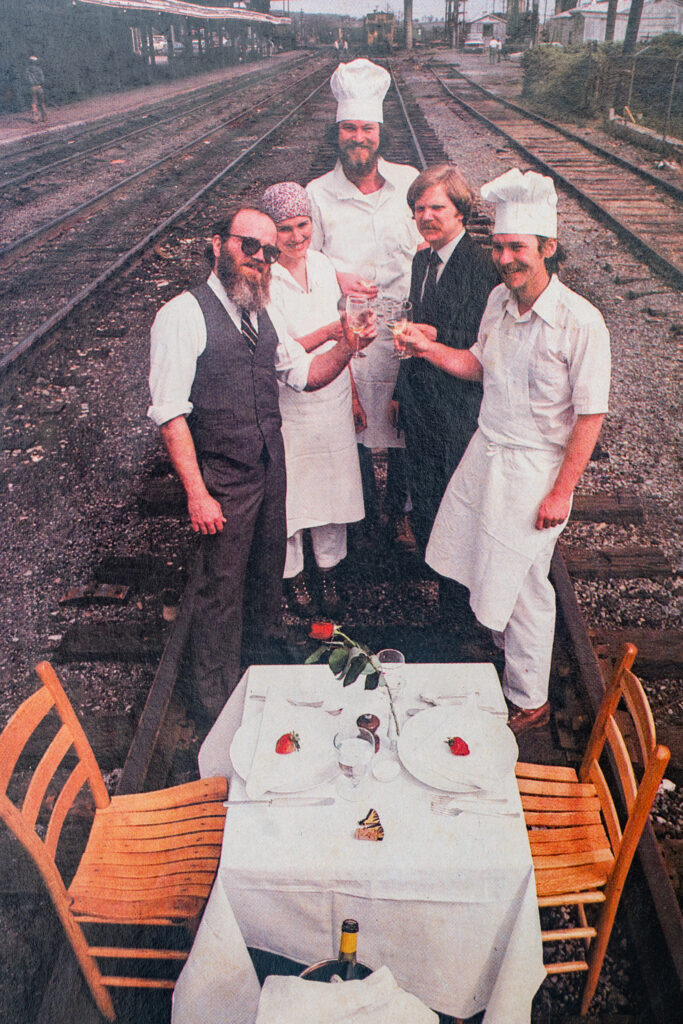
Earlier this year, the C&O Restaurant posted on Instagram: “On March 22, 1976, Philip Stafford and Sandy McAdams opened the C&O Restaurant. Fifty years later, everyone in this town has a C&O story.”
The restaurant’s greatest story, though, belongs to the people who shaped it. It begins with the audacious determination to open a French country restaurant that could compete with the finest establishments in New York and Washington, D.C., and continues through generations of chefs, servers, sommeliers, and loyal patrons whose shared sense of purpose has secured the C&O a unique, beloved place in Charlottesville’s restaurant pantheon.
In the beginning was the word
By all accounts, Daedalus Bookshop was, in the words of C&O’s first employee, Kent Miller, “a huge part of the C&O story.” Sandy McAdams had come from New York City in 1974 and set up shop at Fourth and Market streets with his legendary “boxcar full of books,” and quickly attracted “creatives”—artists, writers, academics, people who’d visited or lived in (or maybe just read about) destinations far from Charlottesville, Virginia.
The bookstore also attracted Phil Stafford, a lawyer and recent UVA graduate, who encountered McAdams at Daedalus, and it didn’t take long for the two men to start kicking around ideas for opening a bar or restaurant.
Critically, Daedalus also attracted the attention of Claudine and Walker Cowen, a world-traveled French journalist and the director of UVA Press, respectively. The Cowens have been credited with persuading Stafford and McAdams to pursue their plans for a restaurant, but to make it a top-flight French country establishment. Claudine mentored the early C&O team in everything from cooking (she delivered extensive training before and after the restaurant opened), to waitstaff protocol, and wine pairing. She and Walker also directed the C&O’s pioneers to visit high-end French restaurants in Washington, D.C., and New York, so they would learn not only what true French food tasted like, but how a true French restaurant looked, how it sounded, how the waitstaff should interact with the clientele.
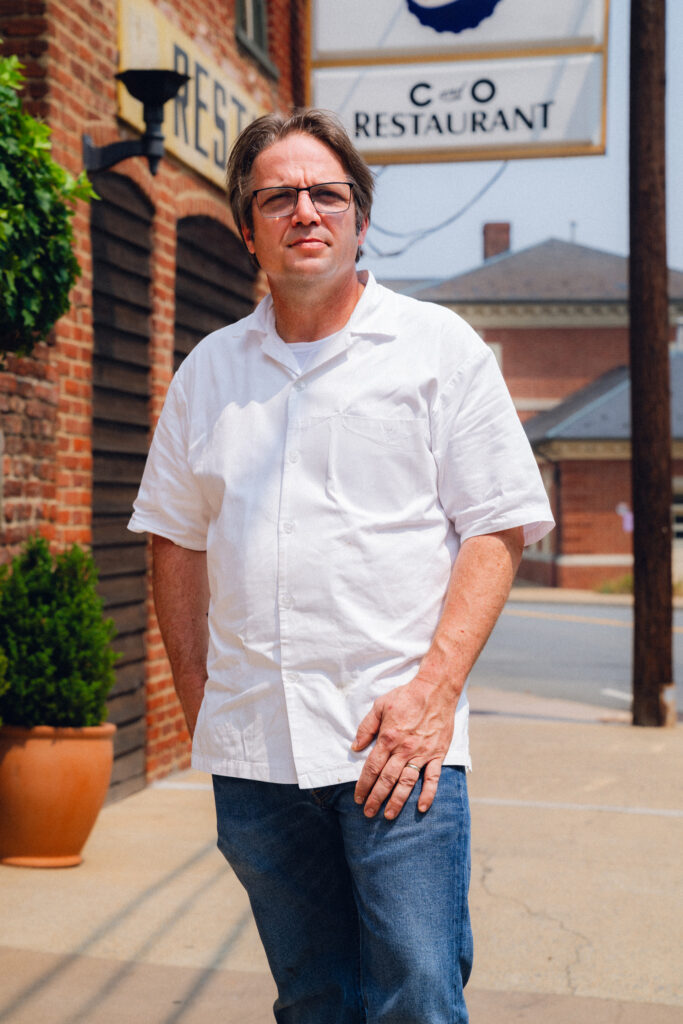
If Claudine was a driving force behind the C&O’s cuisine and French flavor, the restaurant itself was a confluence of inputs, both local and distant. The boxy structure and basic white “Restaurant” sign with the Pepsi logo changed little from when railway workers would trudge over from the railyard across Water Street. Bricks from a West Main Street teardown were put to use in the interior. And the dark timber that envelops the bar (and seems to magically lower the stress level of all who enter) was reclaimed from an old Albemarle County barn. Altogether, the space echoes the rural French bistros of Claudine’s youth, the bars and speakeasies of McAdams’ Greenwich Village, and the rural authenticity of nearby Albemarle, where much of the produce on C&O’s plates sprung from the county’s rich, red clay soil.
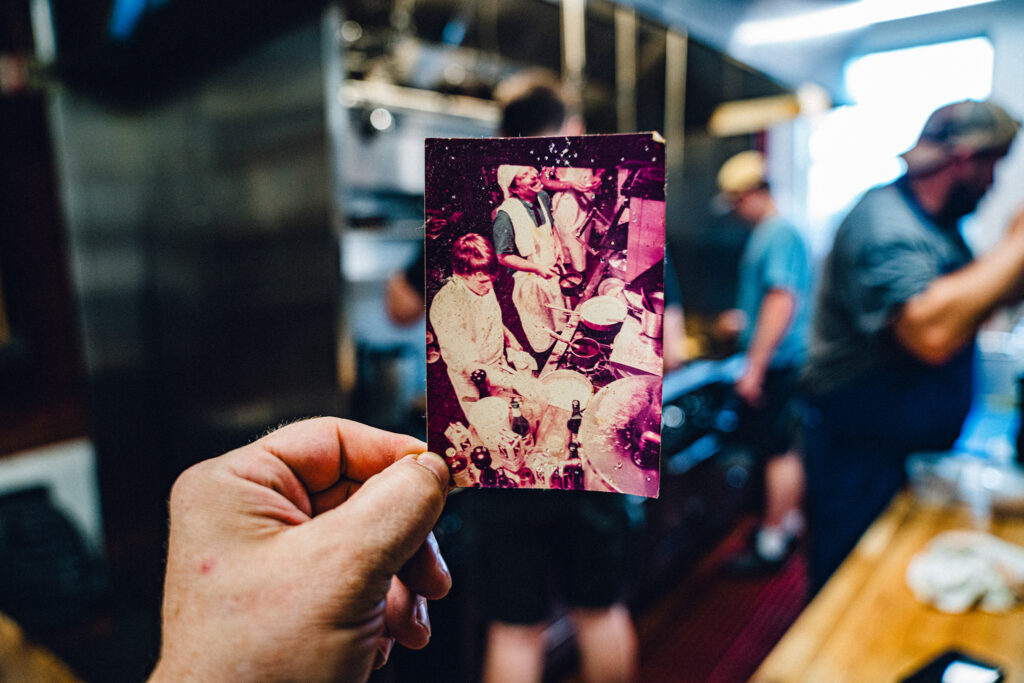
The formal white dining room upstairs, meanwhile, reflected the quiet elegance that prevailed in those fine restaurants in Washington and New York. And the big industrial stove in the kitchen, where the magic would come together every night at the C&O, had served duty for an indeterminate time in the basement of the McGuffey School before it was discovered there by Miller; he had a studio at McGuffey, the historic school having been converted to an art center in 1975.
From literary aristocracy to the professional class
Several early members of the C&O’s staff say the entire team in those days—from the front desk and the kitchen, to waitstaff and the bartenders—embraced the culture of culinary excellence with a passion. Napa winemaker Spencer Graham (a waiter on opening night in 1976), says, “I think that people were inspired by Claudine and by what really good cuisine could be.” Though they were young, just out of UVA, they absorbed the Francophile’s encouragement and training. “All of us,” Graham says, “were incredibly serious and interested in food and, some of us, wine.”
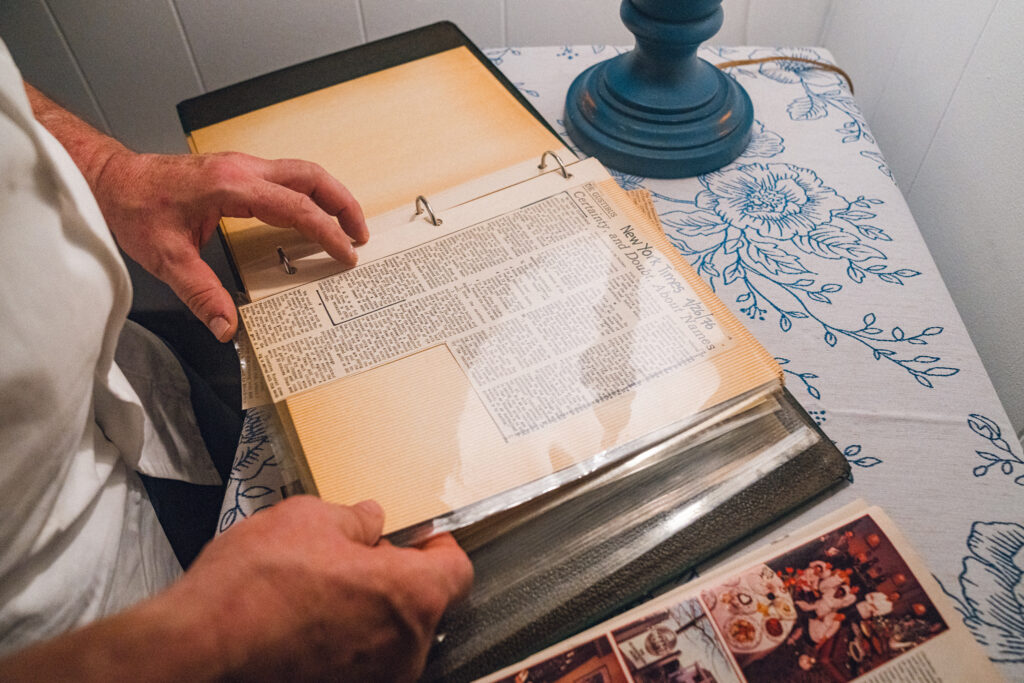
Graham and Miller, now a retired graphic designer in San Francisco, suggest that the C&O began as a place where creatives drawn to Daedalus could go to continue, and deepen, the conversations they’d started at the bookstore. Renowned author Ann Beattie, Miller says, would celebrate her latest book release with friends at the C&O. Future Pulitzer Prize-winner Peter Taylor legendarily suggested to New York Times critic Craig Claiborne that they go to the C&O—when it turned out that Michie Tavern, their first choice, was closed that night—resulting in a glowing review that brought the C&O nationwide attention.
Charlottesville’s Downtown Mall opened just months after the restaurant, but in the late 1970s and into the 1980s, downtown remained patchy, at best. “It was ‘death valley,’” says Bill Curtis, then the chef at the Monticello Hotel’s restaurant and, since 1990, the owner of Tastings of Charlottesville, a block up Market Street from Daedalus. As the C&O established its footing in fine food, it expanded to fill the nighttime entertainment void. McAdams opened a night club adjacent to the restaurant that offered live music five nights a week, competing for music-lovers’ attention with the likes of Trax, The Mineshaft, and Miller’s. And the bar bistro, meanwhile, became a place where writer George Bradley, who waited tables in the late ’70s, says, “an anything goes atmosphere” prevailed. From sundown to the wee hours, the bar hosted boisterous crowds, planned meet-ups, and unexpected hookups.
Notwithstanding the establishment’s expansion into live music, and the late-night bar’s popularity, the C&O’s team didn’t lose sight of its central mission: top-flight cuisine, word of which had spread beyond Charlottesville’s literary aristocracy and permeated its professional class, from lawyers up the hill at Courthouse Square to UVA faculty. It confirmed what Graham sensed. “There was interest in ‘real food’ in the community,” he says, one that helped sustain the restaurant’s high-end offering.
The restaurant’s reputation attracted a steady flow of customers from UVA’s medical school and law school. Peter Scott, a wine importer, began working at the C&O while attending UVA, and, with Dave Simpson, he bought the restaurant in 1984. Scott said the town’s doctors and lawyers were big spenders. They reliably booked tables upstairs and often ordered the finest wine from the increasingly deep and tastefully assembled cellar, which Scott managed before passing the corkscrew to Elaine Futhey, who with broad license from Simpson proceeded to curate the cellar to become the undisputed best in Charlottesville.
Growth & maturation
By the time the C&O celebrated 20 years in 1996, Charlottesville and surrounding Albemarle were showing unmistakable signs of change—change that brought competition for fine dining while driving even greater appreciation for excellent food and wine. The Downtown Mall was finding its identity as a destination for food, arts, and entertainment: Metropolitain, Bizou, and Hamiltons’ opened, as did the Omni hotel, an ice rink, and a new federal courthouse that all anchored the pedestrian mall’s west end.
In the surrounding county, the wine industry was taking root. The Monticello AVA was established in response to a petition in 1984; today, it comprises 40 area vineyards and wineries. And while the City of Charlottesville’s population has held relatively steady since the mid-1970s, Albemarle County’s tripled, from roughly 40,000 to about 120,000.
“Charlottesville in 1976 was a place where you went to school or retired to,” says Graham. “Now it’s a place you live.” And that means far more dining choices, as well as a much larger potential customer base of sophisticated diners. There was a time, Bradley says, when the prevailing American approach to dining was “too much food, too little quality, and a lot of melted cheese on top of it,” but now—at least at the C&O and a lot of other restaurants—the food scene has come up several notches.
Locally grown
The C&O Restaurant, and the people who now run it, contributed to and grew from that larger regional evolution. After working weekends in the kitchen of a long-gone Waynesboro restaurant, Dean Maupin refined his skills at the Boar’s Head, left there with Gerry Newman to open Albemarle Baking Company (then in York Place on the Mall), and while there he answered an ad in C-VILLE Weekly for a position at the C&O, five blocks away. After working for a year with Dean Simpson and head chef Thomas Bowles, Maupin scored a slot in the prestigious Greenbrier Culinary Apprenticeship Program in White Sulphur Springs, West Virginia—a three-year engagement that Maupin calls “eye opening.” At The Greenbrier, Maupin was surrounded by talented (and, mostly, more experienced) chefs, and he gained an even greater appreciation for the patience, skill, and technique required to prepare food at the highest level and for the most discerning palates. “I spent two months just making stocks—veal, chicken, lobster,” says Maupin, echoing C&O’s first chefs’ recollections of their training on that old McGuffey stove with Claudine Cowen.
One winter break from The Greenbrier program, Maupin did a months-long stint at legendary Michelin-starred Tra Vigne in Napa. While back home during another break, he worked alongside Tim Burgess and Vincent Durquenne at Metropolitain and helped Newman relocate ABC to its current home on West Main Street. After graduating from The Greenbrier, Maupin took a position at Fossett’s at Keswick Hall, where he advanced to head chef.
In sum, while Charlottesville and Albemarle—the university, the community, and the wine industry—were evolving and maturing, a young local chef from one of Albemarle’s oldest families was developing into the chef/proprietor who long-time owner Dave Simpson knew he could trust with leadership of the restaurant when he sat down with Maupin in 2012 to discuss a C&O succession plan.
Pivot and growth
When Maupin took over the C&O in 2013, he vowed to remain true to the restaurant’s legacy, and its position as a dining destination. “My plan is not to change a thing,” he told C-VILLE shortly after the transition. The world, though, had other plans, most notably with the COVID pandemic, which briefly shuttered the restaurant. But Maupin says they pivoted, and within two weeks were preparing dishes for carryout and delivery. The pandemic relented—and after that recovery, Maupin and his team reopened with a renewed focus on the food, but without some of the elements that had helped define the C&O for decades.
Gone was “late night,” the first-floor bistro’s kitchen and bar service that offered food and drinks until the wee hours. Gone, as well, was dinner on Sunday and Monday nights. Gone was lunch service for business people and faculty members with a little extra time.
In some respects, change came in the form of opportunity. All those wineries that now dot the region’s landscape and influence the area’s culture? Many host weddings and other catered events. The C&O’s catering business, begun by Dave Simpson in the 1980s, is now flourishing, Maupin says, noting that his team includes a dozen or so part-time employees who focus almost exclusively on catered events, a line of business that enables the restaurant to deliver its offerings miles from East Water Street.
True to its identity
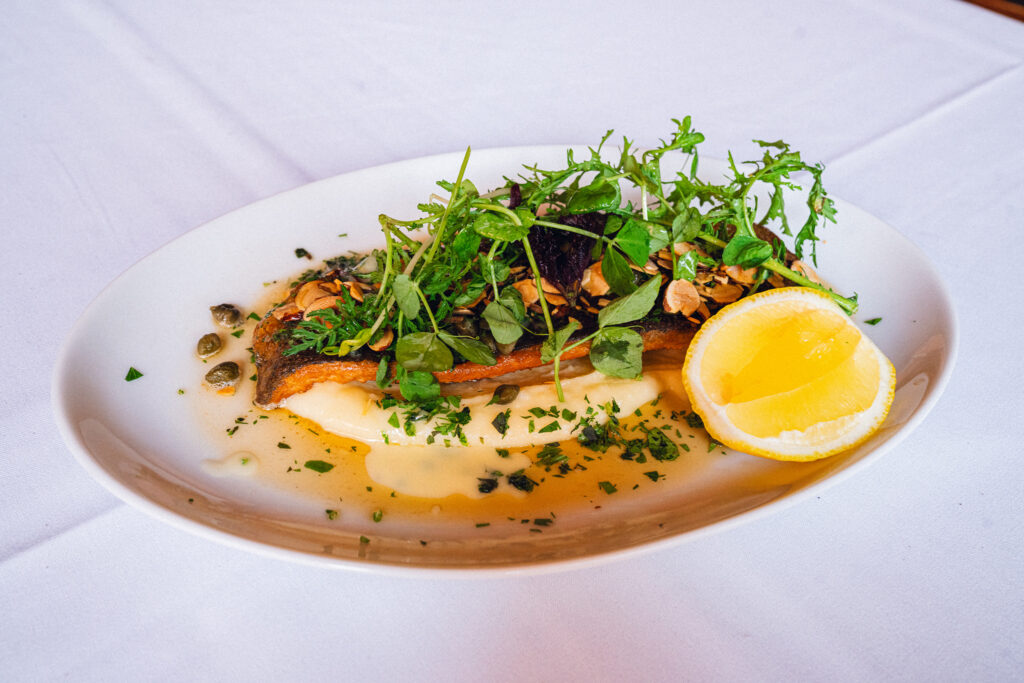
Fifty years later, the C&O’s core remains intact. The French country influence, initially encouraged and developed by Claudine Cowen, then carried forth by generations of line cooks and chefs, is clearly evident on a menu that includes duck confit, trout almondine, crème brûlée, and veal sweetbreads.
Present, as well, is the seasonality, the freshness of the food and the menu composition. Graham, the C&O’s chef in 1980, called seasonality “the key,” adding that “you develop a relationship with suppliers” that ensures a steady stream of the best the season offers. Maupin concurs, explaining that the restaurant has regular suppliers for menu mainstays like lamb, trout, and produce, but that it’s “always bought from people who knocked on the door … and it still happens that way.”
Maupin was quick to add, of course, that freshness is just the start of an item’s journey to the plate. Inspired as a teen by episodes of “Great Chefs” on PBS, Maupin says he now monitors social media to keep up with the latest ideas in the industry, ideas that he might tweak before they land on the C&O’s menu. “We try to elevate the food,” he says, before adding that every dish “has to be interesting, really well-executed with great ingredients.” And with a nod to the region’s sophistication, he says, “we’re really lucky with that, because the clientele that comes here are folks who are open to things being thoughtful and interesting.”
It’s the people
The C&O recalibrated and adopted the five-nights-a-week schedule of many other dining establishments, at least in part, Maupin suggested, to maintain a high-caliber dining experience while also enabling his people to “have a good quality of life,” an approach borne out by the experience now reflected on the staff: Amanda Burress and Sarah Knox, both mentored by Futhey before her retirement in 2012, have been with the C&O for 15 years. Slavisa Milanovic has delivered courteous, skillful table service to C&O patrons for more than 25 years. Michael Volpendesta has worked in the office for 20.
The team still works hard, Maupin says, and it “has always attracted interesting, loyal, caring people.” A big part of his role at the restaurant is to ensure his staff is “happy and has what they need.”
“I worked in other restaurants,” says former waiter Bradley, “but the C&O was the only place where I made lifelong friends.”
Mary Loose DeViney, who’s run Tuel Jewelers since the C&O opened, spoke to the restaurant’s consistency. “You just know it’s going to be a great meal,” she says. Mohammed Sawaie, a UVA professor of Arabic from 1980 until this past year, cited the specialness of a meal there, saying he remembered going to the C&O to celebrate with friends, and though he doesn’t remember exactly what they were celebrating, he remembers the appetizers (“they were heavenly”) and the wine (champagne, followed by Spanish Albariño).
Others comment on the bar’s coziness, the intimacy it engenders. Donna McAdams recalls an evening in the late 1970s. Originally from New Jersey, Donna had just gotten off duty as a nurse at the hospital and had gone to the C&O with a friend, a local. There, she met Sandy in the bar, and he asked her if she’d ever eaten upstairs. Not long after, he took her on their first date to that upstairs restaurant.
“There’s flavor at the C&O,” another regular told us, “in more than just the food.”
Maupin speaks with pride and reverence of the generations of chefs—and waitstaff, and sommeliers, and catering staff, and office staff—who took those first bold steps to create an outpost of white tablecloth dining at the scruffy, blue-collar east end of Water Street.
The C&O’s first generation, Maupin says, established “an identity, a focus on good food and wine and interesting people, and it has never really wavered from that.”