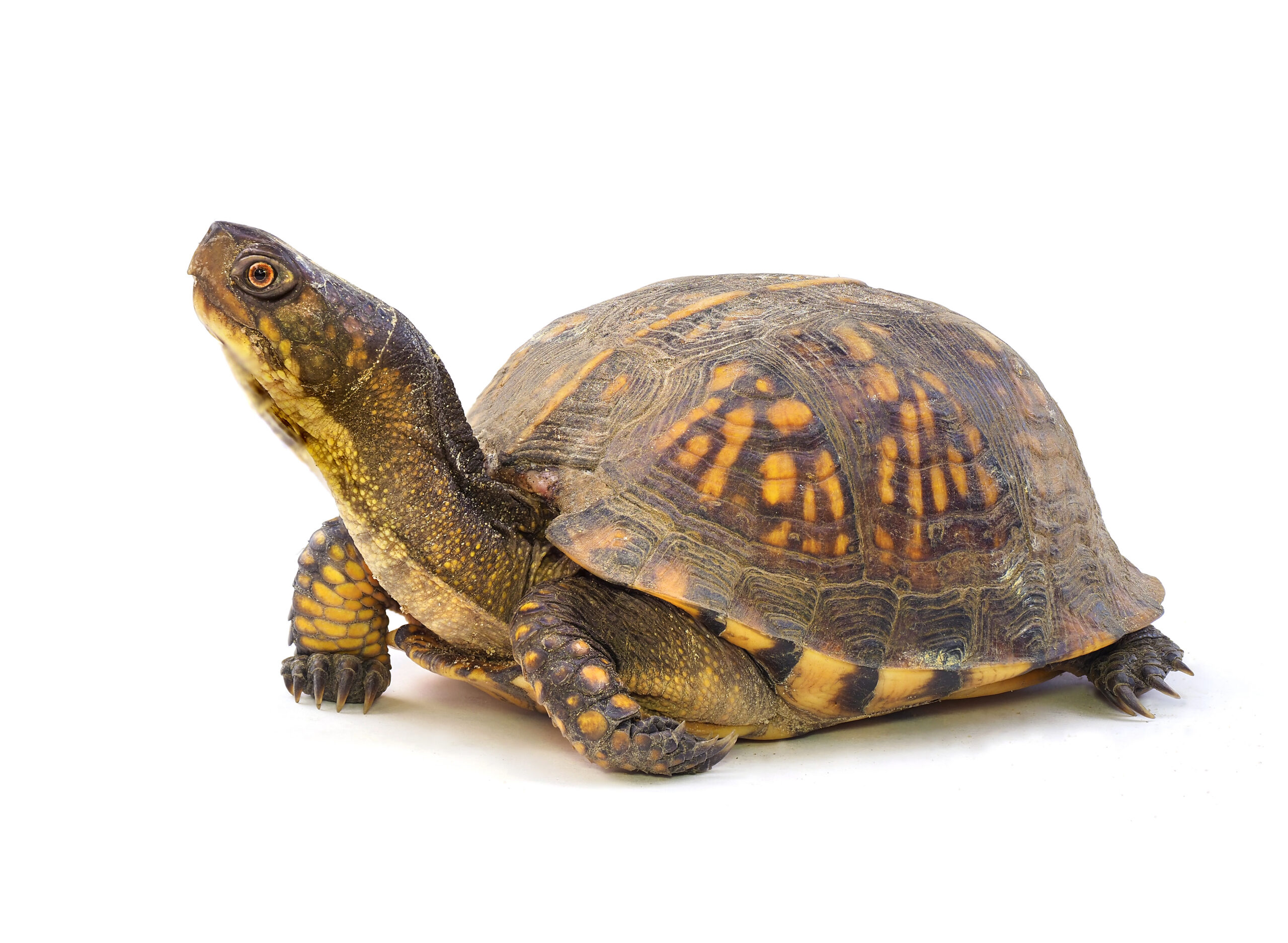
Like ancients made visible, Virginia is home to 25 species of turtles, many of them already in decline or vulnerable to it, due to eroding federal protections that went into effect in July of this year. But with a bit of care, protection, and respect, these creatures—clomping around since the Triassic period 230 million years back, and emerging between April and November to mate, build nests, lay eggs, and hatch—may have a shot at a few hundred million more.
Turtles have feeling in their shells.
While a turtle’s shell is mostly bone, and an extension of the ribcage, atop their shells’ scale-like “scutes” is a layer of skin with nerve endings, says Randy Chambers, a biology professor and wetland ecologist who directs William & Mary’s Keck Environmental Lab.
“The mating ritual is that male turtles have really really long fingernails, and they stroke the female’s shell,” says Chambers, who notes that it takes most turtle species 10 to 20 years to reach sexual maturity. “Female turtles get off on this, apparently, so we know there is feeling there.”
Connor Gillespie, a former zookeeper who’s now the director of outreach at the Wildlife Center of Virginia, sees something similar in the center’s permanent residents, box turtles Shelton and Wilson, who chastely rub themselves against brushes inside their cages. It’s part of why pain relief for turtles with shell injuries (438 turtles were treated at the center in 2025 alone, the majority hit by cars) is a critical part of treatment and rehabilitation, which can occasionally involve putty, metal bars, and even zip ties to re-fashion and re-fuse their broken shells back together.
There are easy clues to distinguish a turtle’s sex, which is determined by the temperature outside as eggs incubate, rather than genetically.
Temperature drives a lot of turtle ecology, including whether hatchlings are born male or female. Cooler temperatures (about 82 degrees) tend to beget males; warmer temps are likelier to produce females.
In snapping turtles, males and females are roughly equivalent in size, but males have longer, thicker tails. Male and female box turtles are also similar in size, but still easy to sex, Chambers says.
“The male’s underside has a concave, or inward, shell, so that when he mates and mounts the female he doesn’t roll off,” Chambers says. “Female box turtles’ undersides are pretty flat. Male box turtles also have bright orange eyes.”
Female diamondback terrapins in the Chesapeake Bay, however, are far larger than males, Chambers found—larger, even, than females of the same species just a few states away in Long Island Sound, where commercial crabbing is banned. Using terrapin cadavers collected by the Smithsonian National Zoo and Conservation Biology Institute to compare, Chambers and his students found that, prior to the advent of commercial crabbing in the Chesapeake Bay in 1940, female terrapins skewed smaller. Smaller females more easily drowned in crab pots, leaving behind larger females that birthed similarly hefty progeny.
“We were able to demonstrate that crabbing led to sexual dimorphism,” says Chambers, which is when species of the same type differ in size and appearance. Sexual dimorphism exists in other turtle species, too, including cooter varieties, painted and mud turtles, with longer, heavier females that typically outweigh males by 40 percent to 104 percent.
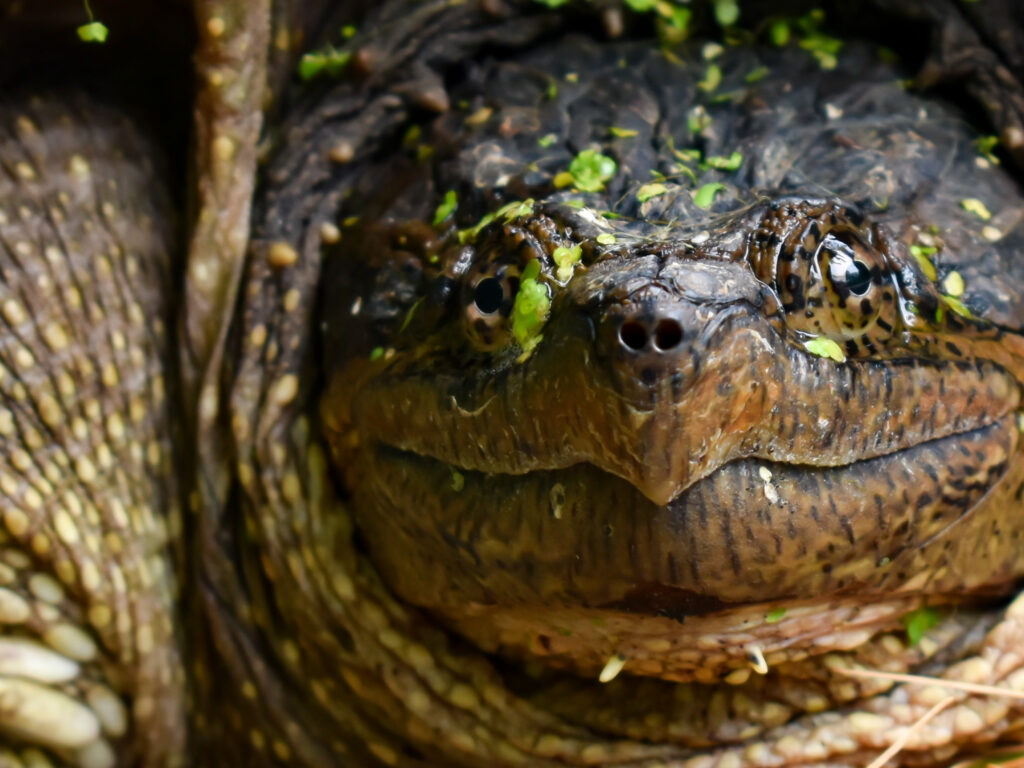
Turtles are loners from birth…
“People will say, ‘Oh, my gosh, I found it, and there’s no water for a mile,’” says Gillespie, “but that’s normal. The mother will go a half mile or a mile to choose a nest she thinks is safe, and babies travel alone after hatching back to that water source.”
Virginia turtles “are aligned to aquatic or wet habitats and require those moist locations but also have to have adjacent upland that’s dry for nesting,” adds Chambers. “Most turtles are homebodies—they don’t really move around much, though if their pond dries up, cooters will march uphill to the next body of water. But for the most part they stay where they are.”
It’s ill-advised and often illegal to nab a turtle and keep it as a pet because “you’ve really displaced that turtle, and taken it from its home range,” which disorients it and compromises its survival.
Also, adds Chambers, “you’ll have to keep it the rest of your life.”
“You’re not technically allowed to re-release it because you’ve unwilded a wild animal,” he says. “It’ll outlive you, so you’ll have to put it in your will that you bequeath the turtle to the next generation. So keep that in mind before you go grabbing a turtle off the road!”
…but communicate and may form communities, too.
Chambers has repeatedly observed clusters (called “bales”) of turtles caught in commercial crab traps.
“The world record for most number of turtles drowned in the same trap is 92, which is amazing,” Chambers says. “That was in Georgia. I’ve seen derelict traps in Virginia kill as many as 30. There’s got to be some social structure to that.”
“Do they talk to one another? I don’t know,” he muses. “Can they say, ‘Help’?”
Turtles also make noise, Chambers says, a sort of grunt-chirp, but no one’s ever recorded their sounds underwater. Though “primarily a visual predator,” Chambers notes turtles’ strong sense of smell, ability to see many more colors than the average human (“They’re tetrachromatic,” he says), and the fact that “they’re making noises means they can hear” and probably communicate.
They’re part of the illegal wildlife trade.
Wildlife Center staff often care for native turtles confiscated by the Department of Wildlife Resources in seizures from people who illegally capture and “sell them, sometimes here, sometimes overseas.”
“We’ve seen box, spotted, sliders—they’ll sell them as pets or used for medicinal purposes or food,” Gillespie says. “Once they come back to us, we can’t just release them because we don’t know where they came from so they stay here while their legal cases are resolved. Then, hopefully, we can find good homes for them at zoos or aquariums, though sometimes, in rare circumstances, we can figure out where they’re from.”
That’s getting marginally easier. With other states on the Eastern Seaboard, DWR is developing a genetic mapping project to figure out where turtles are from, which in 2024, repatriated eight spotted turtles that’d been poached (part of a seizure of 292 animals from an individual’s house) back to their native habitat.
Turtles’ shells indicate their age. Sort of.
Like tree rings, counting a turtle’s scutes roughly indicates their age. That technique doesn’t work for every species, Chambers notes, adding that turtles can live from 20 to more than 100 years.
“You can count the annual rings on the scutes of a box turtle, and you’ll very quickly get to 30,” he says, “but those little concentric scales on the back of a diamondback terrapin, there’s an annual ring that’s deposited, but after seven or eight years, because they’re in the water and burrowing in the mud to hibernate, or brumate, a lot of times the rings get worn off. That’s true of a lot of turtles,” including cooters, sliders, and painted turtles.
There are things you can do to help them.
Don’t keep turtles as pets, something that, for the most part, is illegal. Limit your use of pesticides, which can trigger aural abscesses and infections in turtles, and plant native species to help turtles forage, burrow, and nest. Be mindful as you mow and weed whack to avoid any accidental encounters with slow-moving creatures.
And if you see a turtle in the road? Pull over safely to help.
“The going line is, whatever direction it’s going, help it go,” says Chambers. “Someone who’s doing that is doing okay.”
If you encounter a turtle that’s been hurt but is still alive, gently place it in a container, note the location where you found it, and bring it to a wildlife rehabilitation center.
“The shell is a living part of their body, and if we get to them quickly enough, and the puncture isn’t too deep, our team can save them,” Gillespie says, even when the injuries are sometimes horrific.
That means the creatures might live in one of the center’s “turtle towers” for more than a year while they quietly recover, ultimately graduating to an outdoor recovery area (near where Sheldon and Wilson live) before being released back to their home ranges.
“Then we’ll call you, and say, ‘Hey, you remember the turtle you brought to us last May? She’s healed and is ready to go,’” says Gillespie. “They’re very long-lived. If we treat a box turtle and release it, there’s a chance it could live for 30, 40, or 50 years more.”
But in most cases, pleads Gillespie, “Just leave them alone.”
GLOSSARY
Carapace [KEH-ruh-pays] n.—The bony case or shield covering the back or part of an animal. On turtles, the upper domed portion of their shell.
Plastron [PLAS-trun] n.—The underside of a turtle’s shell, made of bone and cartilage, which usually joins with the carapace along each side of the body to create a rigid skeletal box.
Scute [skOOT] n.—An external bony or horny plate or scale made of keratin.
Brumation [brew-MAY-shun] n.—The turtle equivalent of hibernation, when turtles burrow several centimeters in the soil or mud and reduce their metabolism during winter.
Bale [BAYL] n.—A group of turtles.