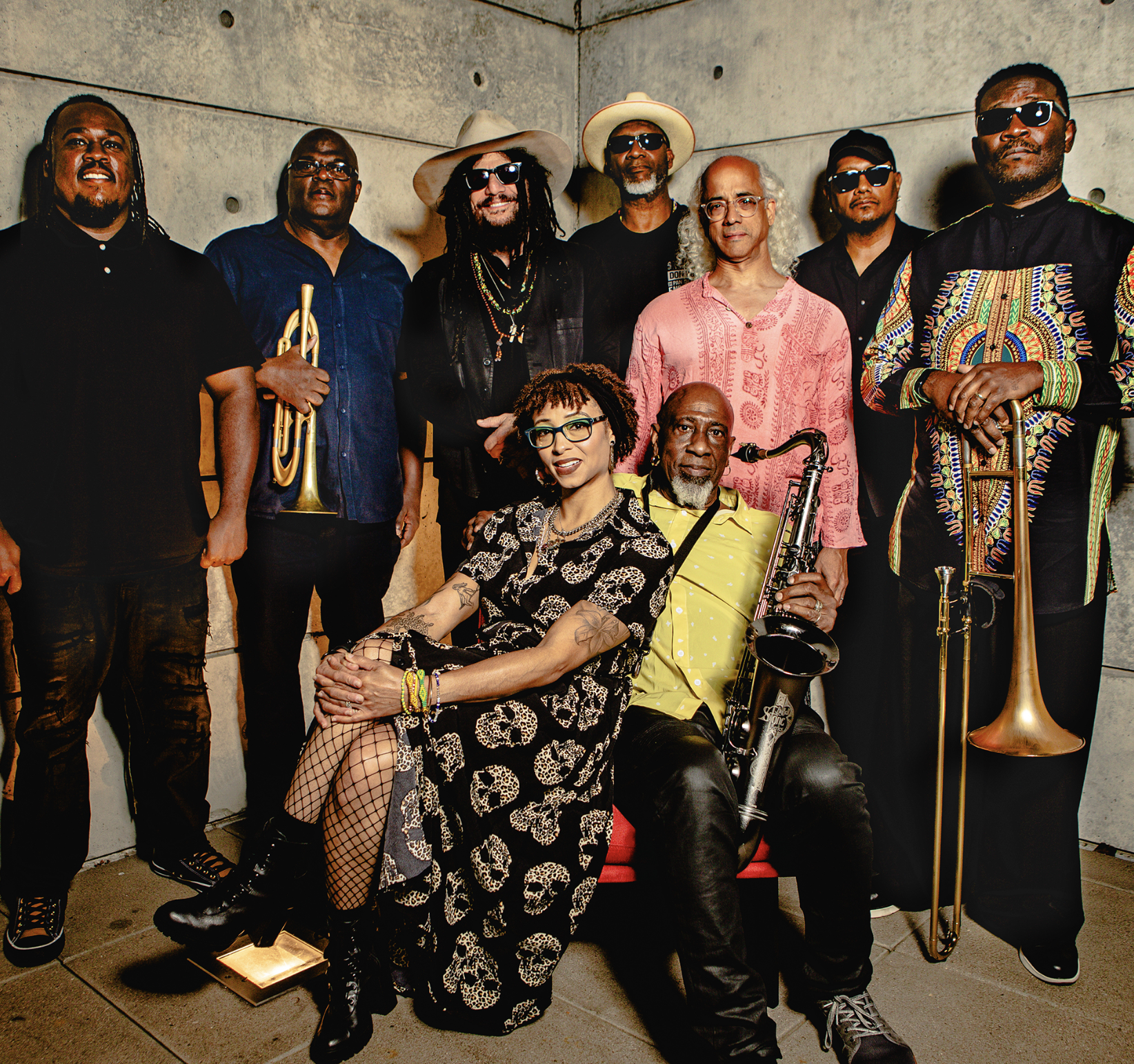
Don Was and The Pan-Detroit Ensemble will stop at The Jefferson Theater on October 16 as part of a tour for the band’s debut album, Groove in the Face of Adversity. Supplied photo.
If you’ve never heard of music industry legend Don Was, don’t beat yourself up. Born Don Edward Fagenson, Was has been making music for nearly 50 years. But until now, he’s never released a record under his own name.
He has produced music for The Rolling Stones, Elton John, and Ringo Starr. He’s played bass for Ryan Adams, Iggy Pop, and Bob Seger. His first commercially successful band, Was (Not Was), found itself on near constant radio and MTV rotation in 1987 with the ubiquitous hit “Walk the Dinosaur.” Since 2012, Was has served as president of Blue Note Records.
The music industry legend recently spoke to C-VILLE about his latest project, introducing John Mayer to Bob Weir, his eighth-grade dance, and what makes Taylor Swift a great artist.
C-VILLE: Your career has spanned so many musical genres. What can folks expect out of the first project you’ve put your name on?
Don Was: Distilling it down is a tough thing to do, but at its core, it’s a nine-piece soul-jazz band from Detroit, and we play like we’re from Detroit. We all grew up listening to the same radio stations and musicians. Some of us have played with each other at different times, but this is the first time the nine of us have been in the same band. It’s a collective with a common musical language.
What is that language exactly?
We’re having fun and improvising every night. Structurally, it’s not dissimilar to what I do playing with [former Grateful Dead member] Bob Weir: Every song has a personality of its own and is different every night. But it sounds like Detroit music, whether it’s MC5 or J Dilla or Motown or The White Stripes or John Lee Hooker. It’s honest, raw. It is not slick, and there’s a groove underneath everything.
Working with a band in that way sounds a lot like what a producer does.
I suppose it’s exactly what a record producer does … at least the way I make records. What I enjoy is getting inside a great artist’s head, helping them define what’s there, and helping them realize that by any means necessary. These aren’t just nine random players; they are individuals I’ve been playing with for about 45 years. When we get together, there’s a jocular familiarity.
Tell me more about the link between improvisational jazz and jam music.
They are incredibly similar, and I think by design. Bobby talks about listening to jazz musicians and playing with Jerry. The scales and modes and rhythms might be different, but procedurally there’s something intuitive about them both. The idea is: ‘Play anything but what you played before.’ You pay attention to where you are and approach each song with a beginner’s mind. That’s the fun part—not knowing what you are going to do. It makes every night an adventure. And it’s not just the fun part for the musicians, but also for the audience.
You’ve worked with John Mayer and Bob Weir, who’ve been playing together with Dead & Company for 10 years. Is that a coincidence?
I introduced John to Bobby and Mickey [Hart]. I met Weir in the ’80s, and when I started working with John, I would get in the car with him and he’d be listening to the Grateful Dead. I was shocked at how specific he could get in describing the music. The Blue Note Records offices are in the Capital Records tower, and one day John was in a studio downstairs. Bobby and Mickey came to see me, and I called John up. Bobby said, “Come and play with us. We drove up to Bobby’s TRI Studios and got two RVs and stayed there for four days. By the end, they loved it so much, they all wanted to work together.
How do you manage running Blue Note on top of making your own music?
I live in Detroit, and Blue Note’s in L.A., but I stay involved. I can almost get more done remotely from the bus or hotel rooms. I’m on Zoom meetings from dressing rooms all the time. Having a record company president who’s out playing and doing the same things the artists are doing every night gives you a greater sense of what they’re going through. I think you behave better as a record company when you understand what it takes to stand up there and turn life into notes. For a label like Blue Note, where the artistry is the backbone, you should be highly sympathetic to the artistic process.
How does your latest project fit in with the rest of your career?
A weird thing happened in the early ’90s. I started getting successful as a record producer, and I got to work with all my heroes: Dylan, the Stones, Brian Wilson, Willie Nelson, Leonard Cohen. I would sit there and watch them, and I got to the point where I was thinking about my own music, “What’s the point of this?” I had writer’s block for like five years. I would look at Willie and think “I will never be as good as him.” But then I realized, Willie Nelson hasn’t experienced all the things I have. Willie didn’t drop acid and see MC5 in Detroit. George Clinton didn’t play Willie’s eighth-grade sock hop. So when the opportunity came, I remembered that the thing that makes you different is a strength, not a weakness.
Your new record dropped on October 10, one week after Taylor Swift’s latest. What’s the state of modern pop music?
What I think about music in general is that there are two types: generous and selfish. Selfish is a guitar player trying to see how many notes he can squeeze into one line. It’s acrobatic and it can be cool, but if that’s all you got, it’s not enough. I’m interested in music that gets under your skin, that communicates a feeling that makes sense out of chaotic and confusing times. Anything that brings you comfort and understanding and an ability to deal with the world, that’s a generous thing for an artist to do. I have no judgment about what genre it’s in or who’s making that statement. If you can communicate with people, you are a great artist.