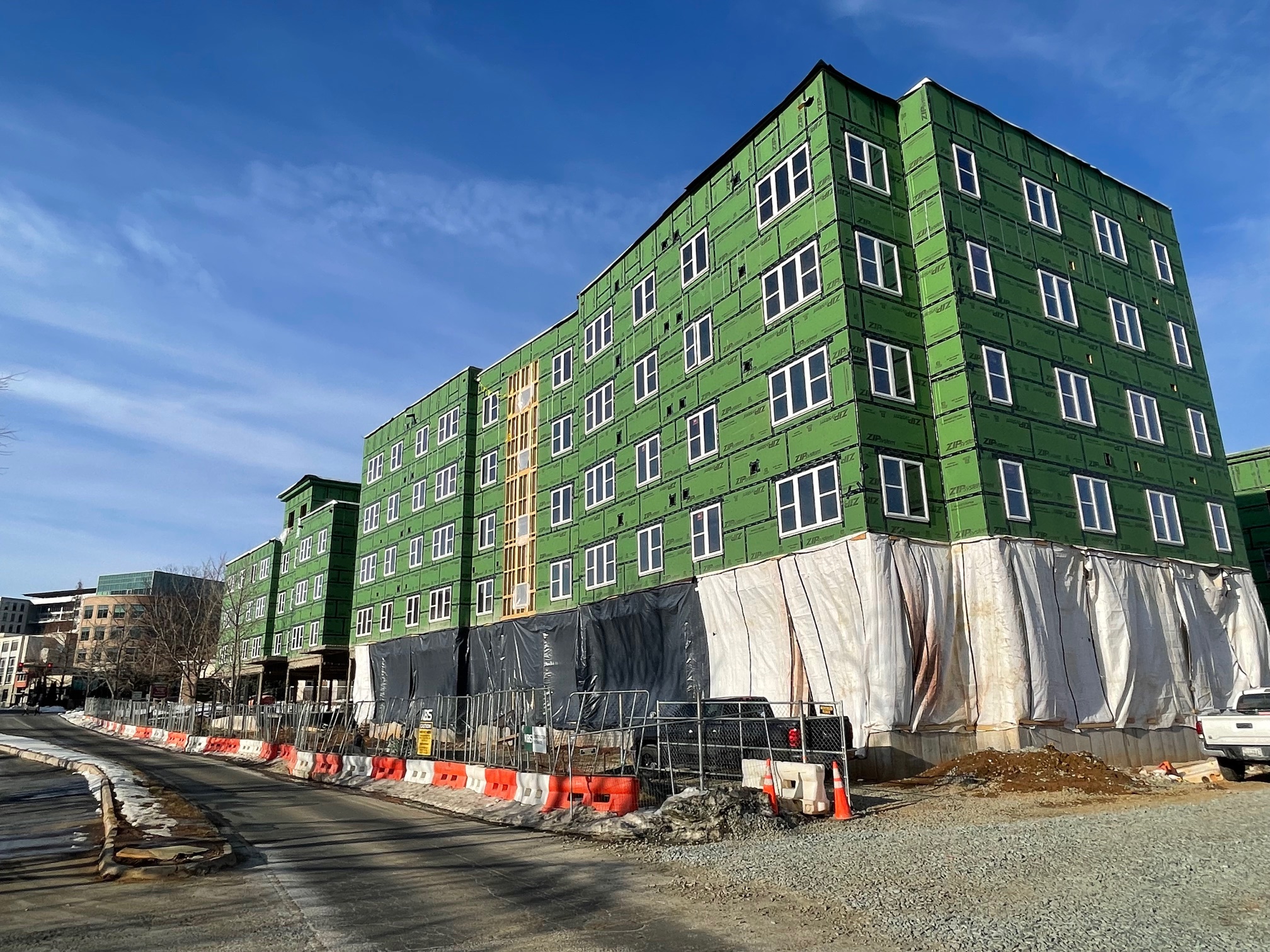
Work is underway on the second phase of Piedmont Housing Alliance’s redevelopment of Friendship Court into Kindlewood.
When the City of Charlottesville agreed to fund Piedmont Housing Alliance’s redevelopment of Friendship Court into Kindlewood, the nonprofit developer was responsible for building a minimum of 425 units.
PHA’s executive director appeared before City Council on February 2 to provide an update before residents get to work overseeing the design of a fourth and final phase.
“We’re going to need creativity to persevere,” Sunshine Mathon told Council at the meeting. “It’s a really, really complex project, structurally and financially.”
Council has invested millions in the project for both infrastructure and financing of individual phases. Subsidized housing developments need multiple layers of financing to guarantee affordability over decades.
The COVID-19 pandemic delayed the project, but the first 106-unit phase is complete, and work is under way on a second with 104 units. Mathon said that while construction costs keep escalating, higher interest rates have also added millions to the bottom line.
“We also didn’t know that in this last year that there would be a massive upheaval in the federal administration that has created all kinds of uncertainty to very risk-averse funders and lenders,” Mathon said.
Mathon said financing is in place for a third phase with 85 units, and the fourth can now be planned based on the current absence of many federal subsidies for new construction. The value of low-income housing tax credits is also trending down, and the process has become more competitive, with three times as many applications year over year vying for the same amount of tax credits.
Council has already committed $4.5 million to help finance the fourth phase, with an anticipated range of 75 to 150 units. Mathon said the upper end is likely not attainable, but a range of 90 to 130 might be.
Mathon wanted to know whether a maximum of 385 units would be acceptable, or if Council would be willing to invest more.
“The one really important question in this calculus is, if Council is going to commit another $5 million, is an additional 40 units at Kindlewood the most efficient and best use of those resources?” Mathon asked.
Mathon’s question needs an answer in order to begin the process of engaging with residents on the design. That work must be finished by March 2027 in order to apply for tax credits through Virginia Housing.
City Councilor Michael Payne said he would accept the lower number.
“I know it’s not anyone’s ideal, and I know it’s not PHA’s ideal, either, but I’m okay with amending where our expectations are, just as an acknowledgment of [the] reality of the funding and cost situations [being] fundamentally different,” Payne said.
Payne’s colleagues all agreed, and Councilor Natalie Oschrin noted that market-rate units cannot be included in projects funded through tax credits.
“If we did allow market-rate housing on the property, it would be in a separate income-segregated building, which is the whole thing we’re kind of trying to avoid,” Oschrin said.
Phase four will also include between 11,000 and 14,000 square feet of commercial space and at least 10 units that would be reserved for homeownership through PHA’s community land trust.
In addition, construction is currently under way for an early learning center site as part of phase two.