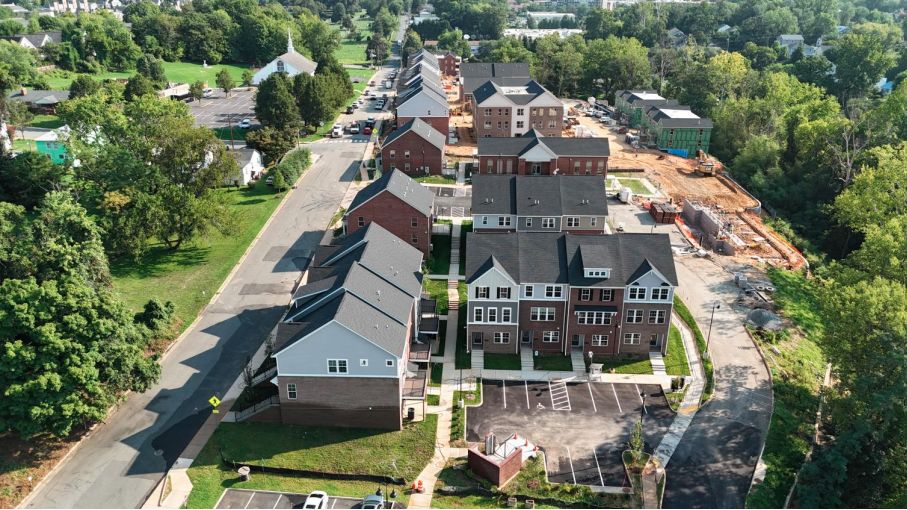
An aerial view of the new South First Street complex operated by the Charlottesville Redevelopment and Housing Authority.
In March 2021, Charlottesville City Council adopted a plan that made a moral commitment to invest $100 million in affordable housing initiatives through the end of 2032. The elected body got a progress report at a September 8 work session.
“In that time, the city has invested approximately $65.8 million, which is about 66 percent of the full 10-year goal,” said Madeline Metzler, senior housing planner in Charlottesville’s Department of Neighborhood Development Services.
The goal of the Affordable Housing Plan is for 75 percent of funds to go directly into housing investments, 20 percent to go to tax relief and programs intended to stabilize, and the rest to increase administrative capacity to keep track of it all and assist with complex financing.
The materials presented to Council did not include the $6 million spent to purchase 2000 Holiday Dr. for a low-barrier shelter, but does include what the city has paid so far toward an $8.7 million forgivable loan to help two nonprofit housing developers purchase the Carlton Mobile Home Park and the $5 million used to jointly purchase several dozen houses with the Charlottesville Redevelopment and Housing Authority.
Other Affordable Housing Plan outcomes were desired as well.
“Over 1,000 new subsidized units are now in the pipeline, which is about 97 percent of the goal,” Metzler said. “We’ve preserved 530 subsidized units, which is about 88 percent of the total goal. And lastly, annual household stabilization is lower than targeted, averaging just over 1,100 households annually.”
Part of the latter comes from $900,000 the city gives each year to CRHA to cover the cost of additional housing vouchers.
Since the plan was adopted, CRHA has completed 190 units including the full renovation of Crescent Halls and the first phase of South First Street. Another 137 units are under construction, and 138 units are anticipated in the first phase of Westhaven’s redevelopment.
Piedmont Housing Alliance has completed 106 units in the first phase of Kindlewood and 104 units are under construction in a second. Another 175 units are planned in two more stages.
The city also tracks the income demographics of who is benefiting from the investments. Around three-fourths of the funds have assisted households that make below 80 percent of the area median income, but only 25 percent have gone to those making below 30 percent.
“Households at or below 30 percent AMI face the deepest housing challenges and also require the greatest level of subsidy to ensure long-term affordability,” Metzler said.
City Councilor Michael Payne has been one of the strongest voices for investing in places for households with the lowest incomes and suggested an alternative approach to get this goal on target.
“If that cost for new construction is so high, maybe we kind of pivot towards more acquisition of existing housing units in order to get to 30 percent,” Payne said.
Payne also suggested that Council needs to adopt a higher annual goal to ensure the resources are in place.
The city has been able to invest in part because of revenues from a growing tax base. The total taxable value has grown to $12.2 billion in 2026 from $5.95 billion in 2016.
In the coming year, Metzler said the city will receive at least $11 million in payments to the Charlottesville Affordable Housing Fund from student housing complexes currently under construction.