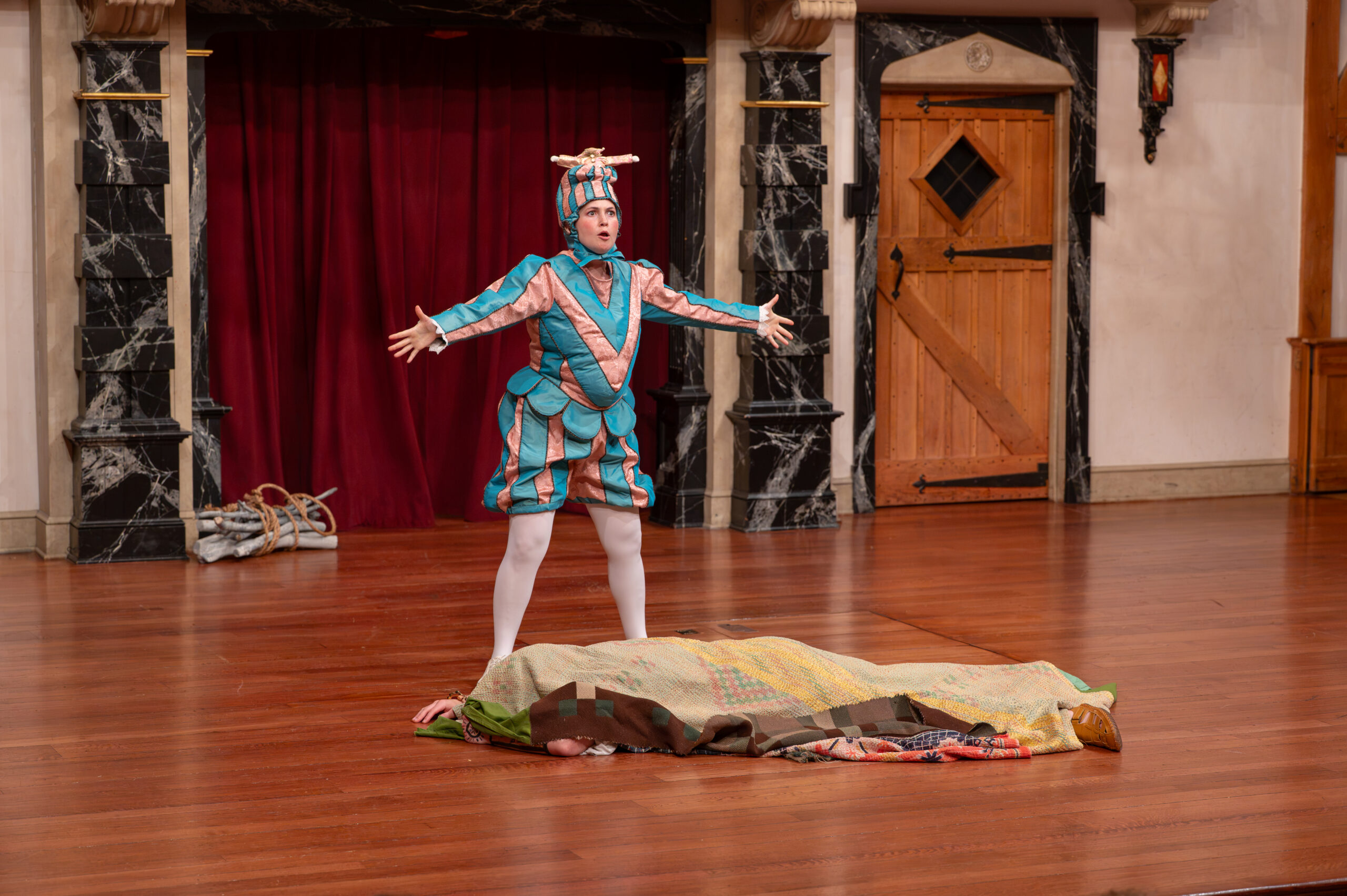
Morgan Rose Ford as Trinculo in The Tempest. Madison Patterson.
Is it okay to laugh about colonialism and oppression?
If you’ve ever seen “The Inquisition” musical number or the French Revolution scenes from Mel Brooks’ History of the World, Part I (1981), you know that recasting the darkest periods of mankind as palatable can still fall within the realm of possibility—depending on the threshold of your sensitivities, that is.
Keeping that skill of walking fine lines in mind, and knowing full well that what we—the American public—tolerated even in 2019 doesn’t necessarily hold water today, how do 400-year-old English-centric concepts of power play in 2026 Central Virginia? And more importantly, is that shit funny?
Because after sitting in an hour of inexplicable traffic trying to get over the mountain to Staunton, you want to be sure your night’s plans are worth it when you finally get to your cushioned bench in the cozy-but-too-bright Blackfriars Playhouse.
So while Google Maps predicted our doom with a horribly late ETA, my partner’s miraculous ability to maneuver around trucks and find quick parking resulted in catching each and every line of The Tempest. In fact, we managed to be early enough to see the bulk of the cast belting out a rendition of the Bee Gees-penned Dolly Parton and Kenny Rogers’ hit “Islands in the Stream” for some reason.
Oh, I’m not that dense; I get the gist of paying respect to a recently passed icon before a play about people on an island, but for the last time in my column I will note that these ASC pop music covers often reveal too many deficiencies in the musical abilities of otherwise highly talented actors and, maybe worse, they feel like pandering to what is often a senior citizen-leaning crowd that is experienced enough to take their drama straight up and like it.
Now about this play. It concerns Prospero (Angela Iannone), a man more focused on his magic than governance who, 12 years earlier, was booted from his dukedom in Milan by his brother and the king of Naples. He and his now-teenage daughter Miranda (Isabel Sanchez) are the only human inhabitants of a secluded island where Prospero’s magic has him lording over a deceased witch’s malformed half-man son Caliban (Ronald Román-Meléndez) and the goodly spirit Ariel (Isa Guitian).
Long story short, Prospero bids Ariel to conjure up a storm (you know, the name of the play), and the opening act takes off with thunderclaps and a shipwreck. The resulting supernatural weather event brings Prospero’s old enemies, a crew of fools, and one old friend Gonzala (played expertly by Sara J. Griffin) to this strange “brave new world” of an island.
What happens next? Colonialism and oppression in action. Many productions have brought these serious subjects even further to the foreground, and director Matt Radford Davies is no exception, feeling compelled to take it to places that struck me as curious.
For instance, he chose Spanish as the first language of native witch spawn Caliban. Rather than having him voice some unintelligible nonce mumbling that could have also done the job, his dialogue was peppered with a translation.
Yet even with the suspension of disbelief needed to imagine multiple settings, with plot points hinging on coincidences and magic acts, it felt odd.
Consider that nearly all the characters are supposedly from pre-unification Italy, and during this time—the tail end of the Age of Exploration when it was written—Spain was doing a pretty fair job of colonizing itself. And while the play may be more indebted to Italian commedia dell’arte conventions than anything else—why the child of an Algerian witch would be cursing his fate in Spanish under a Milanese master is beyond me.
But that is admittedly just nit-picking perhaps best left to fester on its own. Because in addition to introducing hundreds of words into the English language, Shakespeare’s ability to serve weighty subjects with lightness shines on, and Davies is obviously free to interpret.
We’re given grief over lost loved ones, vengeance plotting, mystical power moves, and by Act 3, Scene 2, we’re also treated to drunken revelry. K.P. Powell as the doofus butler Stephano is hilarious and his sidekick Morgan Rose Ford is an equally engaging Trinculo. Our more fundamentalist readership would likely call out hints of sodomy and Satanism as well, but as with basically all worthwhile Early Modern drama (like any John Waters movie), it’s part of the package.
The play hinges on Iannone’s sober Prospero, whom she portrays as complex and commanding; even as a diminutive woman, her artistry elevates a believable embodiment of the powerful magician father out for his recompense. And as the characters fantasize about freedom around Prospero, playing with the idea of running things—no matter the cost or who may have to pay with their lives for it—the liberty of the individual to dream on a different life may be the greatest first step in undoing the tyranny of being subjugated by forces beyond our power.
And yes, it can be quite amusing.