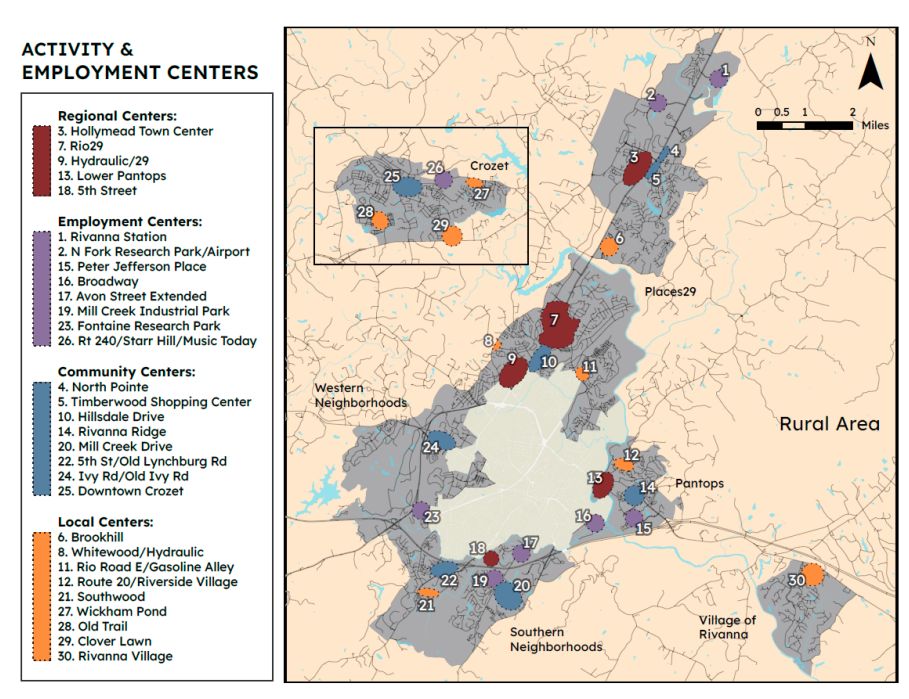
Later this year, Supervisors will select one of these areas to produce a targeted plan to guide growth.
The Weldon Cooper Center for Public Service at the University of Virginia projects that more than 137,000 people will call Albemarle County home by 2040, or about 18,000 more than their estimate for July 2026.
“Now is the time for managing that growth through activity center plans and multimodal transportation plans,” said Tonya Swartzendruber, a planning manager in Albemarle.
Since the late 1970s, the county has operated under a growth management policy that directs growth to about five percent of Albemarle’s 726 square miles. Last October, the Board of Supervisors adopted an updated Comprehensive Plan called AC44 that kept the boundaries in place and suggested new ways to encourage increased density.
Now staff want to move forward with five initiatives including a rewrite of the zoning code, developing a new plan to govern land use in the rural area, and creating targeted plans for some of the 22 activity centers and eight employment centers.
“Looking forward, activity centers are expected to accommodate a significant proportion of the county’s future growth and economic development,” said James Wilkinson, a long-range planner.
The idea is to move ahead with one plan per year over the next three fiscal years, with supervisors deciding each location. This will coincide with the development of a new multimodal plan to find ways to move people around. Much of the county’s growth will occur in northern Albemarle which does not currently have fixed-route transit service.
Supervisor Mike Pruitt of the Scottsville District is a member of the Charlottesville-Albemarle Regional Transit Authority, a body that is studying the same topic.
“At our last CARTA meeting, we got briefed on the more than a dozen transit plans that have been produced in just this decade,” Pruitt said. “I hope you’ll forgive a layer of maybe mild agitation or skepticism on the length of the planning.’
None of the proposed activity centers is in Crozet, one of the designated growth areas. Supervisor Ann Mallek of the White Hall district was first elected in 2007 and has twice voted to approve updates to the Crozet Master Plan. She said much work remains to be done to implement the vision of that document.
“We have old streets in Crozet, over which endless chains of dump trucks now go, where there are no sidewalks,” Mallek said. “The streets are 12 feet wide and the houses were all built in the ’30s, ’40s and ’50s. And it’s just not fair.”
Supervisor Ned Gallaway of the Rio District said staff must ensure that a housing policy adopted in July 2021 is also updated as part of this work.
“I want to be clear as a supervisor that I don’t see the Housing Albemarle update as a separate or a parallel process,” Gallaway said. “I see it as integral to making these projects work.”
Gallaway said he wanted to see more regular metrics from that plan.
Another initiative aims to create a rural area plan in the next couple of years that will involve reviewing allowable uses outside of the growth area to boost economic development.
“It would identify additional non-residential land uses that support the rural area, including local agricultural and forestry recreation, agritourism and other revenue generating uses,” Wilkinson said.
Supervisors will be presented with an updated transportation priority list later this spring.