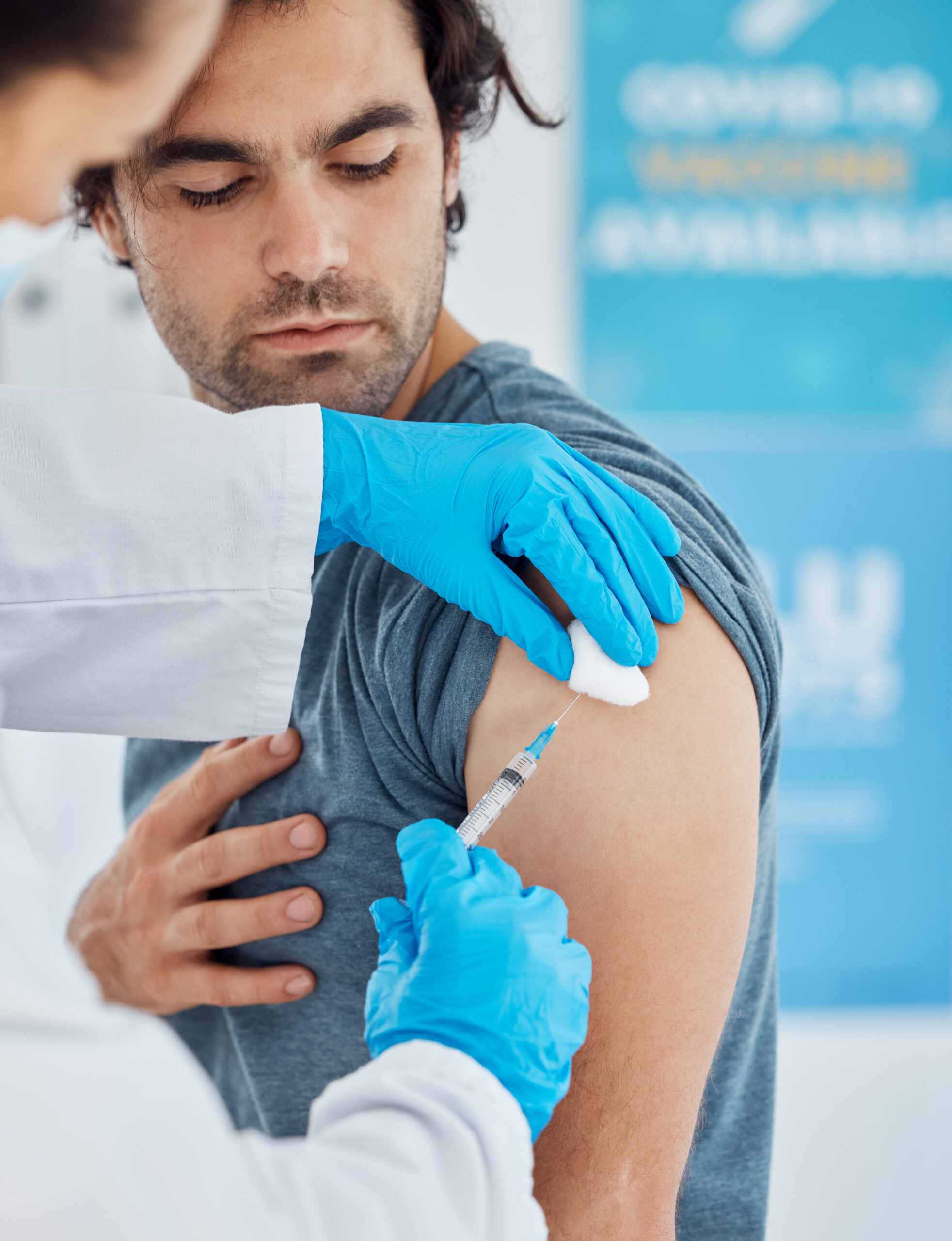
File photo
Fast, cheap, and good,” the saying goes: “Pick two.” But a team from the University of Virginia School of Medicine has discovered a way to make vaccines that embrace all three.
Their new process can develop powerful vaccines in weeks, while costing a dime a dose or less to manufacture. Lead researcher Dr. Steven Zeichner hopes this new platform, described in a peer-reviewed paper published December 22, will help tackle emerging viral threats.
Different approaches to making vaccines have trade-offs. Live modified viruses that deliver an immune-boosting payload against illnesses like Ebola can fail if the patient’s body recognizes and kills that carrier virus before it does its job. The mRNA vaccines that debuted against COVID work well, but they’re expensive and delicate, requiring storage at incredibly cold temperatures.
Vaccines against bacteria are often easier and cheaper to develop. Factories worldwide grow bad bugs, kill them, and use those dead bacteria to train our immune systems. Better yet, those vaccines can stay fresh for years at temperatures your home freezer can match. So Zeichner and his team decided to use bacteria to fight viruses.
They started by identifying potentially vulnerable parts of a virus—HIV, in this case—to attack. “Viruses mutate really fast,” Zeichner says. “You want that vaccine to induce the production of antibodies against something that the virus can’t easily change.”

Once the researchers decided which virus parts to target, they had to accurately mimic those weak points. An artificial intelligence called AlphaFold ensured that the strings of amino acids they encoded would produce the correct three-dimensional shape. The AI program uses a vast library of protein shapes and corresponding amino acid codes to predict how proteins will look. “Sometimes we design something and it doesn’t yield the structure that we want,” Zeichner says, “and we see that on AlphaFold before we make the DNA.”
Next, they had to get that DNA into a host. Bacteria contain little circles of DNA called plasmids that can share useful genes with other bacteria to increase their odds of survival. Zeichner and his team synthesized plasmids carrying their customized genetic code. Then they had to get a little rough. “We weaken [the bacteria] and we shock them with a big electrical jolt, and that opens up pores in the bacteria, and the plasmid can get in that way,” Zeichner says.
Once inside, the plasmids built proteins that resembled the targeted parts of the virus. To move those pieces to the bacteria’s outer shell, where the immune system could notice them, the plasmids’ instructions attached those fake virus chunks to structures called autotransporters, alongside special proteins that acted like alarm signals to draw the immune system’s attention.
Most bacteria have lots of structures on their outer shells—to help them absorb food, for instance, or cling to the walls of an animal’s gastrointestinal tract. But the bacteria Zeichner and co. used were genetically modified to be as simple as possible. That meant fewer outer-shell structures, and more room for the immune-alerting fake virus chunks to stand out.
Zeichner’s team then killed the bacteria to render them harmless, and dosed mice with their new vaccines. And while their creation didn’t kill the virus—Zeichner says he and his researchers basically picked the wrong target—it did generate lots of antibodies that matched the team’s chosen shape. With better targets, he thinks the vaccines will help immune systems catch and kill their viral quarries. In a second preprint paper awaiting peer review, he and his team have already tweaked their approach in ways that partially neutralized HIV.
The speedy, inexpensive process let Zeichner’s team test lots of different approaches at once. (According to Zeichner, waiting to measure immune response in their lab mice took longer than actually making the vaccines.) They could also rapidly tweak and improve new designs. “We don’t have to start from scratch,” Zeichner says. “We can incorporate all the components that we found were good in that iterative process, and then just make what we think is going to be a really good vaccine.”
Experts dream of creating vaccines in 100 days. Zeichner and his team’s approach takes about three weeks. The team is currently testing their technique against other diseases like flu and malaria.
According to Zeichner, this low-cost, fast-paced vaccine development process may have more wide-ranging applications. From a faster, cheaper approach to cancer immunotherapy, cranking out customized vaccines that teach patients’ bodies how to kill their own genetically unique tumors, to vaccines for livestock, protecting them and us against bird flu and other diseases that might otherwise jump from animals to humans—the possibilities, Zeichner hopes, are endless.
So far, this new approach has been tested in mice. When it might reach humans, Zeichner says, depends on a more mundane roadblock. “How long it takes to get to human trials depends on how much money we get. The money and the people are the struggle right now.”