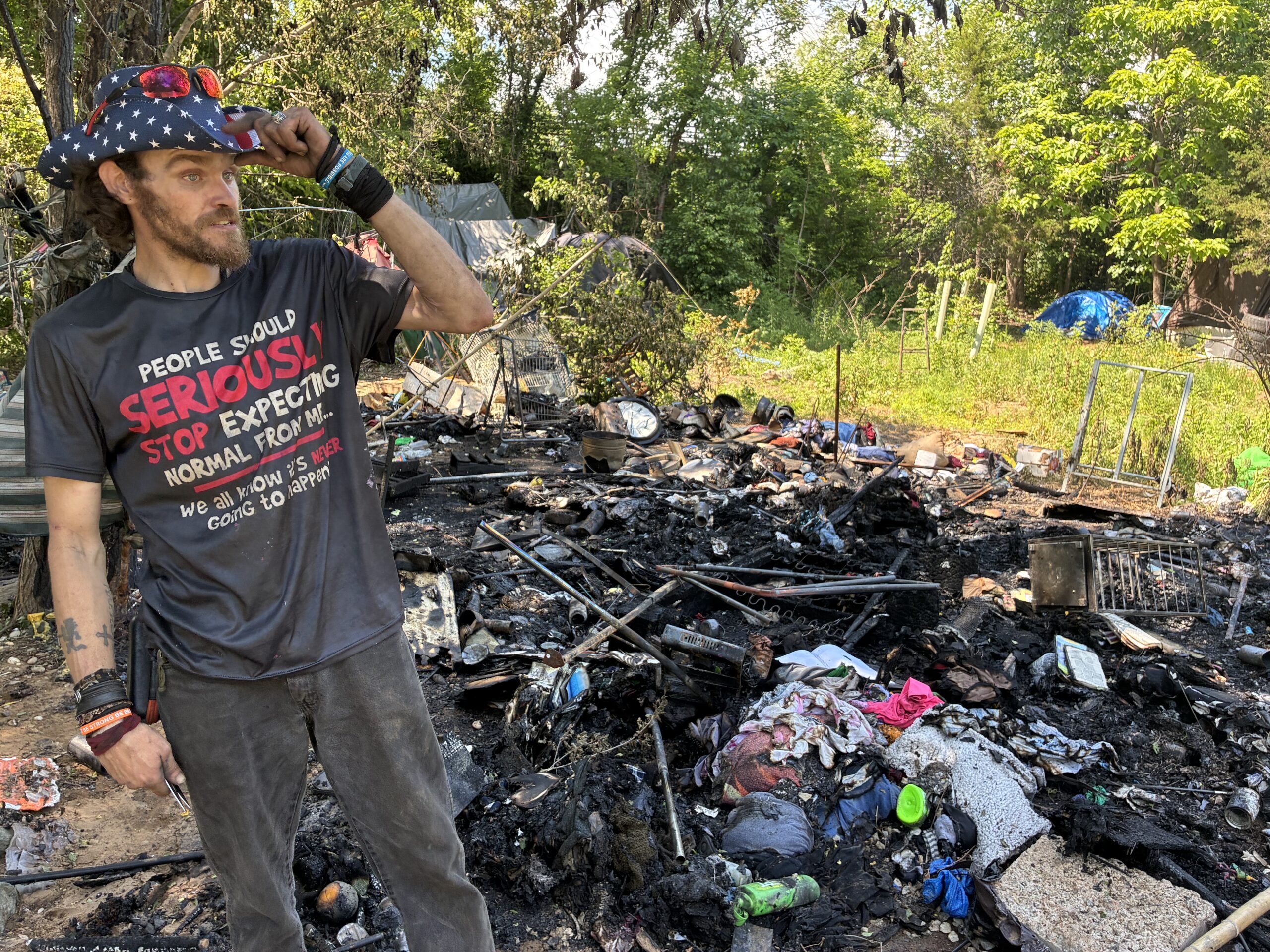
In the afternoon sun along the Rivanna River Trail, Joshua Ballou paced the edges of the burnt-black patch of public land that used to be his home.
The Charlottesville Fire Department responded to the blaze that destroyed Ballou’s shelter late on May 9, at the encampment adjacent to the trail. The fire burned just northeast of the overpass, where the 250 Bypass crosses the Rivanna River heading into Pantops.
Records from CFD indicate that 911 received reports of the fire at 10:44pm, with units arriving by 10:51pm; the incident was listed as cleared at 12:38am.
By early afternoon of May 10, all that remained of Ballou’s former shelter was a charred pile—an oversized clock warped a la Salvador Dali by the heat, the metal frame and springs of a couch, the skeleton of a large patio umbrella. The fire seemingly didn’t touch any nearby brush or structures. A neighbor’s tent with a neatly cleared path to its entrance remained intact, as did others tucked up to the embankment behind the site of the fire.
Ballou’s hands were still black with soot, and he occasionally paused to cough, sometimes apologizing for doing so, as he spoke. He says he doesn’t know how the fire started. By his account, he was in sight of his makeshift home when he first saw the flames, visiting with friends at their tent just down the trail. Ballou says there had been no active heat sources inside the tent when he left it.
He says he ran into the burning structure, supported by metal poles and covered in tarps, to grab his most important items, including a laptop bag with several of his notebooks. He managed to fill a few stray shopping carts with clothes and other items that he pushed into the trail to keep out of the blaze. He showed a mark on one forearm where he says he’d burned it on a support pole inside the structure.
Ballou, who says he’s also known as “Joker,” didn’t see anyone else near his tent around the time of the fire. But he thinks it’s possible someone might have started the blaze deliberately. A set of concrete stairs lead down the embankment to the trail from River Road, directly behind the site of his shelter. He pointed out a pair of metal struts he’d tied to a tree near those stairs, saying they were both propped up as part of the structure before the fire. The only way one of them could have fallen, he says, is if someone disturbed it.
A spokesman for the CUA911 center said Charlottesville police were investigating the incident.
According to maps at drought.gov, Charlottesville currently faces severe drought, with nearly two fewer inches of rain compared to the average year to date. At the May 4 City Council meeting, Councilor Michael Payne expressed concern that given the dry conditions, fires at the encampment could prove deadly.
“I walked there and my heart really does break,” Payne said. “And I am terrified because what is happening is not any minimum level of care; it is not meeting any level of structure that is going to help these folks … Someone is going to die out there.”
Though Ballou says he’s been in Charlottesville since 2017, including a stretch he says he spent living in the old K-Mart near Hydraulic Road, he didn’t say how long he’d been at the encampment. He mentioned losing another makeshift structure when it collapsed under the weight of piled-up snow last January. He described it as a “workshop” where he’d go in private to paint or make crafts, including a series of fake flowers he’d created in memory of friends who’d overdosed, built partly out of the sterilized needles that had killed them.
Ballou didn’t say where he’d be sleeping that night—or in the future. He says he’d been joking about the fire with a friend earlier on Sunday: Though he’d been at the encampment for months, he says, “this is the first time I’ve been homeless.”