“What a strange thing a body is, I thought, how eerie to be filled with blood and covered with hair, to be a machine any part of which might fail,” reflects the narrator in Small Rain, Garth Greenwell’s latest novel. It’s 2020, amidst the early days of the COVID-19 pandemic, and the narrator finds himself surrounded by doctors trying to diagnose his medical crisis—a bit of the “machine” that appears to be failing. In between seemingly endless blood draws, IV hookups, and diagnostic tests, Greenwell’s narrator shares memories and reflects on his life and the systems we live within, gently probing the spaces between health and disability, pain and care, precarity and safety, community and self.
In an interview for The Yale Review, Greenwell described his motivation for writing Small Rain, saying, “The book is not autobiography, but I underwent a medical crisis in 2020 similar to the narrator’s and emerged from it utterly bewildered—about what my body had undergone, about what the experience meant for my understanding of my life. … I couldn’t reason my way to an understanding of what had happened to me; I needed to dwell in it.”
By inviting readers to dwell in it with him, Greenwell asks us to consider how we live our lives when things seem unbearable—in our bodies, our climate, our systems, and our politics. And at least part of the answer seems to be that we bear it by allowing ourselves to experience the pain and discomfort, making sense of it through art and language, and facing it together.
Greenwell’s narrator is a gay poet who grew up in the American South, and spent years living and teaching in the Balkans—experiences that are explored by Greenwell in his first two novels, What Belongs to You and Cleanness. Over time, the narrator ages and changes, gains perspective and new life circumstances. And yet, despite a brush with illness when diagnosed with syphilis in What Belongs to Us, he remains confident of his citizenship in what Susan Sontag described as the “kingdom of the well,” in counterpart to the “kingdom of the sick.”
In What Belongs to Us, the narrator reflects about a dying friend: “The space that had opened up between us remained, and I knew I would stay on the other side of it, the side of health.”
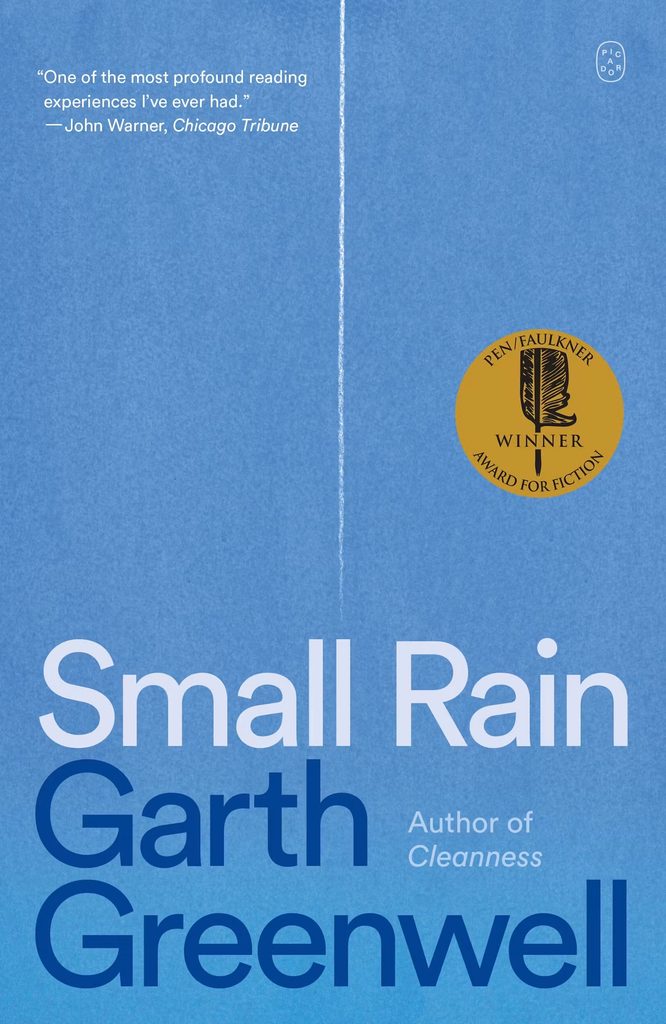
Fast-forward to the opening of Small Rain, which finds the narrator some years later, recalling, “They asked me to describe the pain but the pain defied description, on a scale of one to ten it demanded a different scale. It was like someone had plunged a hand into my gut and grabbed hold and yanked, trying to turn me inside out and failing and trying again. Like that, while someone else kneed me in the groin.”
In this moment, we see the narrator’s relationship to health—to his body—in the process of changing as his body needs a different kind of attention than he’s used to giving it.
The narrator reflects, “I was healthy and still thought of myself as young, young-ish; I thought of myself as lucky is what I mean, I guess, though really I didn’t think of my health much at all, which was the luck, the privilege.”
An apt pandemic-era novel, Small Rain explores what it is to have and then lose that privilege of health, even if temporarily. Which is not to say he is without other forms of privilege: The narrator has good health insurance through his partner’s job. His sister is a lawyer who helps advise him on his medical rights when things seem to be taking a bad turn. He is a white, cisgender man who owns a home. Still, he is a person in pain, experiencing a condition with a high mortality rate, in a dysfunctional and overwhelmed medical system, trying to understand what it means to realize one’s own vulnerabilities.
Amidst this, there are moments of kindness, empathy, and solace: A reassuring touch on his ankle with “no medical purpose, no measurable end but comfort,” a few minutes listening to Renaissance composer John Taverner’s “Westron Wynde” alongside an ER nurse, poetry called to mind while watching a small sparrow through the window—reminders of the narrator’s humanity even when hospital staff more often treats him like a body or a puzzle.
At one point, while processing his own mortality and the meaning he has made of his experience thus far, he notices a priest making the rounds in the ICU. The narrator reflects, “Maybe I wanted to talk with someone whose job wasn’t to fix what had gone wrong in my body, to deflect my worry, to assure me I would get well; maybe I wanted someone who would sit with me and let me contemplate the possibility that I wouldn’t, the possibility of long debility, the possibility of death; someone for whom that wouldn’t indicate failure, of their own abilities, of technology or science.”