Tristan Williams
From the home she’s owned on Azalea Drive since 2017, Casey Gioeli watched the trucks roll in and the trees come down.
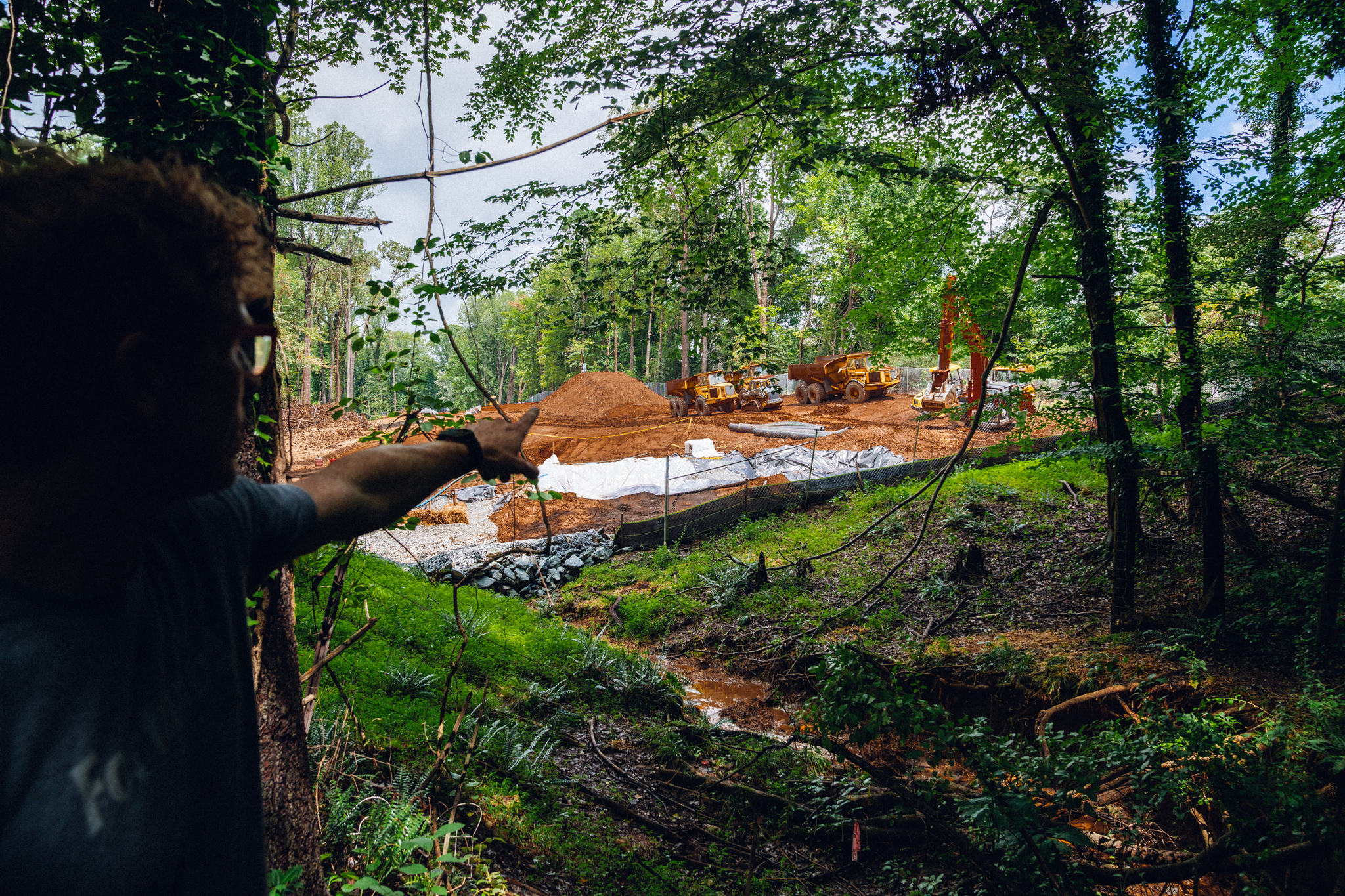
Several weeks earlier, Stanley Martin Homes began construction on Azalea Springs: 45 new Fry’s Spring homes squeezed into a steep, thickly forested 7.6-acre ravine between Azalea Drive and Monte Vista Avenue. “Towards the latter part of the afternoon [on Saturday, August 1], I noticed that they started to dig a small depression at the end of the property,” says Gioeli, a semi-retired physical therapist.
On August 2, “the rains began,” Gioeli recalls. “Azalea Drive drained just as it has always, and because the area had been denuded, the water … quickly overwhelmed what they had constructed in [the] short term, and sediment flowed downstream.”
City records show that Stanley Martin pledged to finish digging a pit to catch rainwater and stop erosion before it began other work. The builder was allowed to cut down just enough trees to enable that construction—but inspection reports say it did too much, too fast. (Stanley Martin representatives did not respond to requests for comment at press time.)
“They were supposed to clear-cut the site eventually,” says city engineer Brennen Duncan. “They just did that ahead of when they were supposed to, which exposed more ground and made it so there was more erosion that could happen.”
City inspectors caught Stanley Martin getting ahead of its promised plans, issuing warnings to the builder after inspections on July 29 and 31. Reports show they ordered Stanley Martin to finish its stormwater control measures, install the correct kind of anti-erosion fencing, and spread enough straw or mulch on the newly bare dirt to keep it from running off in a rainstorm. The city’s deadline, August 3, proved one day too late.
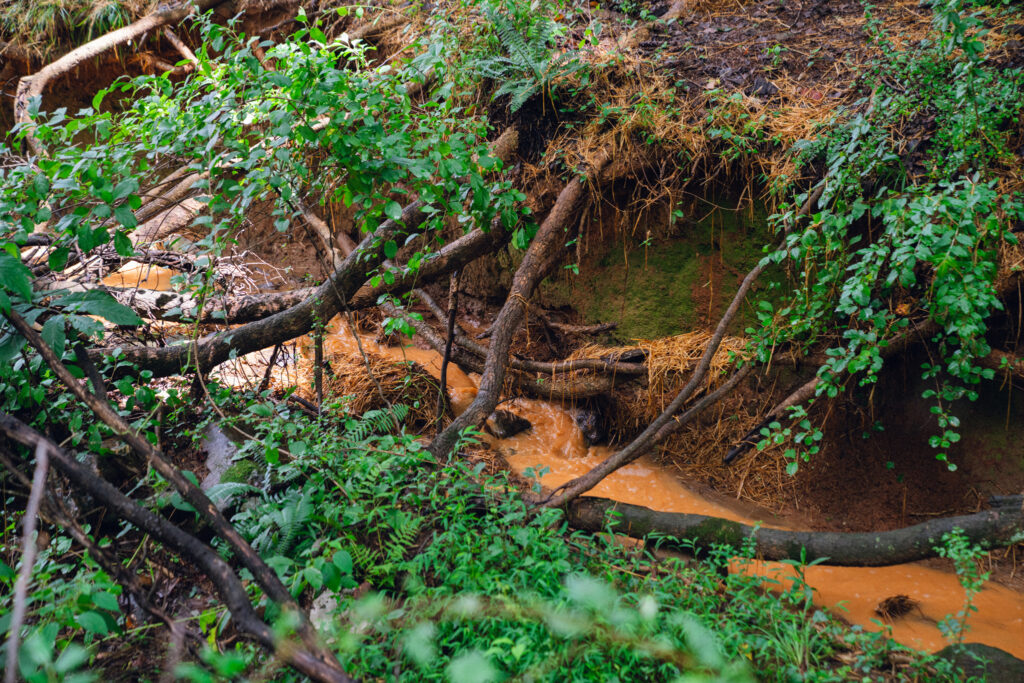
When what Duncan describes as “between a 50- and 100-year storm” rolled in August 2, that dirt flowed down and out of the property, overwhelming reportedly inadequate fencing and dams, and leaving the natural creek south of the development choked with orange mud.
“The site is not an ideal site to build a really dense development,” says Paul Josey, a landscape architect and Fry’s Spring resident. “It doesn’t surprise me on a steep slope site that you’re going to have issues where it was once a wooded stream corridor.”
Jesse Harper, a musician and music teacher, owns a house adjoining the development on Azalea Drive, and another property immediately south of the construction on Monte Vista Avenue. The day after the rains, he says he measured 14-inch-deep sediment in the stream that wends from the bottom of his land down into the restored wetlands in nearby Azalea Park, describing “a river of mud about six feet across.”
A Department of Environmental Quality inspection on August 4, two days after the storm, measured mud four inches deep just across the property line, diminishing as the inspector moved downstream toward Azalea Park.
Even that much sediment “buries the floor of the stream channel, which can reduce [or] eliminate habitat for invertebrates that live in rocky [or] cobble bottom streams,” says Nicola McGoff, director of the environmental consulting firm Wild Ginger Field Services. “The stream then has to work to remove and sort its way through these sediments over months to years, which transports these sediments further downstream into Moores Creek and beyond.”
Duncan pushed back against what he described as exaggerated media reports. “This one’s a little bit more than we want, and so we’re definitely taking action on it,” he says. “But this wasn’t a catastrophe of great amounts.”
“We’ve already had a disaster with it,” Harper said on August 5, watching an excavator continue to dig out a stormwater basin. “Three weeks in, and there’s environmental problems, and [Stanley Martin] violated how many different things that they were supposed to do because it’s not profitable to do it in the way that they’re supposed to.”
Harper also says the site’s development threatens the tall, mature trees in backyards like his, on the other side of its property line—and, in turn, the houses near them. “Those trees now have no wind buffer that has existed for hundreds of years, and their root systems have all been dug up,” he says. “All those trees, those massive trees, are going to die, and look at which way they’re leaning.” Harper says removing those trees for safety would cost him and his neighbors $6,000 to $10,000 each.
Trees have a “critical root zone,” Josey says; disturb the ground or sever too many of those roots in that area, and you risk killing them. “If you exceed 30 percent of root zone removal, that’s where that tree really suffers,” he says. “If you go too close to that tree, you’ll impact what’s called the structural root zone, and that’s when the trees have increased risk to actually fall over.”
But unfortunately, Josey says, Virginia property owners can do whatever they want to tree roots within their own property, even if the tree itself is in someone else’s yard. Site plans for Azalea Springs mark all the trees on property owned by Stanley Martin, but don’t include any trees in adjacent lots.
“These trees are at high risk of dying,” says Gioeli, and “when they do, they will fall on my house.”
The city has issued a stop-work order on the site until Stanley Martin finishes stormwater control measures and cleans up its mess. The developer theoretically faces city fines up to $32,500 a day, though Duncan says any actual penalties assessed will likely be much lower.
“At this point we’re still waiting to see: Can they fix it all?” he says. “Do we get another big rainstorm that has another impact?” He says Stanley Martin’s been “cooperative” thus far.
“I would have expected maybe a little bit more urgency on their part, but right now they have done some things,” he says. “Hopefully, if we do have another rain, we’ve done enough at this point that we’re not going to have another failure. But at the same time, they really just need to get that sediment trap built.”
“I’m going to put some no trespassing signs up on my property,” says Harper, “because Stanley Martin has to [correct] this, but they’re going to have to do it through our attorney, because I’m not going to just say okay. Nobody’s going to do that at this point. They’re going to have to do it right, and if it’s costly and if it makes the project unprofitable, so be it.”
“Thankfully my neighbors are all really industrious people who care about this stuff,” Harper says. “We’re getting together. We’re organizing. Seems like we’re organizing too late at this point, but we’re still gonna.”
Gioeli fears that the site’s planners haven’t accounted for the increasing incidence of heavy rains in our area. “I’m older; I’ll be dead,” she says. “But if we’re looking at long-term management of this, will it be enough, or are we going to look at, at some point, failure on the downstream side that will be much bigger than anything that we can imagine at this point?”