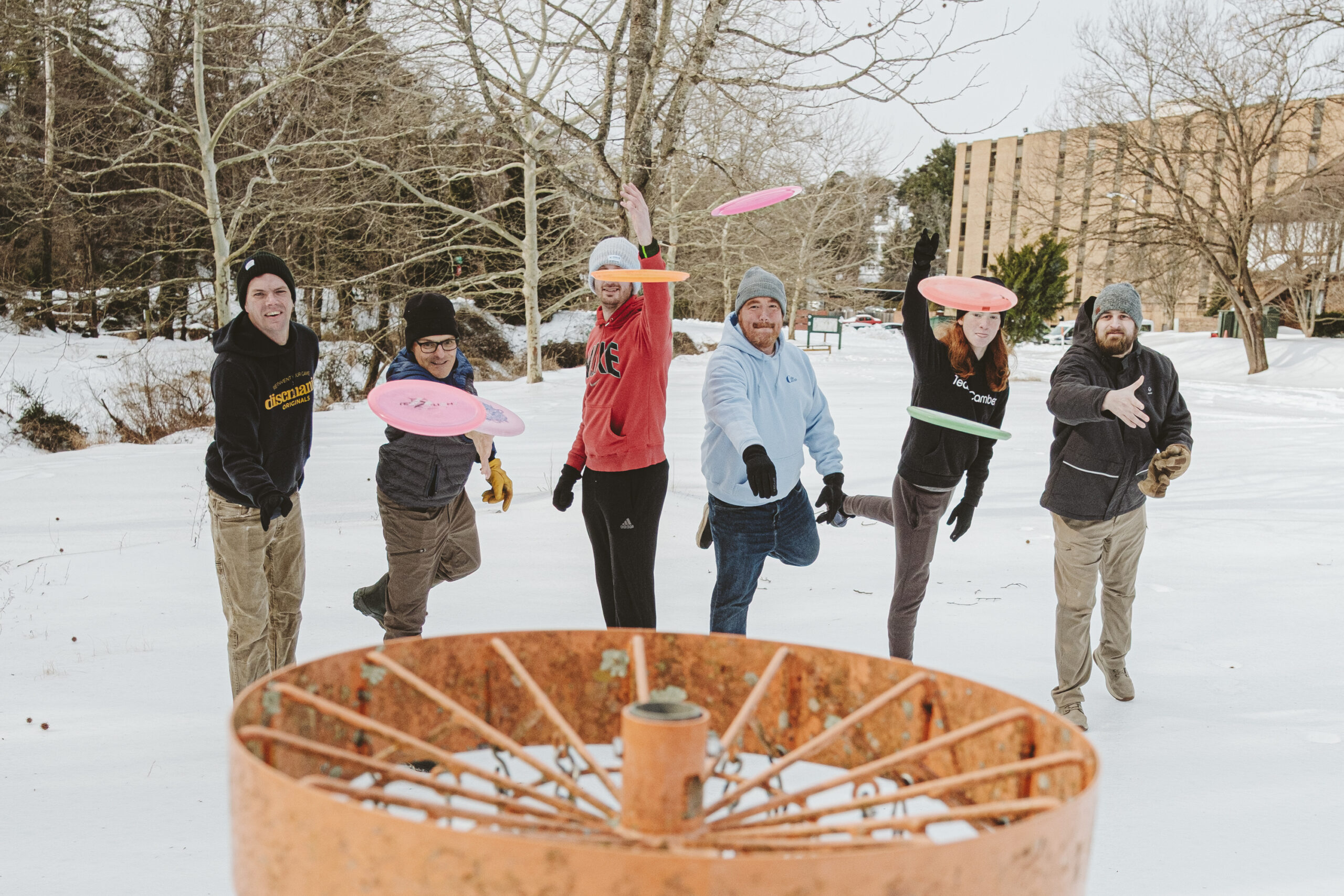
The Ice Bowl, to be honest, seems like two excellent ideas surrounded by a lot of terrible ones.
The excellent ideas: Tossing a disc into a basket for fun, and raising money for the Blue Ridge Area Food Bank while you do so.
But you’re tossing that disc out in the middle of the woods, surrounded by razor-sharp laurel bushes, poison ivy, and any number of potentially unfriendly creatures. You’re trying to steer your disc to that basket around blind curves, through thick stands of trees.
And you’ll do all this for hours, in whatever nightmare mix of winter weather—rain, sleet, snow, freezing cold—Virginia feels like inflicting on you. Possibly after eating a large bowl of chili, while uncomfortably far from a restroom.
The local disc devotees of the Blue Ridge Disc Golf Club will brave the elements on February 28, as they’ve done every year since 2004, to meet that challenge. They play for charity. For bragging rights. And, perhaps most importantly, for a little engraved piece of metal about the size of a silver dollar.
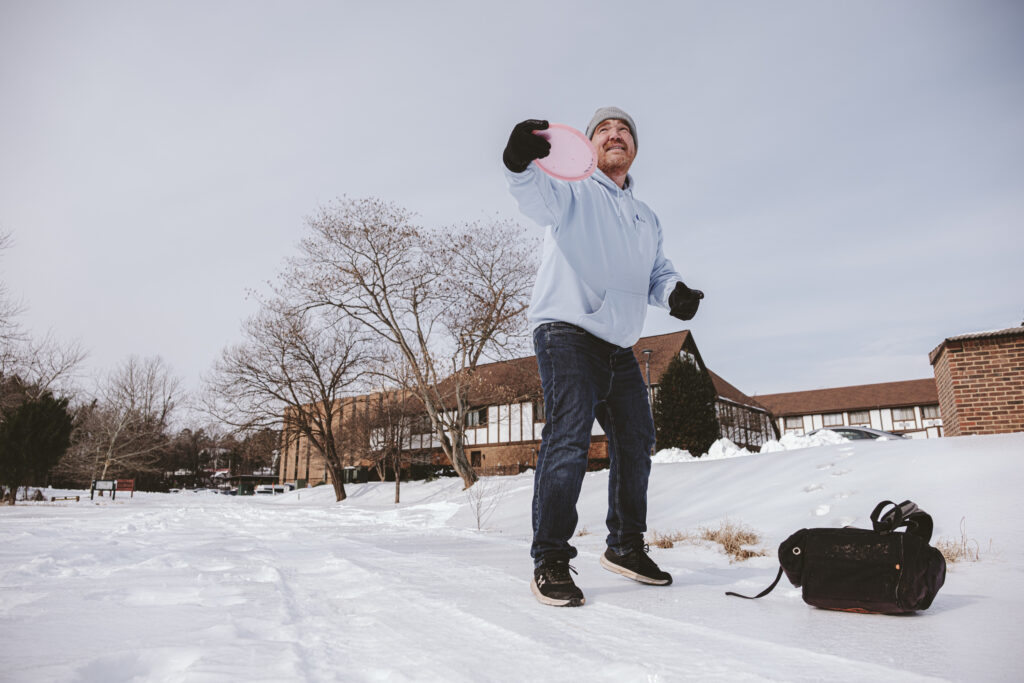
A club (but no clubs)
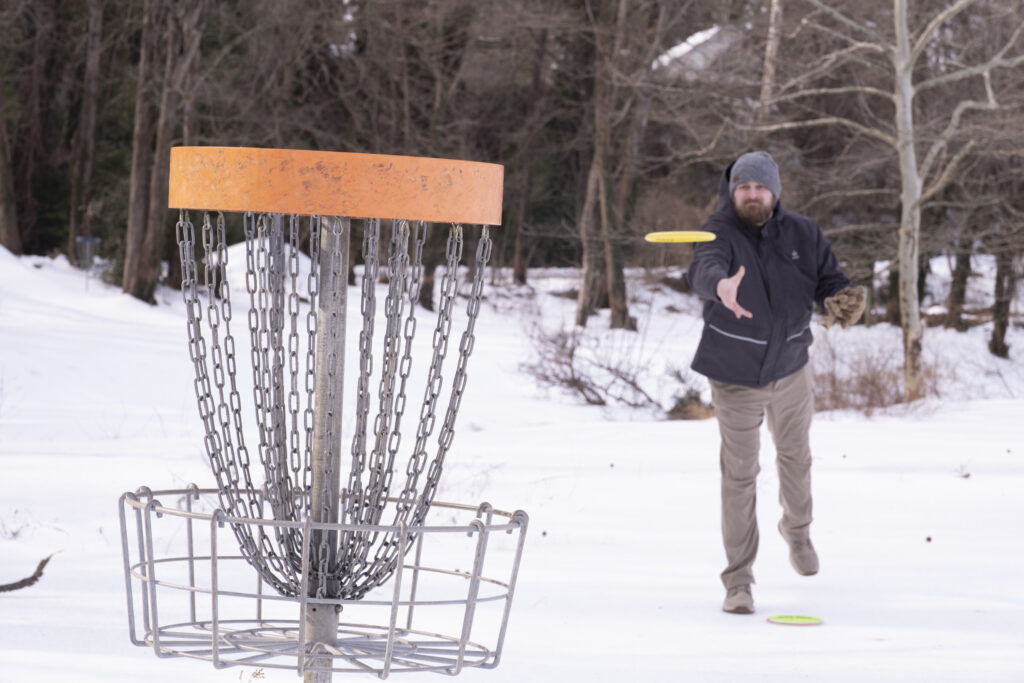
In disc golf, players compete to see who can hurl a flying disc into a pole-mounted basket in the fewest number of throws. Ed Headrick, who patented the modern Frisbee design in 1966, also invented disc golf’s signature chain-fringed basket in 1975. But disc golf’s origins as a sport remain murky; Frisbee maker Wham-O started selling a professional model disc in 1964, but the Professional Disc Golf Association’s official history places the first organized instance of disc golf in 1965.
The PDGA lists more than 100,000 current members on its web site, from countries as far-flung as Belize, Ethiopia, and New Zealand. Locally, the BRDGC’s 2025 club championship on November 22 drew 42 competitors; 44 vied for glory in the 2025 Ice Bowl last February 8. The club ended 2025 with 83 members.
“The sport of disc golf had this huge influx after COVID,” says 2026 club president Kerry Finnegan. During the pandemic, it provided a relatively safe outdoor activity—and a great reason to get out of the house. Disc golf’s ranks are still growing, Finnegan says, but at a slower rate than the pandemic boom.
“Most people don’t get into disc golf until they meet someone who’s into disc golf,” Finnegan says. He took up the sport in 2008, while managing a Chili’s in Staunton, after a coworker took him out to play. In 2020, working from home with two elementary- and middle-school-aged sons, he got back into disc golf as a family activity. “We had to get out of the house,” he says. “Otherwise, two boys would kill each other.”
Finnegan’s sons took to the sport even more than he had, and all three ended up getting involved with the local club after meeting friendly members on the 9-hole course at Meadowcreek Gardens, one of four the BRDGC maintains locally.
Joys and hazards
Andrew Lamont also started early, taking up disc golf at 8 and competing in amateur leagues by the time he was 12, while also playing baseball and other sports. “I think throwing things just tends to be something I gravitate toward,” he says. A physical therapist and former musician, Lamont, now 31, won both the 2024 club championship and the 2025 Ice Bowl.
Like other players, Lamont says there’s just something inherently satisfying about a well-aimed throw. “When you get to a point where you can manipulate the disc’s flight based on the characteristics of that disc, and you understand it deeply and it works the first few times, it is the greatest feeling in the entire world.”
Most of the local disc golfers interviewed head out for a round with a specially designed backpack stocked with 10 to 20 discs. Asking golfers how many discs they have at home seems to be a fraught question; multiple BRDGC members, when asked about it, reply, “Have you been talking to my wife?” Lamont estimates he’s amassed 200, many stored on a custom wooden rack in his garage.
Just like golf clubs, discs are divided into long-range drivers, midrange discs, and short-range putters. Each disc has a different purpose and characteristics, defined by numerical codes that indicate how far they’ll fly, how fast they’ll drop, and how much they’ll curve to the left or right in flight. Those factors can be crucial in helping disc golfers evade tricky obstacles to reach the basket.
When a throw goes right, “it’s a great feeling, very euphoric,” longtime club member Peter Vines says. “And you quickly forget the previous two or three trees that you hit.”
When a throw goes wrong, and you’ve marooned a disc in the underbrush? Players wear tick repellent, try to avoid hostile plants, and try to respect wildlife. “I’m always careful about where I’m stepping,” Vines says, “because you certainly don’t want a rattlesnake or a copperhead to deal with.”
Those dangers don’t dampen players’ enthusiasm, but they can exact a price. This year, “I got cut with some plant or something,” Lamont says. “I had cellulitis on my leg and had to take antibiotics for three weeks. And then I went and did some blood work because I wanted to make sure I was all right and got diagnosed with alpha-gal.”
No. 1 with a frisbee
Injuries and health problems aren’t the only potential burden disc golfers must bear. After winning the Ice Bowl last year, Lamont earned a coveted, and possibly cursed, prize: the club’s No. 1 tag.
Each year, the club issues each dues-paying member a metal tag, numbered in the order in which they finish the season-starting Ice Bowl. Throughout the year, as players challenge each other to see who can finish a course in the fewest throws, the victor swaps tags with the vanquished. The lower the number on the tag you currently hold, the higher your skills, and the more prestigious your standing in the rankings.
The No. 1 tag is made larger than all the others, about the size of a silver dollar. Players who hold it during the season will write their initials on it in permanent marker, creating a record of its changing ownership. Lamont estimated that the No. 1 tag swaps hands 10 to 15 times a season. (This year, he’s taken himself out of the running; he and his wife moved to Wilmington, North Carolina, in January.)
Players find no honor in clinging to the No. 1 tag, Kerry Finnegan says. “You want to defend it. You don’t want to hold on to it for two weeks just because you dodged everybody.”
During his reign as the league leader, Lamont says he didn’t mind if the No. 1 tag became a target. “I love putting it up against other people, because I do like seeing people beat me and then take it,” he says. “We had a guy get it for the first time, I think, ever, and he came to the next [league tournament] to defend it. And he was wearing like a track suit and he was just, like, amped. He was so hyped to just to try to fend off anybody who was trying to take it from him.”
An ice day out
That love for the game keeps players coming out, even in the worst of weather—which brings us back to the annual Ice Bowl.
The Ice Bowl began nationally in 1987 and started raising money for food banks in 1996. The club has held its local edition every February for more than two decades now, in every flavor of winter weather.
Historically, it’s only postponed the event twice—once for 2010’s “snowpocalypse,” when 20 inches of snow blocked the entrance road to Greene County Community Park, and this year, when heavy snow turned to ice and rendered courses unsafe for the original January 31 date. But unless courses are literally impassable or dangerous, club members say, it’s game on.
“[Last] year, 2025, it rained all morning,” Peter Vines recalls. “Cold drizzly rain is probably the worst conditions. Everything gets wet: Your hands are wet, your discs are wet, your towels are wet, your clothes are wet. You need a good grip to throw it hard, and when [the discs] are slippery, it can be tough.”
“We were all, I think, pretty miserable, and we didn’t have as many tents or as many canopies as we probably should have,” says club member Morgan Clark. “The course we played at was not really ready for that amount of water. It was a slip-and-slide for sure.”
“You’re freezing,” says Lamont. “If the discs are 30 degrees, you’re trying to basically throw a piece of solid ice. I believe somebody came out in shorts one year, just because they like wearing shorts. I was like, what in the world are you doing, man? I have like four layers covering me, with gloves, and two layers on my legs, with a freaking ski mask on, and a big old hat.”
Between the morning and afternoon rounds, the club traditionally holds a chili cook-off. While that can keep golfers warm and energized, it has its trade-offs. “Chili on an empty stomach, not a great thing halfway through a disc golf tournament,” Lamont says. “There’s only one bathroom on that whole course. So that turns into a problem sometimes.”
“You know the Ice Bowl motto,” Vines says. “No wimps, no whiners.”
Food for thought
Of each player’s $45 entry fee, $30 covers their annual club dues, and $15 goes to the Blue Ridge Area Food Bank. Players can boost their donation by purchasing mulligans—do-over shots. Each year, Vines says, the club contributes $750 to $1,000 to the food bank in donations and canned goods.
This year, with government aid uncertain and hunger looming larger, players say they take particular pride in helping their neighbors.
“My wife and I, we come from a religious background,” Morgan Clark says. “We were taught as we were growing up, ‘feed the hungry.’ We are struggling with that because we’re seeing that that’s not a priority of the people who taught us that sometimes.”
“Eating is a basic right that shouldn’t be a choice for families,” Kerry Finnegan says. “Politicians will battle back and forth on what’s necessary and what’s not. Down on the ground, it’s more necessary [this year].”
“We know it’s not the biggest donation they’re going to get all year, and we know it’s not going to go the furthest, but we do know that it’s something,” Clark says.
As club members head into this year’s Ice Bowl, uncertain of the elements, they’ll have that charitable thought—and a bowl or two of chili—to keep them warm.
Where to play
The Blue Ridge Disc Golf Club maintains four local courses.
Walnut Creek
4250 Walnut Creek Park, North Garden
18 holes; $5 park admission, Memorial Day through Labor Day
Meadowcreek Gardens
2030 Morton Dr.
9 holes
Greene County Community Park
512 Jeri Allen Way, Ruckersville
9 holes
Chris Greene Lake Park
4748 Chris Greene Lake Rd.
18 holes; $5 park admission, Memorial Day through Labor Day
Join the Blue Ridge Disc Golf Club
Dues are $30 a year. Visit brdgc.org/membership for more information.