This story was updated March 27, 2026, to reflect new information.
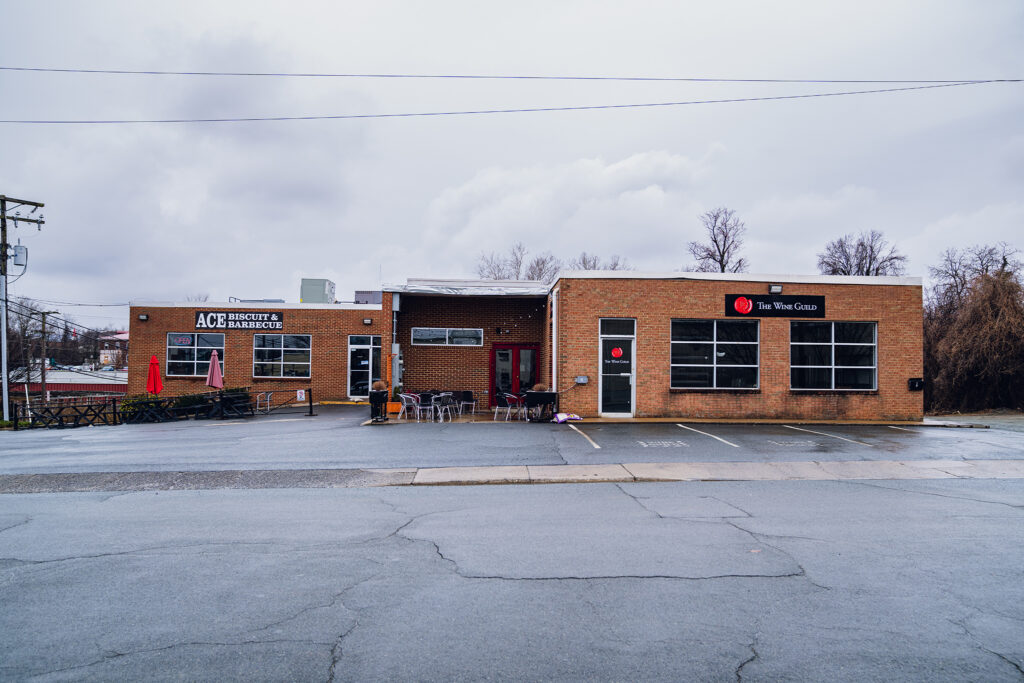
When the axe fell on Stefan Friedman’s restaurants, their sudden closures left staff and patrons surprised. Ace Biscuit & Barbecue, Omakase Obscura, The Wine Guild of Charlottesville, Vitae Spirits Distillery, and Old Metropolitan Hall—the entire once-bountiful table of Friedman’s company, A Moveable Feast—folded or changed hands without any apparent warning. But the signs were there for anyone who looked hard enough.
Friedman is, as one former colleague said, “an extremely private person.” But since Ace shut its doors February 6, we have investigated Friedman’s professional life. As C-VILLE followed the trail of crumbs he left behind, we uncovered a story that grew weirder and more fascinating at every turn.
1.
The restaurateur
“I’ve always been a foodie,” Friedman says. “It’s ephemeral art, in the same way that a beautiful chalk drawing on the sidewalk is before the rain. This is art that you consume, and then it’s gone. But you remember the experience, and that always spoke to me.”
Friedman spoke to C-VILLE in an initial interview on February 16. On February 27, and again on March 2, we sent him follow-up questions addressing the issues raised in this article, and repeatedly invited him, via emails and in a phone conversation, to discuss them.
Friedman declined to comment further on the record, instead issuing this statement: “While I have not been given the opportunity to read the article prior to publication, from assertions and questions presented to me, I believe there to be numerous substantive factual errors and inaccuracies. Given the decades-long scope of your inquiry, I was not given sufficient time to research and comment on these matters.”
“My thought had been that there were a number of struggling businesses,” Friedman said in the February 16 interview, regarding his decision to get into restaurants, “and if I could see what in them needed to be fixed pretty readily, and I thought it was quite doable, that made for an opportunity.”
But Friedman says he found that “the hospitality industry was a quagmire, much different from other kinds of business I’d been involved in.”
Former employees at various Moveable Feast operations described a chaotic atmosphere where management didn’t track expenses.
Cait Taylor was the pastry chef at Bonny & Read, a Moveable Feast seafood restaurant that Friedman and Chef Chris Humphrey ran from November 2023 until it closed in September 2025. “From the beginning,” Taylor says, “I was concerned with the fact that we didn’t have a cost analysis. I’m used to working inside of some kind of budget. To have free reign on that was nice, but at the same time, it was concerning.”
Humphrey says he calculated the costs of each dish he served. But “there was never any talk about numbers or percentages, or any of that sort of thing, until the end,” he says, “which is when I was given a food cost … that was absolutely incorrect. It was too high.” According to Humphrey, supplies for the adjacent Omakase Obscura restaurant were erroneously lumped in with Bonny & Read’s budget.
One source familiar with Friedman’s operations, speaking on condition of anonymity, says that, to their knowledge, Friedman did not maintain formal bookkeeping for any of his restaurants to track how much money came in against how much flowed out. That meant his restaurant group was flying blind from the beginning.
In addition to those issues, former employees say A Moveable Feast’s problems coalesced around two key areas: permits and payments.
Permits
Rick Wampler is Friedman’s business partner in a second hospitality company, Draft Taproom—also known in business filings as Tapt Charlottesville, a name Wampler says is easier to trademark for franchising. He says that during Draft’s long post-COVID closure, Friedman and several associates undertook renovation work in the Downtown Mall space at 425 E. Main St.
According to Wampler, the changes shrank the kitchen, moved an interior wall, and used the freed-up space to create more seating in a private event room—all allegedly done without a permit.
“I wasn’t there much, but I remember somebody talking about a conversation with the city,” Wampler says, “and it was, ‘You’re not doing anything structural, you don’t need a permit.’ And there was a big wall that came down that was like, is this thing structural or not? They figured out, no. So that sentence I remember, and I think resonated with Stefan for a while, which was, okay, we’re not doing anything structural. We don’t need a permit.”
After Draft, Friedman attempted to reopen Fellini’s on West Market Street in early 2023. Leo Schultz, A Moveable Feast’s original food and beverage director, said Friedman recruited him to help with Fellini’s revival. But Friedman stopped working on the property in summer 2023 after a dispute with the building’s owners over renovations.
“We were knocking holes in walls, looking at completely nonstructural stuff … trying to open up the space,” Schultz says.
“I’m not sure where the breakdown of communication was, because [the property owners] had seemed on board, and then when they’d come in and seen some of the renovation that had happened, they were surprised,” Schultz says.
The owners of the Fellini’s property, now occupied by Afghan Kabob, declined to comment.
Schultz says he and Friedman were talking with engineers about getting permits for more “substantive changes” at the time. When asked whether he’d ever heard Friedman say, “If it’s not structural, you don’t need a permit,” Schultz says, “I believe I’d heard him say that.”
Would the city ever tell someone that nonstructural changes didn’t require a permit? “There is not a situation where this would happen here,” building code official Charles Miller says.
The city requires permits if renovations involve “any electrical work, plumbing work, gas work, kitchen hood modification, or any mechanical work. If adding seats or table layouts, this can also require permits to check for occupant loads and egress.” Moving walls in restaurants requires a permit. And, Miller says, “permits are required prior to any work starting.”
City records show no permits on file at Fellini’s W. Market Street address between 2016 and 2025. At 425 E. Main St., Draft Taproom’s previous management filed a permit in 2016 for renovations including the demolition of an existing wall. Since then, there have been only two permits filed at the address: a fire sprinkler adjustment in December 2022, and an occupant load permit in December 2024.
Payments
Friedman’s former employees say they sometimes received their wages in unusual ways—if they arrived on time at all.
“Stefan had a variety of bank accounts, and he did not keep enough money in the Ace Barbecue bank account,” former employee Lauren Black says. “No one was managing the funds in that account, and he was not keeping it stocked. So a bill would hit, and then it would be overdrafted, and then the whole staff would have their paychecks bounce. This happened multiple times.”
A source familiar with Friedman’s business described Black’s story of bounced checks as “a fair assessment.”
“I was paid through [online money transfer service] Zelle for the first several months I worked for Stefan,” Black says. “I didn’t receive a pay stub during this time, but my pay was lower than my salary, so he was deducting money.” Black did not have access to records confirming whether taxes were properly remitted. Both Black and Schultz recall receiving multiple payments without any paystub listing how much had been deducted from their pay, nor what those deductions went toward.
A source familiar with Friedman’s operations confirmed these irregular payments—both for the early stretch of A Moveable Feast’s operations, before the company switched to the first of two different payroll processors, and the last few months, when it stopped paying its payroll provider and lost those services. During both periods, employees would receive payments directly from Friedman, net of taxes.
J.H. “Rip” Verkerke, a UVA professor specializing in employment and labor law, says payments like those raise potential red flags. Employers face “the greatest legal risk” if they fail to properly withhold and pay state and federal taxes from employees’ wages, he says. Under state law, those checks must be “accompanied by a written pay statement detailing gross wages and all deductions, and make only legally authorized deductions.”
It’s possible that Friedman did withhold and remit the proper amount of taxes from employees’ paychecks during the periods when his business wasn’t using third-party providers to run payroll. The source familiar with his operations could not say for certain, given the lack of bookkeeping, and what they described as Friedman’s refusal to let anyone else look into or use the company’s bank accounts.
While many employees and contractors have been paid since February 6, others are still waiting. That includes Black, who says she’s still owed more than $5,900 for her portion of a January catering job she subcontracted for Ace at UVA Hospital. “The money was direct-deposited to [A Moveable Feast] on [February 4] for the job,” she says. “And they decided to keep it, instead of sending it on to me.” Black provided C-VILLE with a copy of a February 24 email she sent to Friedman asking for payment on the invoice; on March 3, Black said Friedman had sent her $500 of the outstanding balance.
“I was trying to give them the benefit of the doubt because of all this stuff going down,” says Black. “But here’s the most recent thing I heard from them, and this is a quote from Stefan: ‘I fully intend [on] paying everyone as soon as I have the money. I just don’t know when that will be.’”
2.
The borrower
Philip Conlin is a real estate agent in Ann Arbor, Michigan. He’s listed on a November 5, 2008, state filing incorporating Gemstar, LLC there. Reached by phone, Conlin described Gemstar first as “a partnership I had with a couple other people,” then later said that he wasn’t involved in running it at all.
But he’s blunt in his assessment: ”[Gemstar] was a shell game of trying to find a loophole in the federal tax system.”
According to Conlin, Gemstar found people in need of a quick tax break, and sold them gemstones—”semiprecious … not top-shelf diamonds”—that Gemstar, through a third party, would help them turn into finished jewelry. Customers could donate the jewelry to charity, taking advantage of an apparent IRS loophole for a timely tax deduction. “The donor got his write-off right away,” Conlin says, “and these guys made some money in between, on upcharging the value of the gemstones.”
Was this legitimate? “It wasn’t illegal,” Conlin says. But “it rarely survived IRS scrutiny.” He says most of the people who tried Gemstar’s approach wound up audited.
On May 20, 2009, court records show Gemstar accepted a promissory note from Virginia-based Ultraseed Capital. Ultraseed would receive $140,000 worth of finished gemstone jewelry—roughly 17,000 pieces—and pay for it within three months, with interest.
Three months later, Ultraseed hadn’t paid. “They’d personally guarantee,” Conlin says, “and when you got to a deposition, or any time you’d get them to sit down, it’s just a shell.”
After more than a decade, Conlin’s fuzzy on the details. He remembers Gemstar dealing with more than one person from Ultraseed, and he isn’t clear on their names. But Michigan court records list a single individual as co-defendant in the October 8, 2009, lawsuit Gemstar filed against Ultraseed: Steve Friedman.
Stefan Friedman lists himself as Ultraseed’s founder and manager on his public LinkedIn page. Steve Friedman and Ultraseed’s shared address in court filings matches a property in the Charlottesville area where, according to public records, Stefan Friedman appears to have lived since the early 2000s. That same address appears on the December 29, 2004, Virginia filing establishing Ultraseed Capital, LLC, with Steven Friedman as its registered agent. Steven Friedman’s name, signature, and apparent initials, “SMF,” appear on a copy of the promissory note from Ultraseed to Gemstar included in court files, which is certified by a notary public in Albemarle County.
By January 2010, the Michigan court had ruled in Gemstar’s favor, finding that Friedman and Ultraseed owed Gemstar more than $152,000. Gemstar pursued Ultraseed, Friedman, and its money to Virginia, filing suit in Charlottesville Circuit Court on January 10, 2012, for an interest-boosted sum of more than $162,000. Seeking to garnish Friedman’s funds, Gemstar’s local counsel gave the court a list of bank accounts it said belonged to Friedman and Ultraseed.
Court records include a letter from Virginia National Bank, dated February 7, 2012, stating that “all accounts for this customer have been closed.”
In April 2012, the court summoned Friedman to appear, and Gemstar subpoenaed documents from him; filings state that he initially failed to comply. Threatened with contempt, Friedman showed up in August 2012 with the requested documents. The official record ends there.
“The solution was … give it all back,” Conlin says. “Of course, they didn’t give it all back, but quite a bit. I mean, I’d say 80 percent, 90 percent, and then it just—there’s no way to collect anything.”
The Gemstar case wasn’t the last time court records show Friedman running up debts he at least initially failed to pay. On November 12, 2025, EKV Corner Properties, owners of 1427 University Ave., sued Friedman, Wampler, and Tapt Charlottesville for more than $85,000 in unpaid rent. According to court filings, Tapt signed a lease there in September 2023, but stopped regularly paying rent as of January 2025. After smaller payments in March and April, and larger catch-up amounts in May and July, EKV says in filings that it received no further payments.
On November 20, 2025, the original owners of Vitae Spirits Distillery asked the Charlottesville Circuit Court for a confession of judgment against Friedman, seeking $270,000. Friedman purchased Vitae in October 2023. As part of the price, court filings show he promised to pay Vitae’s owners $250,000, plus 3.75 percent annual interest, over the next three years. The contract obliged Friedman to make a $200,000 lump-sum payment two years after its signing.
Based on the amount Vitae’s owners say they’re owed, and the timing of the filing, calculations suggest that Friedman may have not only failed to pay that $200,000 after two years, but also made none of the monthly interest payments the contract specifies. Vitae founder Ian Glomski declined to comment, citing the ongoing proceedings.
Two sources familiar with Friedman’s business dealings say that the more than $350,000 total debt documented in court records is just the tip of the iceberg. One says Friedman owes rents, state sales and city meals taxes, and other debt payments to businesses he purchased, “and it seems most of the bank accounts are empty.”
A second source with knowledge of Friedman’s operations says that collective debts of $25,000 to two individual food vendors “sounds reasonable,” estimates that Friedman owes between $50,000 and $75,000 in unpaid city meals taxes, and places Friedman’s additional obligations in rent and other promised payments at more than a quarter of a million dollars.
These additional figures could not be independently verified.
When reached for comment, city officials declined to discuss whether Friedman owed meals taxes. Virginia law forbids public officials from divulging a private individual’s tax records or returns. C-VILLE attempted to reach various vendors and property owners to ask about unpaid bills. Nearly every business either declined to comment or did not respond.
Travis Wilburn is the cofounder and managing partner of Stay Charlottesville, which sold Old Metropolitan Hall to A Moveable Feast in March 2025, and which once again took control over the Downtown Mall wedding and event venue’s operations shortly after Friedman’s other properties shut down.
“Stay Charlottesville has resumed all operations under a new entity to ensure that all of the couples and corporate contracts that were signed under Old Metropolitan Hall, Stefan Friedman’s business, are taken care of,” Wilburn says. “Stay Charlottesville will fully operate Old Met into the end of 2026 to make sure that Charlottesville does not have another negative story.”
A source familiar with Friedman’s negotiations says he is working on payment plans with his creditors, but that the amount he is able to repay “pales in comparison” to what he owes.
3.
The businessman
Dwight Gibbs was the first chief technology officer at Alexandria, Virginia’s The Motley Fool. (Full disclosure: This reporter worked for the Fool for 20 years starting in 2005, after Gibbs left the company.) Gibbs met Friedman—whom Gibbs knew as “Steve”—in 1997 through a mutual friend, and hired him to help assess the fledgling investing advice company’s data security.
“He seemed like a smart guy who understood the online space,” Gibbs says. “In ’97, that was rare.”
According to Gibbs, Friedman said he’d helped to build the first online brokerage, digiTRADE. The New York-based company pioneered Internet-based stock trading in 1994 and was purchased by Thomson Financial in 1998. Gibbs hired Friedman for a single monthlong project; the two didn’t work together after that, but Gibbs says they remained friendly.
Other associates testified to Friedman’s skill in investing and business. Arlington-based New Media Strategies, founded in 1999, was one of the first marketing agencies to focus on social media. Friedman “took an early bet on us, and he was wonderful,” says founder Pete Snyder.
Here in Charlottesville, Friedman co-founded the Companion Animal Fund in 2018. The charity runs a trap-neuter-release program for stray cats, and a pet food bank that distributes to local food pantries.
Friedman also quietly funded Charlottesville: Our Streets, a 2018 documentary about the 2017 Unite the Right attack. Daedalus Books owner Jackson Landers wrote the film. He said Friedman’s involvement, which Landers described as donating the money without attempting to exert control over the project, was “incredibly generous.”
“He’s an all-around good dude,” Landers says. “He’s a little bit odd, but I’ve never known him to be anything but completely honest with the people around him.”
But while C-VILLE verified many of the accomplishments Friedman listed on his public LinkedIn page, others appeared to vary from how he described them.
Friedman’s LinkedIn page says he served as “Managing Director at National Capital Companies.” In a statement, National Capital Companies told C-VILLE, “Mr. Friedman was not employed as a Managing Director with our firm or its Broker Dealer. He did work closely, for a very short period of time, with one of our investment bankers (an [independent contractor], not employee either) introducing potential early-stage tech clients, but we elected not to pursue any of these opportunities.”
Following the original publication of this article, Friedman, through an attorney, provided a June 27, 2007, email from an employee of National Capital Companies, asking for his approval of a business card proof that lists Friedman as the managing director of National Capital Ventures. This business name differs from that shown on another card proof for a different employee attached to the same message. That employee’s card bears the name National Capital Companies.
Friedman and his counsel also pointed C-VILLE to an archived page from National Capital’s website, captured on February 7, 2008, with a bio listing Steve Friedman as Managing Director of National Capital Ventures.
In a statement, a source at National Capital Companies with direct, contemporaneous knowledge of Friedman’s association with the company said Friedman was collaborating with an independent contractor licensed under National Capital’s broker dealer. The contractor’s name appears on the June 2007 email, and its attachments include a proof of a business card with that name, listing them as Managing Director of National Capital Ventures.
“They were endeavoring to find early-stage companies they could raise capital for, obviously for a fee,” the source says. “Steve was involved with [the contractor], primarily in identifying opportunities, then [the contractor] would do the necessary work to determine in each case if there was something there.”
The source says Friedman was never a W-2 nor a 1099 employee of National Capital Companies. “It certainly could have been that he was afforded a courtesy card to show his affiliation with the business, but he was not afforded nor did he need office space.”
According to the source, “National Capital Ventures was not a legal entity. It was merely a trade name that [Friedman and the contractor] used in pursuing early-stage funding candidates. If they had been successful, the advisory services would have been performed through NC Securities, our broker dealer entity. … We permitted him to use the trade name.”
The source says the company never had any problems with Friedman. His efforts to work with the firm “just really never got off the ground,” and Friedman and National Capital parted ways with no issues.
Then there’s digiTRADE. Friedman’s LinkedIn page says, “Companies co-founded by Mr. Friedman include digiTRADE, which invented the first technology for internet stock trading.” A May 9, 2024 Daily Progress profile describes him as “a former venture capitalist who helped develop the first online stock trading platform in the 1990s.”
New York state documents list Theodore Tsung as digiTRADE’s first CEO upon its incorporation in 1994. Mr. Tsung is now the CEO and CTO of AppCrown, where his bio page describes him as digiTRADE’s founder.
“I was quite fortunate enough early on to be one of the founders of a tech company,” Friedman said, when asked about digiTRADE. “And we had the right idea and were lucky enough for it to be at the right time with some talented people. And we created the first technology for internet stock trading, which was back in the mid-’90s.”
One source familiar with digiTRADE’s founding said they did not recall hearing Friedman described as a co-founder. They remembered seeing Friedman around digiTRADE’s offices in its early days, but recalled his father, Allen, as the company’s crucial early investor.
A second source familiar with the company’s founding said that the younger Friedman “had no interaction with digiTRADE. He was definitely not a co-founder of digiTRADE. His father was an investor in digiTRADE.”
Who is Stefan Friedman?
The answer varies depending on whom you ask.
“I don’t think any of this was malicious or anything of the sort,” Chris Humphrey says. “He owned all these other businesses that he actually made money on, and I think that he put his focus on those, and not the restaurants that were just breaking even at best, like most do.”
“I think he was a passionate and ambitious individual,” Leo Schultz says. “That he was looking around at a town where a lot of the things he loved and cared for were about to go away. And he thought he was in a position with experience and funds where he might be able to do something about it. I think he overestimated what he was capable of, and what a lot of the people underneath him were capable of.
And that he went too far, too fast. … I don’t think any of it was from a place of malice.”
“That job was years of gaslighting and sabotage,” Lauren Black says. “I would love to never think about Stefan or his empire of chaos again, but people need to know what kind of person he is, so that next time he [tries] to lure a business partner in, they are aware of more than his slick words.”
“I’m very upset by what happened, and obviously I lost a lot of money,” Friedman said in the February 16 interview. “Thank goodness it was my money and not, you know, investor money or anything like that. But the fact is that I’m more thinking about what next, and a lot of people are going to say that I’m crazy. All right.”
“Look how much of what went wrong that is on my shoulders,” he said. “But you have to learn lessons from what went wrong.” Looking back, Friedman says he would have “tackled significantly fewer projects,” brought in “the most experienced team,” listened to “some of my best people earlier and more carefully,” and kept more money in the bank—”the reserves needed for this industry were bigger than I had realized.”
Friedman concluded the February 16 interview by quoting silent movie star and early film producer Mary Pickford: “She said, ‘This thing we call failure, it is not the falling down, it is the staying down.’”
UPDATED 3/4/26:
As part of our reporting for this story, C-VILLE interviewed Stefan Friedman on the record on February 16. We requested a follow-up interview on February 23 and sent written follow-up questions on February 27 and again on March 2, noting our 5pm copy deadline that day.
We spoke with Friedman by phone at 2:36pm on March 2 and encouraged him to respond to the questions. He declined further comment on the record at that time and instead provided a statement, which we published in full in the piece.
After our 5pm deadline, we were contacted by an attorney who indicated that Friedman wished to submit written responses. C-VILLE goes to press at 2pm on Tuesdays. Counsel for both parties communicated the morning of March 3, and we reiterated our 2pm press deadline. Friedman’s written responses were received at 6:33pm that evening.
We are publishing his responses in full here:
C-VILLE: Did you ever keep books for any of your restaurants?
Stefan Friedman: We maintained accounting records, but in hindsight we should have invested earlier in more specialized restaurant bookkeeping support. The hospitality industry involves a high volume of vendors, cash flow fluctuations, and paper-heavy processes that were more complex than I initially anticipated. That is a lesson I take seriously and would address differently in the future.
Did you pursue renovations without proper permits, including at Draft Taproom or Fellini’s?
We sought to comply with applicable permitting requirements. It was never my intention to bypass city requirements. Any issues identified through inspections would, of course, have been addressed as part of the normal process.
Did payroll checks ever bounce?
I am not going to discuss specific internal banking details. What I can say is that my priority was always ensuring that staff were paid. Where there were operational challenges during difficult periods, I worked to resolve them and continue to do so.
Were employees paid by Zelle or check during periods without a payroll provider? Were taxes properly handled?
During particularly challenging periods, payment methods varied as we worked to ensure employees were paid as promptly as possible. We aimed to comply with all wage-and-hour and tax obligations. To the extent any administrative documentation requires reconciliation, we are working with appropriate professionals and agencies to ensure everything is accurate and complete.
Did anyone besides you have access to restaurant bank accounts?
I’m not going to comment on internal financial access arrangements. My focus has been on resolving obligations and winding down operations responsibly.
What is your plan to repay debts related to 1427 University Avenue, Vitae Spirits, or other properties?
For landlords and counterparties, I have either reached agreements or am in active discussions to reach agreements. My intention is to address obligations in good faith and move forward constructively.
How much do you owe the city in unpaid meals taxes? Have state sales taxes been properly paid?
I’m not going to discuss specific figures while matters are being reconciled. We have aimed to comply with tax obligations, and any outstanding items are being addressed through the appropriate channels.
With these debts, how do you intend to move forward?
I expect to meet my obligations and move forward. While the restaurants did not succeed as I had hoped, I take responsibility for my role in that outcome. I am focused on applying the lessons learned — including better planning, greater caution, and reliance on experienced industry professionals — to whatever I pursue next.
Questions Regarding Past Business Affiliations
With respect to older professional roles and decades-old affiliations: the passage of time, personnel turnover, and archival limitations should not be misconstrued: the absence of evidence is not the evidence of absence. Where clarification is needed, I am prepared to provide documentation once records are assembled. It would be inappropriate to draw adverse inferences from incomplete present-day recollections.