Stacey Evans began taking photos from trains more than 20 years ago. What started casually, with a couple of images snapped on a trip, evolved into a serious body of work produced over 44 separate train journeys, along 14 different routes. “Passenger: Riding the Rails” at Second Street Gallery features photographs taken by Evans along the Charlottesville/New York portion of Amtrak’s Northeast Regional line.
For Evans, the word passenger includes the notion that we are all passengers traveling through life. “I realize I’m floating through this universe on a sphere; I’m not in control, nor do I know the final destination,” she says. “I’m a bunch of atoms moving along with everything else. One may wonder why—why are we here? What do we want to leave behind? I don’t have biological kids, I have photographs. I’m a passenger collecting data to leave for the future—at least that’s my hope.”
Evans grew up in the Shenandoah Valley where public transportation was nonexistent, and she was in her 20s when she first boarded a train. As a newbie rail passenger, Evans was attuned to the experience in a way that might elude a more seasoned train traveler.
Observing how the terrain shifts between different regions, and transitions from rural to urban, Evans began to consider how we occupy and transform the land, and how connections are made through infrastructure.
Inspired by the work of Walker Evans and Robert Frank, Evans wanted to photograph the American landscape, but in the beginning she felt vulnerable as a female on her own. The train offered subject matter and also provided a sense of security. “I felt safer on the train,” she says, “which became a moving studio tethered to the earth, giving me access to the American landscape.”
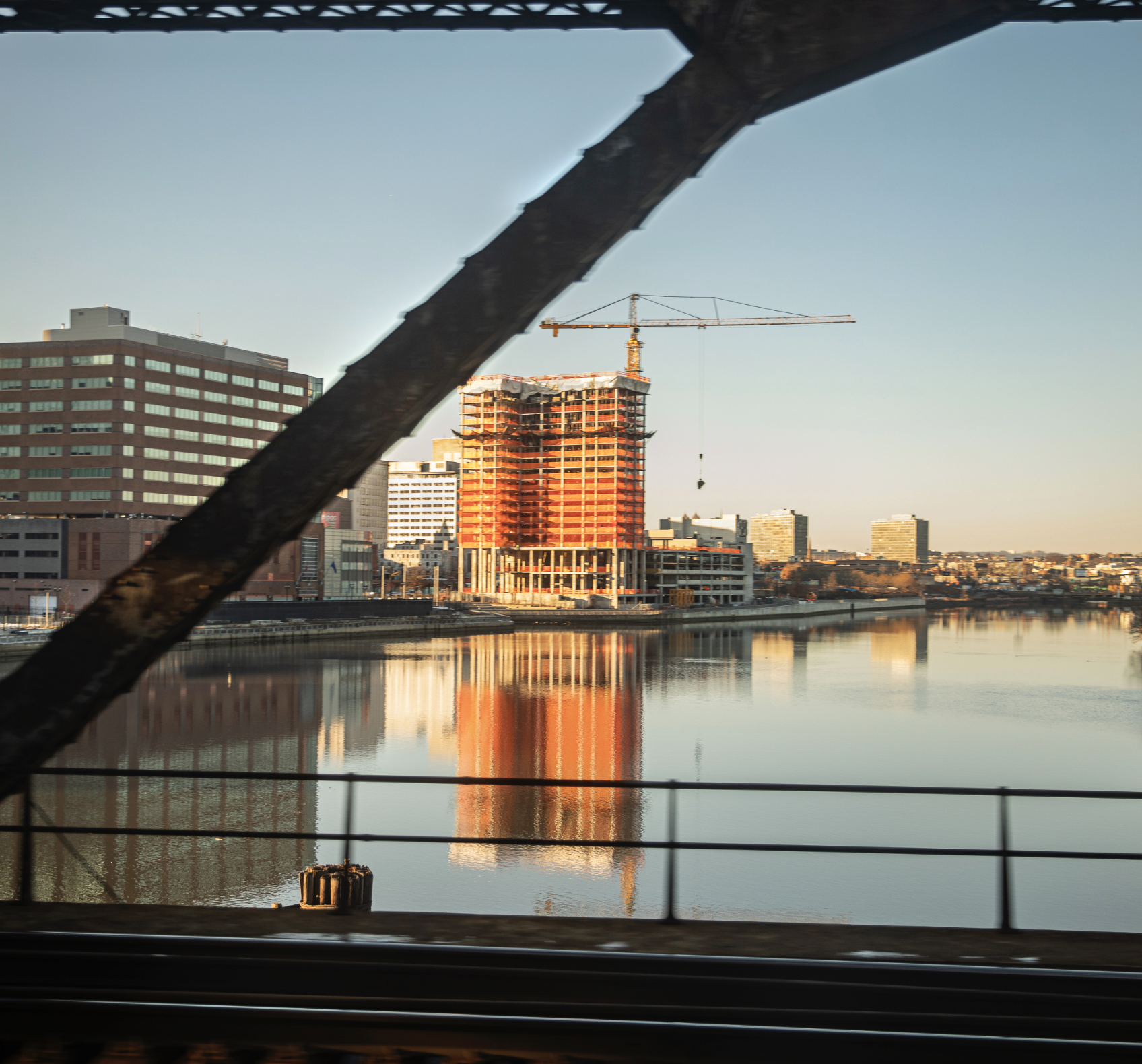
At Second Street, the three largest photographs in “Passenger” are images of bridges. For Evans, these structures are potent symbols of progress, innovation, and connection, integral components of the network of transportation and industry linking us all. Bridges are one of the things Evans “collects,” repeatedly photographing them, along with power lines, intersections, water towers, monuments, industrial clouds, and above-ground pools, all of which appeal for how they look and what they represent.
Riding the Northeast Regional, you pass through farmland, industrial swaths, residential areas, urban centers. You see fleeting glimpses of lives lived, and because trains aren’t routed near fancy neighborhoods, poverty. A series of what Evans refers to as visual poems reveals moments of interest along the route—like the stark white Virgin Mary frozen in focus in a shabby cemetery, or a backyard covered in beach umbrellas for a celebration, or the atmospheric image of the deer stand in a stretch of misty woods, which catches both speed—the blurry trees—and stillness embodied in the sharply defined aluminum ladder.
There are spots Evans photographs every time she rides the route, like the banana tree in front of a house on Charlottesville’s Albemarle Street, or the Washington Monument. “I love the scene of crossing the Potomac and try and take it every time I go,” she says. “So there are certain photos I anticipate.” But other shots, she takes as they come. As an artist, she embraces the challenges that come with photographing from a train, managing to consistently produce strong compositions despite the fact she has only a fraction of a second to do so. “I can’t control what’s happening outside, or the movement, or the light,” she says. “But I can control what’s happening in the camera and I can control my attention.”
“Often, when we’re passing something and we’re going fast, I have to swing the camera around to catch the shot, causing the image to blur.” Other times, she’s shooting into the sun. What might be considered faults in other photographs, works here, adding layers of experiential authenticity to the images—blurring conveys movement, over-exposure can impart a dreamy, nostalgic quality, and reflections speak to the train car that surrounds the photographer.
Evans rarely takes photos of train interiors—the striking image of the scarlet wall and travel poster is an exception—but it makes its presence known in reflections that appear in her shots, as does the occasional person, or their reflection. These remind us of the experience of being in the shared space of a train car, surrounded by strangers, all on different journeys that encompass the full range of human emotion and experience.
In one photograph of the Washington Monument, Evans pulls off the neat trick of capturing the parallel realities of the inside and outside of the train simultaneously through the use of reflection. She also uses reflections like visual flourishes. You see this in the sunset shot where the luggage rack and its ambient lighting parallels the band of rosy light on the horizon.
Over the years, Evans has compiled a substantial collection of train images. Inspired by her job as senior digital imaging specialist and project coordinator at UVA’s Shannon Library, she began to crave a proper organizational system and has set to work assembling her archive.
Working with the UVA Scholars’ Lab, she’s also produced an interactive ArcGIS map, accessible through the gallery. It not only tells you the location of each of her 998 train images, but also things like season and route.
“It’s hard to say what it is that the train gives me and it’s hard for me to articulate exactly why I’m doing it,” says Evans. “It’s something that’s grounded me over the years. I’ll go off and do other things, but then I always come back.”