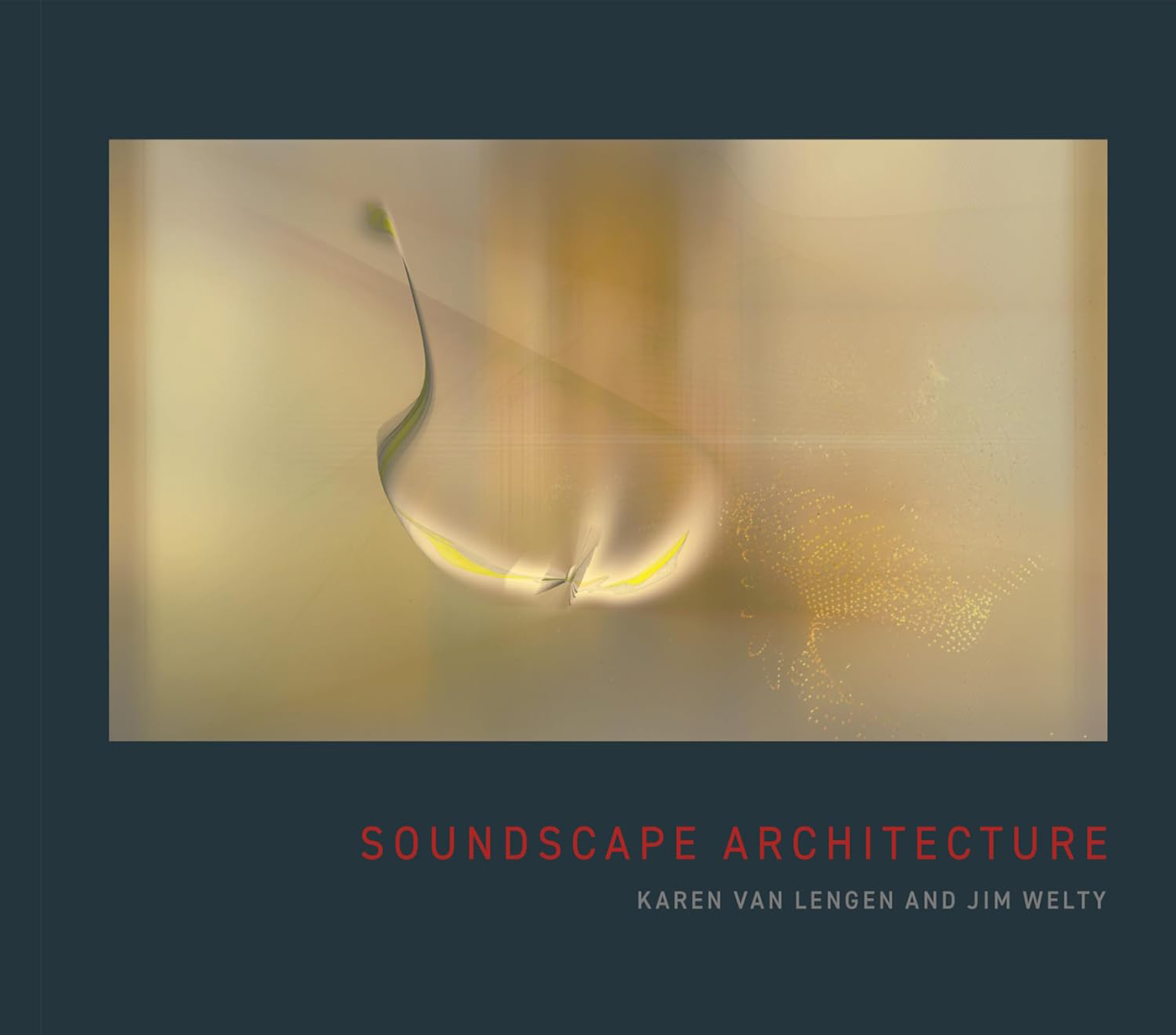
Soundscape Architecture, a new book co-authored by former UVA School of Architecture Dean Karen Van Lengen, explores how architecture and art can enhance listening as a social and political act. “When we listen, we begin the first act of engagement and communication with others,” writes Van Lengen. “Listening is also critical when we consider our local natural habitats, and it can remind us, in a particularly visceral way, of the fragility of our lived environments, increasingly stressed by climate change. We ask, therefore, how the act of intentional listening can prompt us to engage more fully in the world and with the people in it; and how architecture and urban design can encourage this type of engagement.”
The book features Van Lengen’s own writing and collaborative work, as well as installations and work by others. Van Lengen recently spoke to C-VILLE about Soundscape Architecture, co-authored with her partner, Jim Welty, and designed by their daughter, Kiri Van Lengen-Welty.
C-VILLE: In the book, you write about the “songs of architecture.” For those new to your work, how long have soundscapes and the acoustics of place been a focus and how did you center that within your architectural practice?
Karen Van Lengen: I have long been attentive to the sounds that inhabit spaces. They are the sonic architectures that enhance the visible ones. For example, when I think of my childhood home, I remember it not only in images and spaces but also as a sequence of sounds, layered and precise, that are preserved in my memory.
Sound, as a design factor, entered my architectural practice during the Amerika-Gedenkbibliothek International design competition, which I won in 1990. This was an invited competition to create proposals for a 150,000-square-foot addition to West Berlin’s main public library.
In my first studies of the site, I observed the original library from the cemetery across the street, a pocket of stillness south of the city’s historic southern gate. Guided by that peaceful landscape, in my design I oriented the principal reading room toward the cemetery, assuming silence would follow the view. It was only later, through the acoustician’s analysis, that I learned how the street between the two would act as a conduit for noise. That discovery clarified an essential aspect of architectural analysis; for any site one should consider not only visual attributes such as light, geography, and context, but also clearly understand the sounds that penetrate and activate the site. Sound—elusive, migratory, and persistent—must be understood as carefully as the visual forms we typically emphasize in the design process.
Reflecting on the activation of public spaces through art and architecture, you write, “Sound has the emotive potential to invite us to feel a place, a memory, or an event in a new way.” Connecting this with your work in spaces on UVA Grounds, how do you think your sonic inquiries open up possibilities for renegotiating or reinterpreting local historic spaces?

Our family lived in Pavilion IX on the Lawn for 10 years, and it is the memory of the sounds of the garden gates, their openings and closings, that is most present for Jim and me.
These sounds, simple as they may seem, are imbued with meanings that extend far beyond their literal nature. The gates, in their perpetual rhythm, speak of an openness, a kind of invitation to visit and participate in the Academical Village. Their sounds remind us of the many visitors and participants that energize the heart of this university.
But beyond this, the gate sounds, diverse and unique, form a soundtrack of these spaces where engagement is inevitable. This is an architecture of unintended encounters, of listening—not just to words, but to the very atmosphere of the place. It is as though the buildings themselves conspire in this act of openness, allowing us to hear the presence of others sometimes before we even see them. These sounds do not offer a precise historical narrative; they do not tell us the complex story of the university’s origins in the way an archive might. Instead, they evoke something more subtle—an impulse to learn, to question, to imagine what has been. And in this, there is an inextricable link between the present and the past, a continuous echo of all that came before, whispering through the spaces we now inhabit while allowing us to dream of our futures, separately and together.
The book closes with a selection of digital paintings created from sonic engagements, accompanied by text about this being, “the final chapter of our exploration.” What’s next for you?
Jim and I have been working on this Soundscape Architecture project for many years and plan to continue developing it and expanding to new spaces. Currently, we are making new animations related to Central Park, in New York City. Matt Wyatt, a local musician and composer, worked with us to produce the sonic composition for this part of the project, using a hybrid of my recorded sounds and his musical interventions. This is a new process for us as we explore the soundscape, not only as recorded information but also as a musical interpretation of those recordings.
Karen Van Lengen (pictured) and Jim Welty will discuss Soundscape Architecture at New Dominion Bookshop on January 16.
Sound—elusive, migratory, and persistent—must be understood as carefully as the visual forms we typically emphasize in the design process.