LV Collective
When Charlottesville City Council adopted a new zoning code in late 2023, it wanted to help developers make it easier to build new places to live. The city’s Department of Neighborhood Development Services is moving forward with changes designed to further that goal.
“We’re jumping into 2026 with lessons learned, and to try to move things quicker,” said Matt Alfele, development planning manager for NDS.
After taking feedback from developers last year, NDS has recommended dozens of changes at three different levels. At a public hearing before the Planning Commission on January 13, Alfele likened the process to taking your car in for service.
“Tier 1 is washing the car,” Alfele said. “Tier 2 is changing the oil, rotating the tires. Tier 3 is the car is making an awful noise and needs a new transmission.”
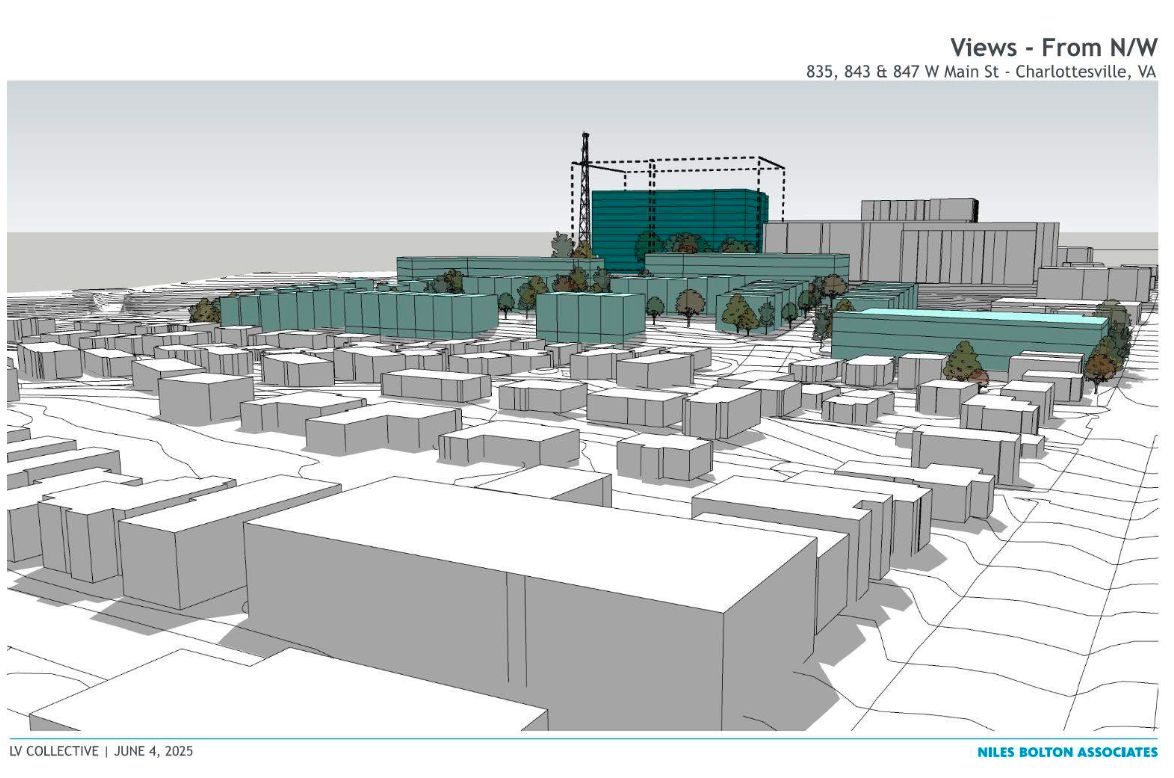
Tier 3 changes, for example, could include a review of whether the city’s zoning code should be altered to restrict development in some areas. The Public Housing Association of Residents and other groups want Council to once again be able to set conditions for large apartment buildings, such as one planned for 843 W. Main St. and another on Seventh Street SW in Fifeville.
An in-house study of those changes will begin later this winter and into the spring, and will be informed by a work session City Council held on January 20. NDS is reviewing the rules for affordability and whether there should be specific places for student housing.
“Looking at the Affordable Dwelling Unit manual and this question of student housing actually really does represent a Tier 3 study that we have determined was appropriate to bring forward as a priority on our work plan,” said Kellie Brown, the NDS director.
One of the Tier 1 amendments more clearly states that the Planning Commission gets to review special exception permits, which can be sought for changes to technical requirements such as setbacks. Council has the final say, and Planning Commission Chair Carl Schwarz said special exceptions introduce uncertainty and can take months to process.
“I don’t know if there’s some way that some of these things seem so small,” Schwarz said. “Is there another way to make them go faster and not cost as much?”
Alfele said a potential Tier 3 change would streamline the development review process. That might include a review of whether more special exceptions could be handled administratively.
Ross Harness, one of two new appointees to the Planning Commission, said the city should be doing what it can to reduce the burden on developers.
“Three or four or five months doesn’t seem like a long time in the general scheme of things, but it really does have an impact when you’re thinking about building and potentially taking out loans,” Harness said.
The Planning Commission endorsed 63 Tier 1 amendments and 23 Tier 2 changes after the January 13 hearing.
“These are addressing copy edits, scrivener’s errors, legislative updates, and small changes,” said Alfele. “This is to provide clarity, to remove some misunderstandings, and just to provide small changes that do not require much in the way of community engagement.”
The Public Housing Association of Residents and other groups want City Council to once again be able to set conditions for large apartment buildings, such as the one from developer LV Collective at 843 W. Main St.