This project started with a vision one couple had of living in the midst of the landscape they love. Once they discovered the perfect spot, the adventure of making that vision come to life began.
In 2017 they found about 20 acres in southern Albemarle County that had been left in pasture, close (but not too close) to Charlottesville. To begin the process of making their vision a reality, the couple hired landscape architect Anna Boeschenstein, owner and principal of Grounded, who started by planting a mix of native trees and understory plants along the road bordering the property to provide privacy and reduce noise.
Facing a blank slate, the couple wanted the home they envisioned to have a cohesive integrated feel. So they enlisted Julie Kline Dixon and Keith Scott, partners at Rosney Co. Architects, and Anne Hulcher Tollett, owner and principal designer of Hanover Avenue in Richmond, to work as a team with them and Boeschenstein.
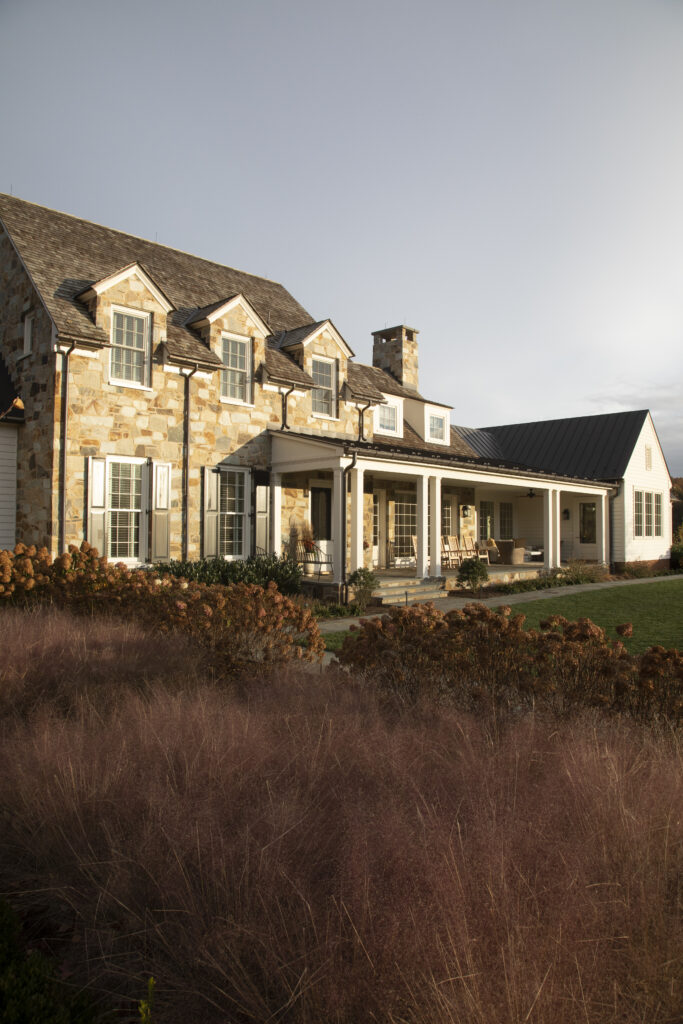
“The clients asked us to design a classic farmhouse that had an easy connection to its setting,” says Scott. “They wanted a fairly modestly sized home, and asked us to use materials that would endure our local climate and age gracefully—a home that looks like it could have been on the site for 100 years.”
Rather than putting the house on a high point, Dixon and Scott suggested a site on the side of a knoll, facing southwest toward a saddle between two mountains. As a result, the home nestles into the slope; the cut that carves out the walled parking court at the house’s entrance provided fill for the curved plinth lawn facing the mountains. Its placement also offers privacy from the road, Scott notes, and “the house gradually reveals itself” as you drive in.

All materials were chosen to fit and enhance the landscape. Stone walls line the courtyard’s garden border and the plinth lawn (raised to a height of 30 inches, so as not to require a visually intrusive railing). The house is constructed of fieldstone and clapboard, with cedar shingles on the fieldstone sections. The porch along the plinth lawn is paved in local bluestone, also used for the entry porch, and the parking courtyard is paved in tan quartz gravel bordered by a cobbled curb and apron of granite.
The couple specifically asked Rosney to make the house one room wide, with windows on both sides making the most of the light and views. “This creates a connection to the surroundings as the light changes throughout the day, not only on a daily basis but seasonally as well,” says Scott. “We also fine-tuned the orientation of the house so that the main living rooms (primary bedroom, living room, dining room, and kitchen) all have the best views.”

The southern end of the house has two areas side by side, the library/office and the outdoor dining porch. At that point, the layout makes a 90-degree turn for the mudroom and a breezeway to the connected garage. This makes the house’s footprint more compact, and creates the main-house-with-outbuildings feel of a country farmhouse.
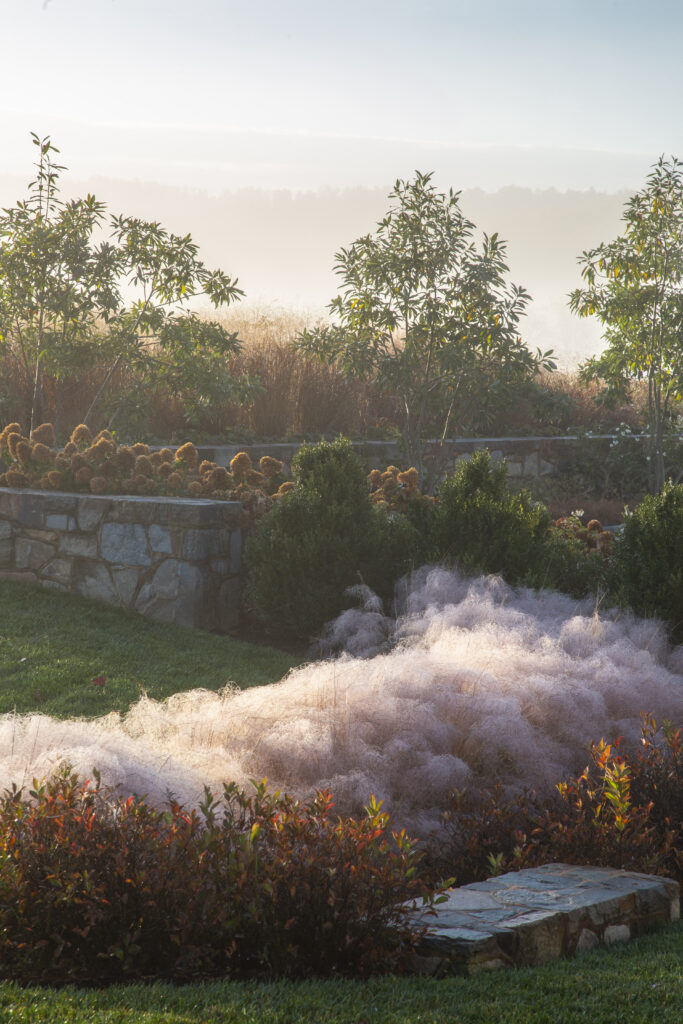
The entry drive, bordered by a line of sugar maples on one side and a mix of native trees on the other, passes a rain garden in a swale next to the parking court. The court’s low fieldstone wall shelters beds of bulbs, flowering shrubs, ornamental grasses, and sweetbay magnolia, providing changing seasonal color as well as a visual transition to the meadow beyond.
The house itself is surrounded by gardens that are tied to, and intersect with, the living spaces of the home. This was part of the original concept.
“The clients’ vision was very landscape-driven,” says interior designer Tollet. “The grounds are beautiful in all four seasons, so we really focused on the changing light and seasons. The primary bedroom is a winter season, sunset on snow; the central rooms, the living and dining spaces, are spring and summer, while the kitchen and library end are geared to fall.”
But a farmhouse ethos didn’t mean old. “This client doesn’t particularly like antiques or old-fashioned,” says Tollett. “They wanted classic, timeless pieces, but also chose a lot of contemporary art and Virginia artists.”
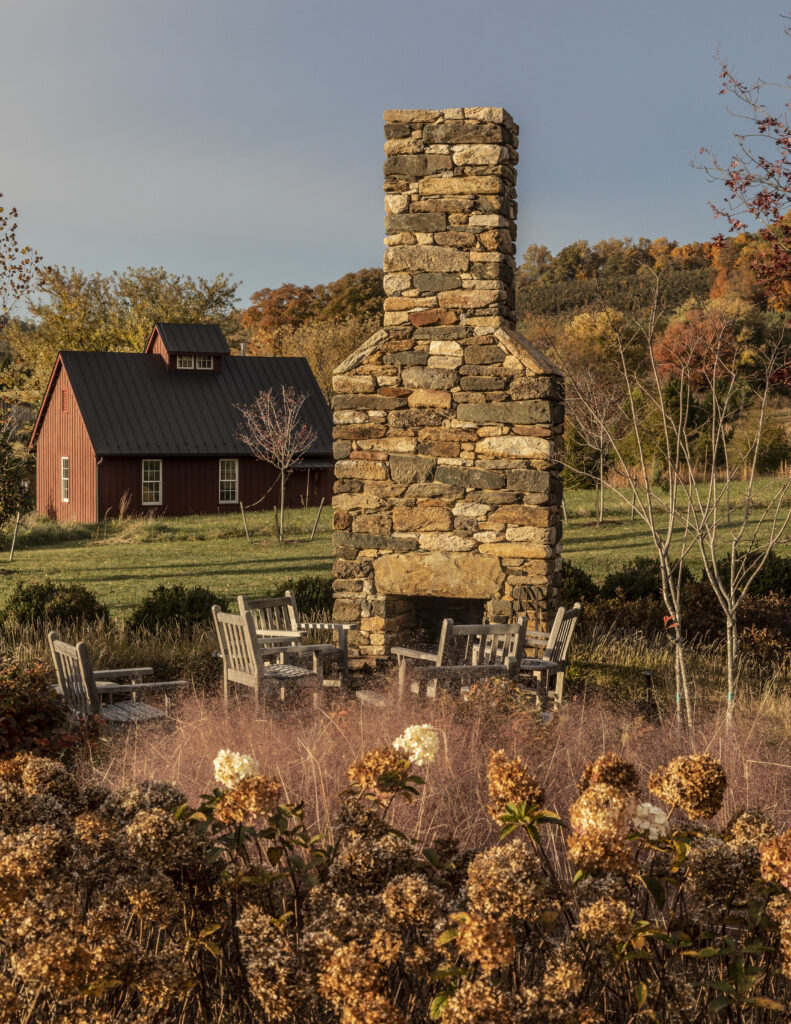
The primary suite overlooks the firepit garden built around a chimney salvaged from one of the deserted cabins scattered through these mountains (Boeschenstein found it on Craigslist). The client collects old millstones, notes Boeschenstein, one of which is embedded in the brick-paved seating area in front of the outdoor fireplace, surrounded by beds of leatherleaf viburnum, sweetspire, little lime hydrangea, fothergilla, and boxwood.
Through these beds, a brick walkway leads to the plinth lawn, bordered at both ends by rectangular “pocket gardens” where liriope, pink muhly grass, laurel, inkberry and prairie dropseed are enclosed by hydrangea borders. The plinth lawn itself is bordered by a bluestone walkway, with steps leading up to the porch off the living and dining rooms, with full-story windows allowing both rooms light, air, and tremendous sunset views.
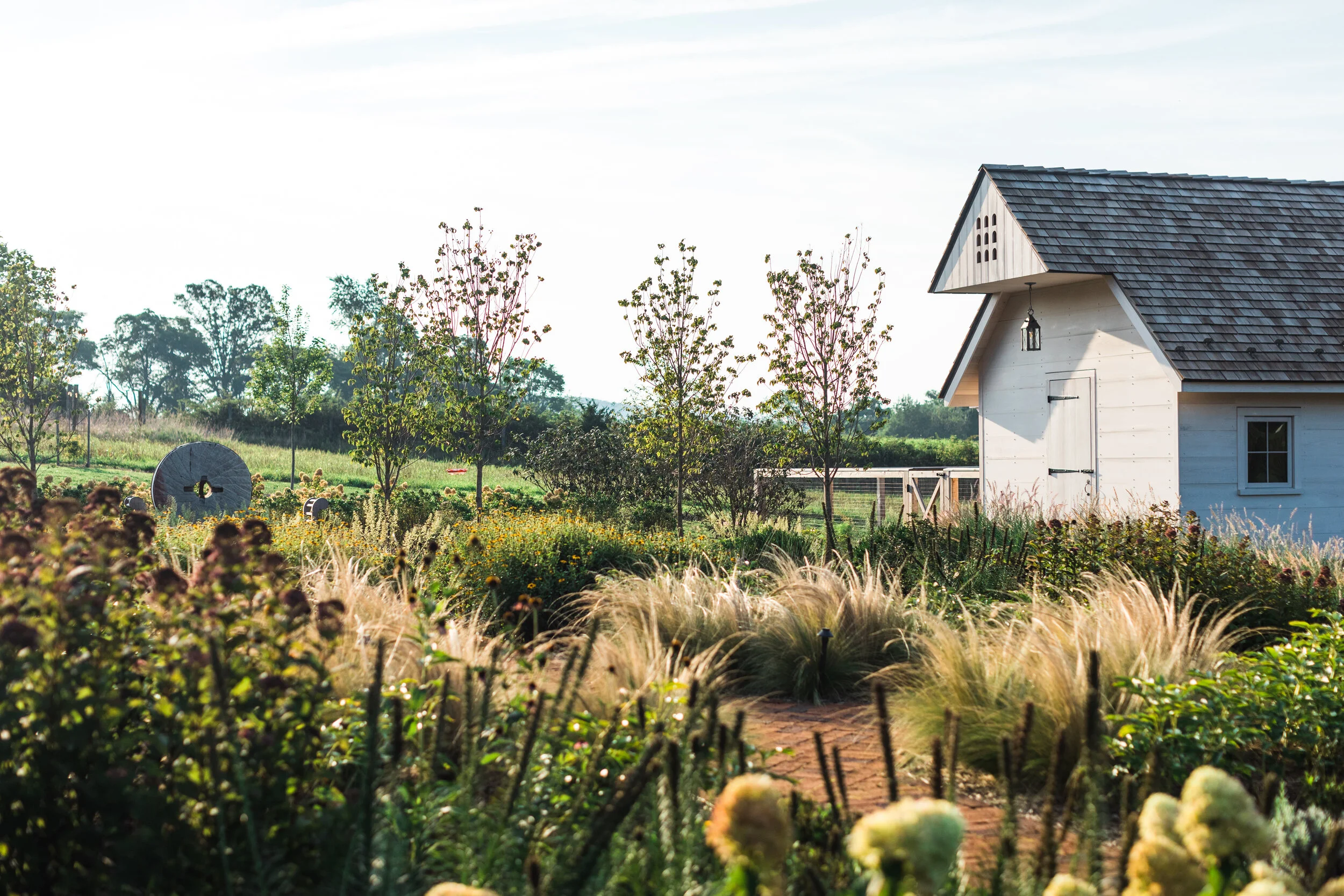
At the house’s other end, the dining porch overlooks the fountain garden—two millstones placed horizontally as a water feature in the center of a circular lawn surrounded by a border of flowers and shrubs. The fountain is one end of an axis that runs across the end of the house to another millstone placed vertically as a sculptural feature. The clients specifically asked for a cutting garden that would work through three seasons, so these beds feature black-eyed Susan, Joe Pye weed, Russian sage, peonies, two kinds of coreopsis, blue ice amsonia, and two types of echinacea as well as Mexican feather grass and fountain grass.
Stepped down on the south side of the flower garden is the vegetable patch—less decorative, but still important. On its east side is a small outbuilding that combines potting shed and dog kennel. (“The clients never got a dog, but we still call it the doggie cottage,” Boeschenstein says with a smile.)
As if on cue, resident long-haired ginger cat Tucker comes striding down the brick path, right on axis with the sun behind him, ready for his photo shoot.

Serving the land
This couple wants both their house and their land to last. They worked with James River Consortium to plant a riparian buffer along the creek running along their property, and have used trees and branches removed from nearby construction sites to build brush piles (habitat for bugs, insects, and snakes as well as safe havens for small critters).
One partner is a devoted gardener, and Boeschenstein recalls him saying, “I want to spend every day outside.” In addition to the flowers, vegetables and maintenance, he is also working on two restorative projects.
On four acres at the back of the property, he’s started a traditional forestation project: about 1,200 seedlings of a variety of native trees. These are in their fifth or sixth growing season and “doing quite well,” he reports.
On a quarter-acre plot near the barn, he’s trying to restore a section of Piedmont savanna—which used to cover much of this region in pre-colonial times. “People think this area used to be all forest,” he says, “but really there were all these pockets of tall grass prairie.” To help bring back that mix requires intensive soil preparation for about 18 months before densely planting a mix of understory, midstory, and overstory species—“The idea is to really accelerate the progression.” Planting the various layers simultaneously also encourages the return and flourishing of the wildlife mix that makes for a healthy ecosystem: bugs, beetles, insects, pollinators, birds, and small rodents.
“It’s an experiment in motion,” he says. “Some things will work, and some will fail. Five to 10 years from now, we’ll know. I’m trying to work with the land.”