One of the reasons so many of us love this area is that in times of reflection or stress, through every season, the beauty, the wonder, and the solace of nature is freely available to everyone.
Or is it?
Examining that question has spurred efforts to make natural and recreational sites more accessible to those with mobility issues and other challenges. It has also motivated volunteers in this area to ensure our beautiful natural environment is truly available to all.
One national effort began a decade ago with the work of a Texas birder named Virginia Rose. A wheelchair user since youth, due to a riding accident, Rose developed an enthusiasm for birding in middle age. But she found it challenging to find sites that were wheelchair accessible—and noticed how few disabled birders were out there.
Rose began collecting information on the accessibility of birding sites, not just for those in wheelchairs but for people with other mobility issues. At a National Audubon Society conference, she gave a presentation on her efforts to create an online resource of accessibility information about Texas birding sites. Her idea struck a chord with Audubon, and among other birders, and, in 2021, a national nonprofit called Birdability was launched.
Birdability aims to improve the physical accessibility of birding sites, empower an inclusive birding community, and introduce people with access challenges to birding. Its main project is the Birdability Map, a crowdsourced compilation of accessibility information about birding sites across the country (the online map was built and is maintained by the Audubon GIS team).
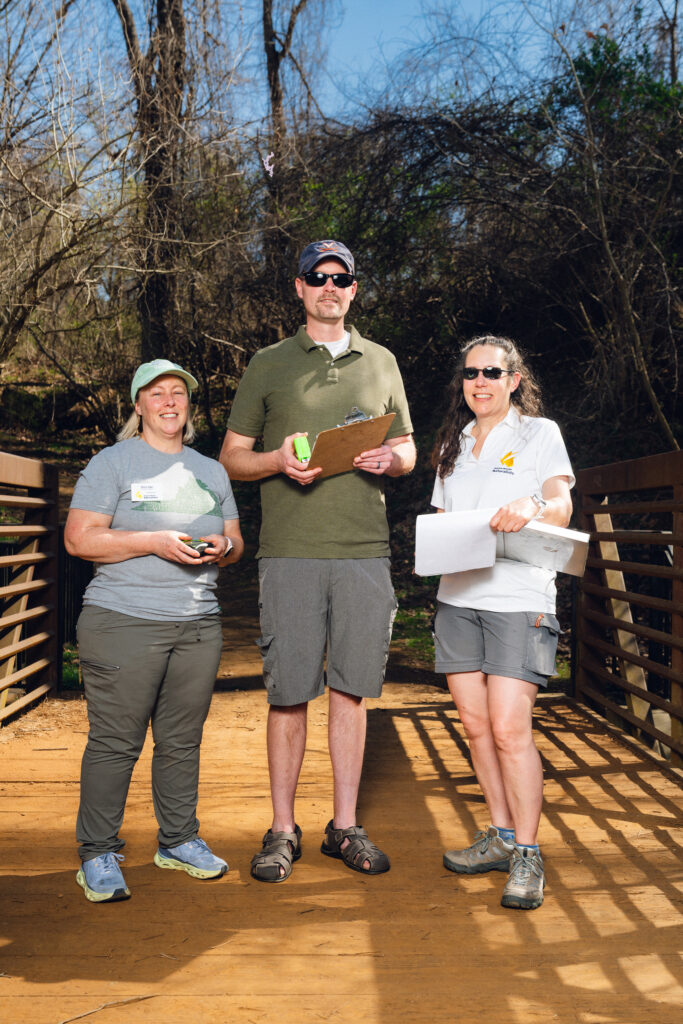
Cat Fribley, Birdability’s executive director, knows the accessibility challenge firsthand. She began birding in college as a way of healing after a PTSD diagnosis; later, a series of injuries and illnesses limited her mobility. She notes that Birdability did a survey in its formative years, asking people what made a natural space accessible. The findings weren’t just about walkways or steps, but also factors like bathrooms, water fountains, seating—“things not necessarily mandated by the Americans with Disabilities Act,” Fribley notes. “If you include [factors] for people over age 65 and under age 5, that’s a large portion of our society.”
In the meantime, the Virginia Department of Wildlife Resources had been looking at ways to make the state’s natural areas more accessible. For years, DWR worked with Virginia Master Naturalists (as one of its sponsoring agencies) on an effort called Adopt-a-Trail, with volunteers documenting wildlife and reporting any issues at parks and trails across the state. With DWR’s desire to expand access to these sites, the Birdability concept—making accessibility information available on a central website—fit right in.
In October 2024, DWR staff and Michelle Prysby, Virginia Master Naturalists program director, held a training session for master naturalist volunteers. The objective was to begin collecting accessibility information at the sites on the Virginia Bird & Wildlife Trail, a collection of state, county, and municipal parks; nonprofit natural areas; and private lands that DWR’s Watchable Wildlife Program had been developing and promoting for both conservation and tourism. “Virginia was one of the first states in the U.S. to have a statewide wildlife viewing, not just birding, trail and it served as the model for many others,” says Lisa Mease, a Watchable Wildlife technician. The VBWT now comprises more than 600 sites statewide; 194 are in the Piedmont region, which includes the Charlottesville/Albemarle area.
The master naturalists volunteers use Birdability’s site questionnaire, based on the broadest definition of “access”: What might represent a barrier to potential visitors? This includes those who have mobility challenges, impaired vision, hearing issues, chronic illness, intellectual or developmental disabilities, mental illness, or are neurodivergent. Other considerations—like lack of transportation, financial barriers, discrimination, and safety concerns—also interfere with people’s ability to spend time outside. Mease notes that the volunteers do not make a judgment about the sites’ suitability for any particular visitor. Instead, all the information collected is uploaded to both the Birdability map and the VBWT website, so users can make an informed decision based on their own needs.
Just a sampling of the information collected on the Birdability Site Assessment checklist:
Is the site on a public transit route? Is there free parking (and are there handicapped parking spaces)? Is there an entrance fee for the site?
Are there restrooms? Are they handicapped accessible? Are there water fountains? Are they accessible (e.g., how high are they)?
Are the paths paved, gravel, or dirt? Are they level or sloped? Are there steps? How are the trails marked (colored badges, notches, tactile signs)? Are there bridges, and if so, do they have railings for safety?
Are there areas of shade? Are there benches? Are there pull-outs or set-aside areas in spots where visitors can stop and observe birds or wildlife easily?
Are there informational signs? How high? Is there signage in Braille? Are there audio guides?
Are the trails open to other users (e.g., cyclists, horses, ATVs)? Are dogs allowed, and are they required to be leashed?
How busy is the site, and at what times of day/year? If it’s a park, is it also used for sports events/large groups?
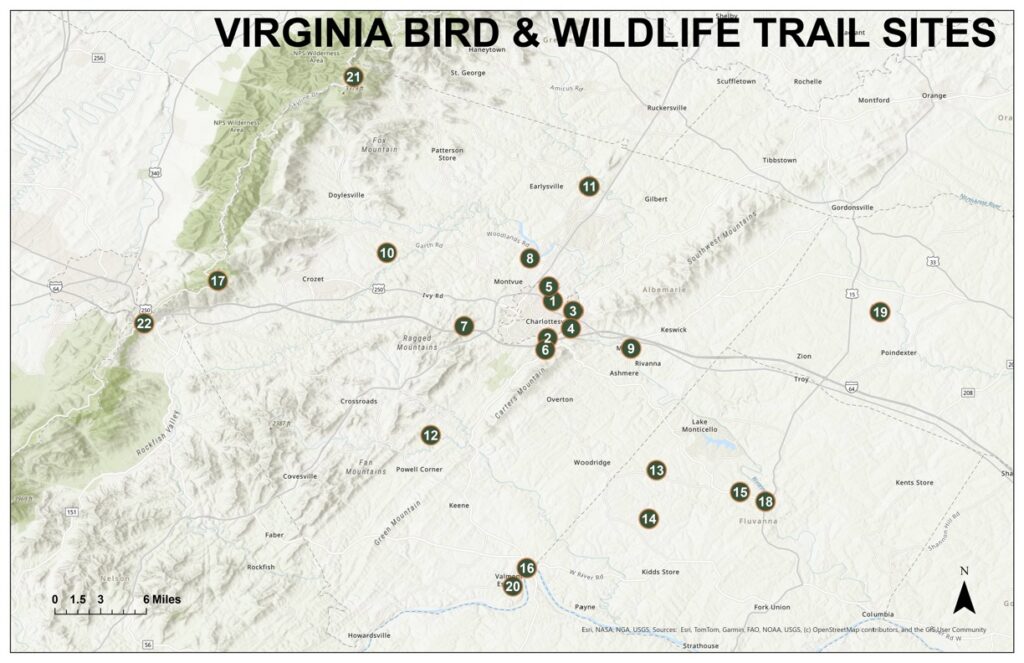
For each master naturalist chapter, one member serves as the VBWT-Birdability coordinator to make sure there isn’t duplication on who will assess which site. Prysby, based in Charlottesville, belongs to the Rivanna chapter and has done assessments for several local sites, including Greenbrier Park. “I go to that park all the time, so I’m familiar with it,” she says. “Doing the assessment took me much longer than I expected, and made me so much more aware [of potential barriers.] Greenbrier is a small park, but it has three trails and there’s a different surface on each trail.”
RMN member Stacy Agar feels this program is important because “nature should be available to everybody. You might think it’s about wheelchairs and crutches, but what if you have [digestive issues] and need to be near a bathroom?” She did her first assessment at Scottsville’s Dorrier Park, a small community space with a playground, ball fields, a picnic area, and a farmers’ market. Her conclusion: “Would I go birding there? No, but this [program] is 100 percent about providing information. There are people in our community who would love to get outside and need to know [if they can].”
Andrew Sell, another new RMN member, was part of the master naturalists when he lived in Minnesota. “I’ve always loved birds and birding,” he says. “I like this program because of its impact on mobility and accessibility. You can check out the maps and make an informed decision, and also go see some cool new places.” He’s conducted an assessment at Lake Albemarle (“It’s near me but I’d never been there!”) and the main Saunders-Monticello Trail. Next, he plans to assess the Nature Conservancy’s Fortune’s Cove preserve in Lovingston and the Botanical Garden of the Piedmont, one of the newest additions to the VBWT.
Virginia Masterson developed an interest in accessibility issues through her work with the chapter’s diversity outreach efforts, now part of a statewide master naturalists initiative called Nature for All. She began organizing a group of volunteers for a birding walk for those with mobility challenges “or [people] who just don’t feel comfortable outdoors.” Their first walk, with 12 participants and 12 volunteers, was held at Riverview Park in October 2024. In November, she led another event for participants from JABA’s elder care group. “I did it as a birding, but basically we’d share our experiences with nature,” Masterson says. Last year, her group did two more events, one at Riverview Park and one at Old Trail in Crozet.
For her birding walks, Masterson also tries to recruit volunteers from the Piedmont Virginia Bird and Young Birders clubs to provide added expertise. But she emphasizes that participants shouldn’t feel reluctant to come along if they don’t know a thing about birds, or nature; something she’s discovered from being with the master naturalists, she says, is that “we are all learners.”
The idea behind the VBWT-Birdability effort is a simple one: Know before you go. “For people with disabilities or other accessibility challenges, lack of accurate information is a major barrier to wildlife viewing away from home,” says Mease. “But the information in a site review, like trail surface types or the presence of bathrooms, is useful for everyone, not just people with disabilities.”
And with hundreds of VBWT sites still to be assessed, she adds, “We honestly couldn’t do it without these volunteers! They are an integral part of DWR’s mission to connect, protect, and conserve Virginia’s wildlife and outdoor spaces.”
For more information about Birdability, go to birdability.org.
For more information about the Virginia Bird and Wildlife Trail, visit dwr.virginia.gov/vbwt.
To find out whether local master naturalists will be hosting birding events for those with disabilities, go to: vmn-rivanna.org or oldragmasternaturalists.org.
Blind Birder Bird-a-Thon brings nature to the visually impaired
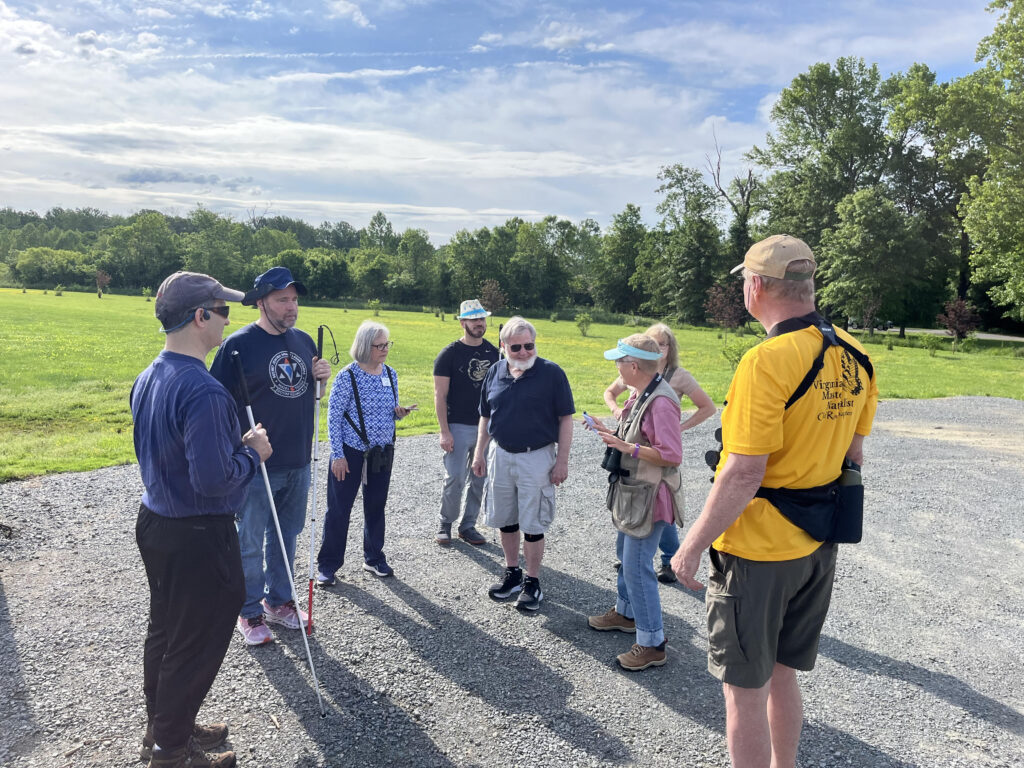
Charlene Uhl, vice president of Old Rag Master Naturalists (which covers the six counties north of Albemarle), grew up on a fruit farm and now lives in rural Madison County. Years ago, in a job working with people with disabilities, she recalls one of her clients saying to her, “Why do people think we’re bad?” That comment and the attitudes it revealed stuck with her, so when she heard about the VBWT-Birdability program, “I thought it was a fantastic idea.”
Working with both Birdability and the National Federation of the Blind of Virginia, ORMN volunteers were trained on the most respectful ways to offer assistance to visually impaired individuals. The chapter chose Lenn Park in Culpeper as a good birding site that was also accessible, and made sure to have a one-to-one ratio of volunteers to guests.
“All our volunteers were experienced birders,” Uhl says, “but we had to learn another way to communicate.” How do you describe a male cardinal to a person who has never seen red? Or explain the difference between a blue jay and a house finch to someone who can only judge size with their hands?
“It was a really special thing,” she remembers. “The people we took out had never been birding. We taught them to use Merlin [the Cornell University Lab of Ornithology app that identifies birds by their calls].” The president of the National Federation of the Blind of Virginia was astonished, she says; “He told me, ‘I’ve been around birds all my life, and I didn’t know what was there.’”
Last May, Uhl and her colleagues organized the Old Rag chapter’s participation in Birdability’s first national Blind Birder Bird-a-thon, designed to “encourage blind and partially sighted birders of any age, experience, or location to head outdoors, tune in, and celebrate the sounds and songs that make birding such a powerful practice of connection,” according to the Birdability website. Participants can identify species visually or aurally, alone or as part of a group, anywhere. “We got so much out of [the experience],” says Uhl, that her chapter is hoping to participate again this May in the second annual Blind Birder Bird-a-thon.
The Virginia Master Naturalists awarded ORMN its 2025 Nature For All Award.