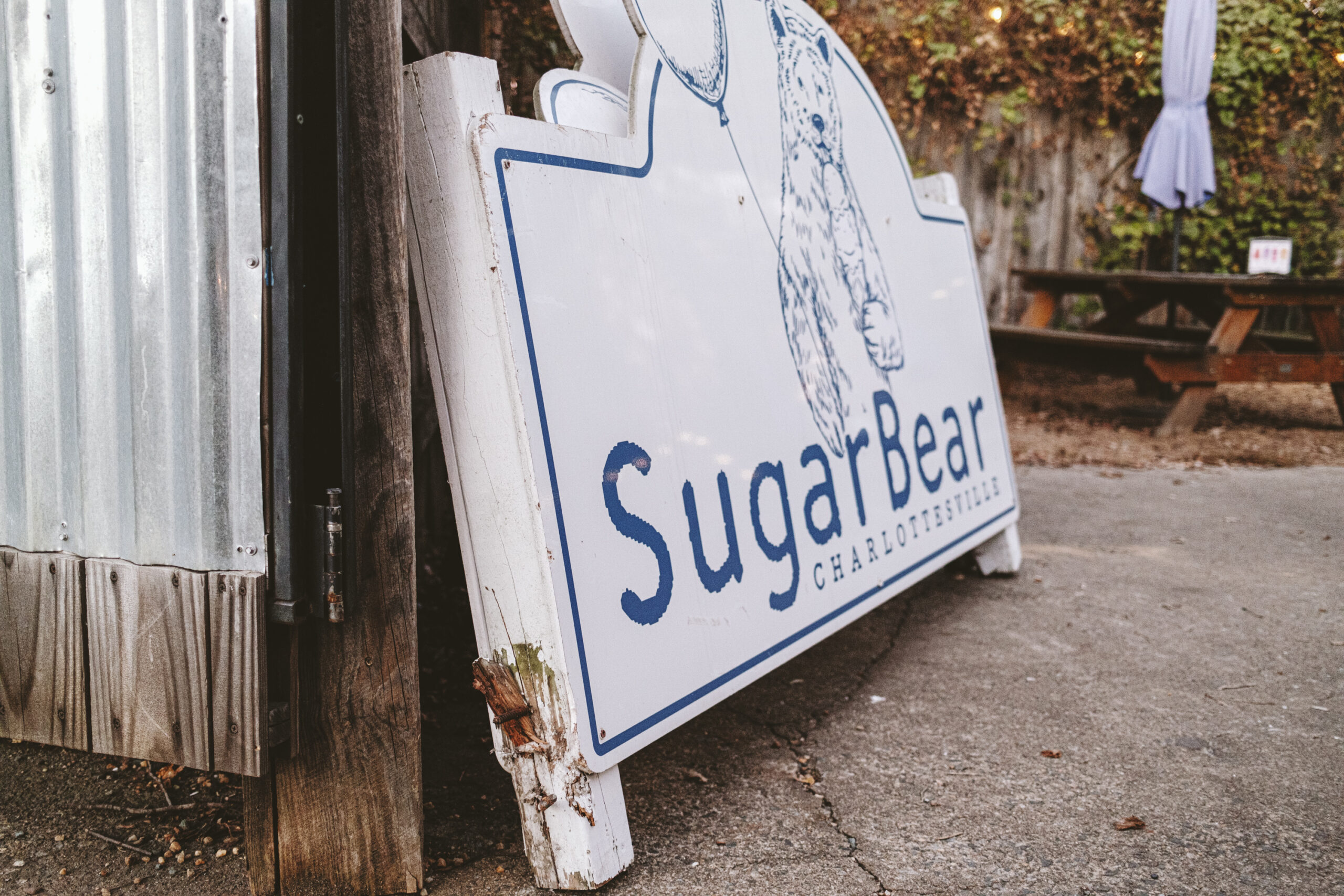
SugarBear owner Emily Harpster posted an online petition calling for safety improvements around the East High Street corridor. Photo by Eze Amos
Eight years after a pickup truck ran off the road and fatally pinned a 54-year-old Louisa man between two cars in the Jak ’n Jil parking lot, accidents continue to plague the East High Street corridor. On the morning of November 9, a traffic accident destroyed the wooden sign in front of SugarBear Gourmet Ice Cream at 1522 E. High St. Fortunately, no one was harmed.
“I have seen too many incidents,” says SugarBear owner Emily Harpster. “This one was too close for comfort and the last straw, and it could have been a lot worse.”
In 2022, Dwight Corle of Charlottesville Glass & Mirror spoke out about the safety issues on East High Street, and started a petition that collected dozens of signatures. Harpster’s own online petition, posted on November 11, had 221 signatures at press time. Both petitioners cite the 2018 fatality at Jak ’n Jil as one of many tragedies and close calls that spurred them to action.
“I don’t want to wait for the worst-case scenario to happen,” Harpster says. “I want to do everything I can to prevent it, and I know many others feel the same way.”.
Ben Chambers, transportation planning manager for the City of Charlottesville, appears to agree.
“VDOT data indicates that this section of East High is one of the state’s top road segments with potential for safety improvements, which is based on analysis of crashes over the past five years,” Chambers says. “The East High Street corridor was in the highest tier of roads in the region in terms of number of crashes resulting in severe injuries and fatalities.”
Harpster says the community is frustrated with the city’s perceived lack of action, despite what seems like an obvious need for improvements.“Multiple people have told me that traffic studies have already been conducted, that solutions have been identified, and that community members have been advocating for improvements for years,” she says. “I’m not interested in assigning blame, but I am someone who is on the front lines of this issue every day and feel an obligation to speak up—loudly and repeatedly, if necessary.”
But staffing and interdepartmental communication in city government could be putting the brakes on a potential fix. In a Charlottesville Bicycle and Pedestrian Advisory Committee meeting on November 8, Bike and Pedestrian Coordinator Tommy Safranek said that previous city engineers had taken steps to streamline the traffic-calming request process, but that when these engineers left their positions with the city, these incomplete measures had “been shelved.”
Charlottesville Planning Commission member Josh Carp said this was “news to [him].”
“The traffic-calming request process was being rewritten, but that has stopped,” Safranek said. “That means the old process still exists, so I encourage people to fill out a petition.”
Harpster says the traffic safety issue affects where consumers go to spend their money, which in turn affects the local economy.
“If people don’t feel safe, they won’t use a space,” she says. “What the data doesn’t capture are people who don’t use this space because it feels incredibly unsafe.”
The city might finally be prepared to fix High Street. Chambers says he and city planners and engineers aren’t waiting for a petition to get to work.
“The city will continue to roll out traffic safety improvements, including the lane definition quick build project that was identified by the Bicycle & Pedestrian Advisory Committee,” Chambers says. “Public Works is scheduling the implementation of the demonstration project that changes the signalization of East High at the Meade Avenue and Stewart Street intersections, which was approved by City Council in 2025 with the adoption of the Move Safely Blue Ridge regional safety action plan.”
In her petition, Harpster requests additional speed enforcement tools, such as “a speed camera and a driver-facing speed feedback sign near the crosswalk at Willow Drive and East High Street, as previously recommended [by the City of Charlottesville] through the Safe Routes to School program.”
Chambers addressed this request specifically, saying that it is not as simple as putting up a camera. Both the practicality and viability of speed cameras still needs to be assessed, he says; the city’s currently trying out cameras near Charlottesville Middle, Summit Elementary, and Tall Oaks Elementary schools to see whether that monitoring makes drivers slow down. Chambers adds that many of the traffic accidents in this area were related to other factors, and that enforcing traffic laws does not just mean enforcing speeding violations, but also “reckless behaviors, including distracted driving, aggressive driving, and driving under the influence of alcohol or other drugs.”
Harpster’s petition also asks that the city begin these improvements within one week. Without specifying target dates or timelines, Chambers said that help is on the way. Prior to Harpster’s petition, VDOT and the City of Charlottesville had already agreed to include the East High Street corridor in the Strategically Targeted Affordable Roadway Solutions program, researching potential improvements and marshaling state resources to address safety and congestion issues.
Harpster said that her high hopes for the East High Street corridor can only come to fruition once people aren’t scared to travel there.
“Bottom line, I think this stretch of East High can and needs to evolve,” she says. “My business, [along with] Hogwaller Brewing and Rivanna River Company, have all invested tremendous time, money, and effort into transforming this area. There is a real opportunity for Charlottesville to help us develop a vibrant riverfront destination—not just for tourists, but for local families and the broader community.”
Community members interested in signing Harpster’s petition can visit tinyurl.com/3wdz5jw9.