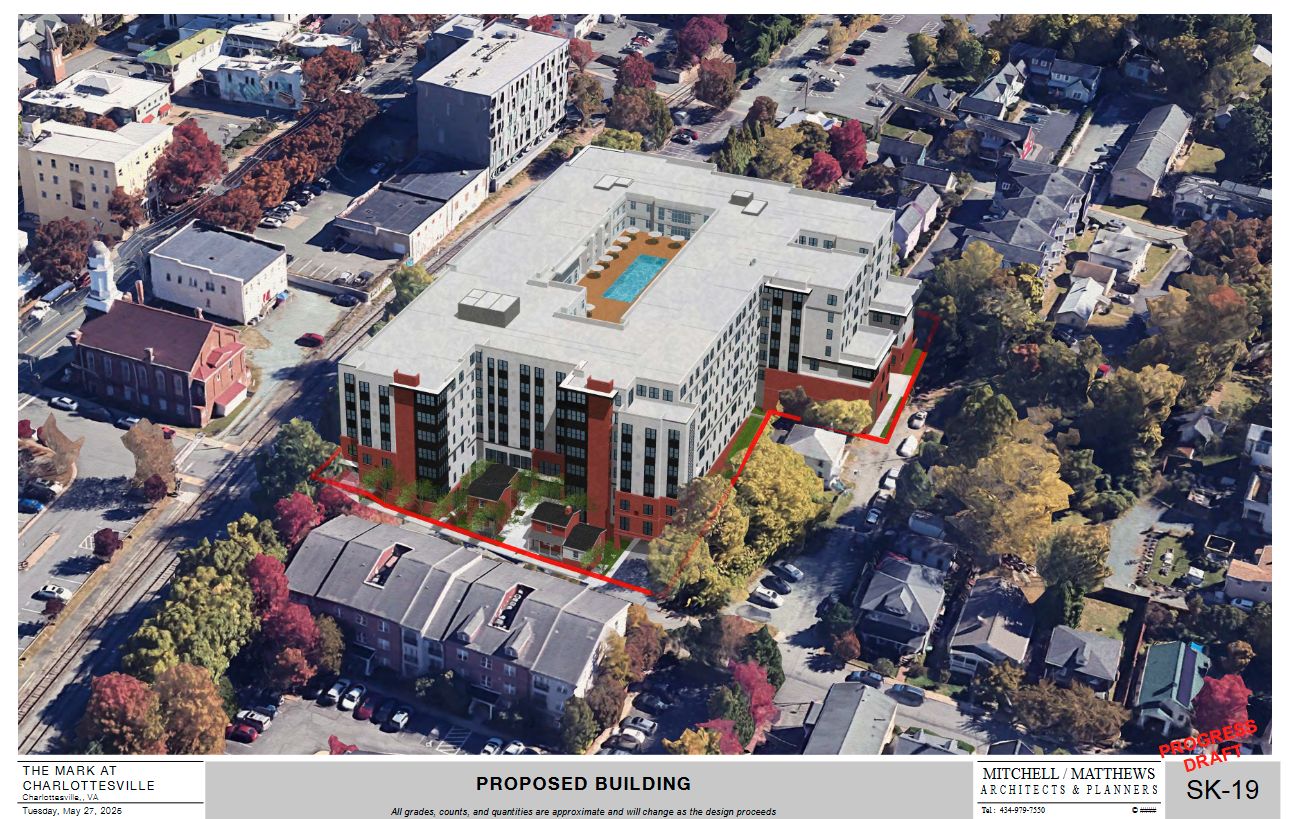
Preliminary plans depict a seven-story building constructed behind two historic houses on Seventh Street SW. Photo: Mitchell Matthews Architects & Planners.
Charlottesville is once again legally in the clear to implement a zoning code that was adopted in December 2023, and was intended to allow developers to build more places to live across the city. But legal clouds remain on the horizon.
In a written opinion published August 22, Circuit Court Judge Claude Worrell reversed a previous ruling of default judgment in a lawsuit where the plaintiffs claim the city did not sufficiently coordinate the new zoning with the Virginia Department of Transportation. That issue will now proceed.
“Defendant need not prove that they are likely to succeed at trial, merely where there is a possibility that there will be success at trial,” Worrell wrote, convinced the city had shown good cause for him to reconsider a June 30 ruling that voided the zoning code. A trial had previously been set for June 2026 but must now be rescheduled.
This opinion unfreezes the new rules for now, but an eventual trial will determine the fate of a code upon which several projects are dependent. At least one development firm will exercise caution before launching a new project.
“I’m glad that the case is back on track toward resolution, but we’ll be waiting for certainty before starting new projects in the city,” says Charlie Armstrong, vice president at Southern Development. “I hope a decision comes soon—people desperately need housing.”
Frank Stoner of Milestone Partners says his firm has no projects in the city and will not pursue any.
“Aside from the legal challenges, there are still obstacles to development that the city needs to address,” Stoner says. “Most notably the storm water requirements render much of the additional density unusable.
Mitchell Matthews Architects & Planners is overseeing planning for a student apartment building on Seventh Street SE in the Fifeville neighborhood. John Matthews says he is confident the new zoning ordinance will survive but there are other questions to consider.
“At what point will current projects be vested/protected should the outcome of the challenge to the NZO be successful next year?” says Matthews. “If new projects are to proceed, without fear of pending changes to the zoning ordinance in the short term, the city will need to provide an answer to this very quickly.”
Matthews says he believes the city did comply with Virginia code and regulations and called the transportation question a red herring.
“It may seem counterintuitive, but higher density within a city does not automatically equate to more traffic,” Matthews says. “In fact, the opposite might be true, where residents can walk or use alternate means of transport, or employ the growing number of other options to perform some of their daily tasks.”
A major reason for the zoning code’s development was to increase the number of affordable units. The Piedmont Housing Alliance is involved with multifamily projects, such as Kindlewood and 501 Cherry Ave., that would have been approved under the old zoning. However, the success of its community land trust initiative depends on the ability to build more units in what had been single-family districts. The default judgment cast a shadow on those plans.
“Our smaller homeownership developments that rely on the new zoning code were stymied though,” says PHA executive Director Sunshine Mathon. “It’s a relief to have that reinstated for the time being.”