By now, you’ve likely seen them: videos of people in homes like ours, on streets like ours, sobbing, screaming, or silent. Dragged from their cars, their homes, their lives by masked, anonymous men dressed and armed for war. You’ve seen federal agents shoot and kill unarmed Americans, and witnessed federal officials blame those people for their own deaths.
And you’ve probably wondered: Will what’s happening in Minneapolis happen here?
There is no evidence that United States Immigration and Customs Enforcement officers are or will be headed to Charlottesville in force. The Deportation Data Project, whose limited information does not seem to include two reported arrests at local courthouses in April 2025, lists 24 apprehensions in Charlottesville and Albemarle between January 20, 2025, when President Donald Trump took office, and October 16, 2025, the last day of data. All of those involved inmates released from the regional jail.
But immigration enforcement has been rising elsewhere in the state. For the portion of 2025 covered by the Deportation Data Project, ICE arrests in Virginia totaled 6,610 people, 56 percent of whom had no history of criminal charges. In the equivalent period of 2024, ICE arrested 1,249 people in Virginia, 25 percent of whom had no charges or convictions.
To find out how our community might respond to large-scale ICE operations, C-VILLE spent weeks reaching out to agencies and organizations in Charlottesville and Albemarle County.
The more power those entities had, the less many of them wanted to say.
The human stakes
First, you need to understand what detention means for the people subjected to it.
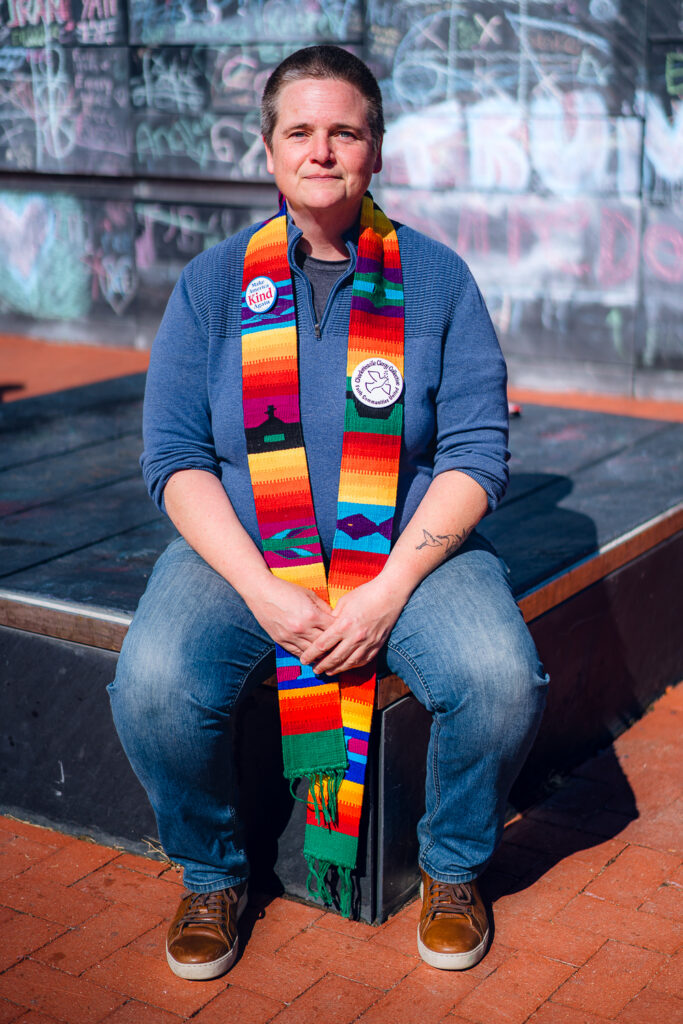
Karen Mann, a pastor at Sojourners United Church of Christ, regularly drives more than an hour to visit detainees at the Farmville Detention Center, a for-profit prison for migrants.
“You used to be able to walk just directly into the building, and now there’s a fence and a gate,” Mann says, adding that the fence is lined with razor wire. “I think that went up in December sometime.”
As of January 22, data from TRAC Immigration showed that Farmville held a daily average of 714 people, all male, close to its total capacity of 732. A year ago, Farmville averaged 440 prisoners. ICE data shows that of those 714 detainees, 541—three out of four—had no criminal record.
“Sometime over the summer or fall, they moved to non-contact visits only,” Mann says. “So when we visit, or if any of their family members visit, you have to go into a room, you’re separated by glass, and you talk over a phone set.” Detainees aren’t allowed to write or draw; they’re forbidden pencils or even crayons.
“They’re stuck in these rooms together all day,” Mann says. “A lot of them don’t have contact with their attorneys, if they have attorneys, so they don’t know the status of their case.”
“It is probably one of the most emotionally wrenching things that I have done as a pastor,” she says, “to sit across a man who’s weeping because he hasn’t been able to speak to his children in a year, and he did nothing wrong, nothing, he has no criminal record, and he’s being held for no reason.”
Seth Michelson, a professor at Washington and Lee University, serves as an interpreter for detained people. “It took over five hours yesterday just to talk to somebody,” he says of a recent visit. He and the person’s lawyer struggled through an arbitrarily canceled video conference, then tried for hours until they could finally reach the person by phone.
Michelson and Guinevere Higgins help to run the Central Virginia Community Support Fund, raising money to release detained immigrants on bond pending further hearings.
“Our average bond is about $7,500,” Higgins says, “so, completely out of reach for most working families. The trend that we’re seeing, because we are tapped into a nationwide network of immigrant bond funds, is that bonds are being set higher and higher and higher.”
Higgins says immigration judges, who work for ICE under the executive branch, are being fired and replaced if they show detainees too much mercy. “They’re being replaced to insert more cruelty into the system, to have higher bonds, to maybe not grant bond at all. So it’s really a miracle if you get to the point where you are even granted bond in the first place. It’s basically an impossibility if you don’t have an immigration attorney.”
“We also know that ICE is moving people around so that [it’s] even harder for them to access their attorneys,” she says. “If you’ve been transferred to Missouri or Texas, how are you supposed to meet with your attorney?”
“We pay ransom,” Higgins says. “That is what we do.”
The official response
If ICE comes to our area in force, it will not lack for targets.
The U.S. Census’ American Community Survey for 2024 says that 10.6 percent of people living in Charlottesville, and 11.6 percent in Albemarle County, were born outside the United States, compared to 13.5 percent for Virginia as a whole. Of that foreign-born population, 63.1 percent in Charlottesville and 45.9 percent in Albemarle were not U.S. citizens. That’s 3,028 and 6,235 people, respectively. These figures include students, refugees, asylum-seekers, and others here legally. But given ICE’s pattern of race-based “Kavanaugh stops” in Minneapolis and other cities, that distinction may not matter.
If area agencies and organizations have included an influx of armed federal troops in their emergency planning, few of them are talking about it.
“The county cannot provide legal advice or disclose public safety tactics that could compromise incident response,” said Albemarle County Director of Communications Abbey Stumpf in a statement. The county declined C-VILLE’s request to speak to emergency planning personnel.
The City of Charlottesville did not respond to requests to interview its director of emergency management.
“To protect the safety of our patients, team members and visitors, we do not discuss our preparedness plans in detail,” University of Virginia Health spokesperson Eric Swenson said in a statement.
What, then, will local institutions do if ICE rolls up? Here’s what they told us.
Prosecutors
Unlike other states, commonwealth’s attorneys in Virginia do not bring charges directly in most cases. They generally must wait to prosecute until they receive a charge from a local magistrate, usually resulting from a police investigation.
“As a prosecutor, I don’t deal in hypotheticals,” says Charlottesville Commonwealth’s Attorney Joe Platania. “However, the citizens of Charlottesville can expect that all allegations of criminal conduct will be reviewed and criminally investigated if appropriate.”
“Our office is a reactive office,” says Albemarle Commonwealth’s Attorney Jim Hingeley. “If there are ICE operations in our area that may result in crimes being committed, the first responders to that would be the police department.”
Last April, Hingeley said he would launch an investigation into ICE’s two arrests at the county courthouse. “There has been no charge that has emerged from any investigation,” he says, “so I’m not going to be in a position to comment about any investigation.”
“If the police bring a charge to me that’s based on evidence and there’s no legal reason why it shouldn’t be prosecuted?” Hingeley says. “Yes, I would prosecute it.” If the case were moved from state to federal court, as federal officials have the power to request, Hingeley says, he feels confident that he could ask for and receive support in the case from Virginia Attorney General Jay Jones.

City and county government
The City of Charlottesville directed C-VILLE to a February 2 memo from City Attorney John Maddux to all city employees. If confronted by an ICE request to enter city buildings, it instructs employees not to physically interfere with agents, and to notify Maddux’s office and their supervisor. While agents can enter public areas of any building, they can’t enter non-public areas without a valid judicial warrant or authorization from any of a small pool of city officials.
The memo notes that ICE’s administrative warrants or notices to appear do not compel employees to grant federal agents access to any files or non-public areas of city property. It instructs employees to ask for identification from agents, get copies of any legal documents they’re given, and avoid making any statements about city policy. If agents try to force their way into any areas where they’re not allowed, the memo tells employees not to stop them, and to register their lack of consent, document the incident, and notify the city attorney.
Albemarle County specified no instructions or policies for county employees. Agendas for recent Board of Supervisors meetings contain no resolutions or proposed regulations regarding federal operations. The county declined C-VILLE’s request to interview members of the Board.
Hospitals
The University of Virginia hospital declined to answer questions about whether it would allow ICE officials to conduct arrests in non-public areas of its buildings without a valid judicial warrant. Per a statement from spokesperson Eric Swensen, employees who encounter ICE are told to contact University Police, provide no patient information, and ask federal agents to wait in a public area of the building “while officials coordinate a response.”
“Sentara is committed to providing high‑quality health care while maintaining the safety, privacy, and dignity of everyone who seeks care in our facilities,” spokesperson Mike Kafka said in a statement. “We have longstanding policies that cover how we engage with law enforcement, and we follow all applicable federal and state laws, including HIPAA regulations governing the protection of patient information. … Sentara will continue to comply with lawful and appropriate judicial warrants and court orders, consistent with our legal obligations and our commitment to patient care.”
Schools
In Charlottesville City Schools, 721 students (16 percent of the student body) speak another language at home. Some 1,842 students, 13 percent of the student body, are learning English as a second language in Albemarle County Public Schools. Neither school system keeps data on students’ immigration status, and both say they have plans in case ICE arrives.
“It’s important people know no one is allowed into school buildings within the school property unless there is a warrant issued by a court,” says Jason Grant, chief communications officer for Albemarle County Public Schools, “and then [our attorneys] would obviously review that to make certain that it is a viable legal warrant.”
“Any request for student information from ICE or any law enforcement agency would need to be accompanied by a judicial warrant,” says Amanda Simalchik, community relations coordinator at Charlottesville City Schools. “Additionally, if ICE or law enforcement seeks access to schools, they must provide legal justification.”
Both officials stressed that school resource officers—currently present in Albemarle County high schools and slated to return to Charlottesville High School and Charlottesville Middle School this fall—do not and will not perform immigration-related duties.
But both school systems noted the limits of their ability to protect students. In Minneapolis, immigration enforcement officials have regularly been spotted parking near public schools around dropoff and pickup times. Beyond their property lines, schools say they have no control over ICE officers’ presence in the area, beyond calling local police. Parents who want to alter or add to the lists of people authorized to pick up their children can easily do so by contacting their local school.
Law enforcement
No local law enforcement agencies, including the city, county, and UVA police, the city and county sheriff’s departments, and the regional jail, have 287(g) agreements that oblige their officers to perform federal enforcement duties for ICE. That’s true both for the departments overall and their individual officers. Federal law forbids local law enforcement to impede federal investigations, and requires them to cooperate with any warrants signed by a judge. But what form that cooperation takes can vary.
“Historically … external law enforcement agencies at the local, state, and federal levels have contacted the University Police Division in advance of any planned activities on Grounds so that UPD can help ensure that those activities are conducted in the least disruptive manner possible,” says UVA spokesperson Bethanie Glover.
University Police did not respond to repeated requests for interviews, and UVA declined to answer whether UPD would allow federal immigration officials into dormitories, classrooms, or other buildings on Grounds without a valid judicial warrant.
Charlottesville Sheriff James Brown III, whose office handles security for city courthouses, says masked and armed individuals aren’t allowed inside the courts. “If someone was there to arrest someone inside the courthouse, we would talk with the judge about it and just kind of play it by ear,” he says. “We haven’t had that situation come up.”
In Albemarle County, “the courthouses are public buildings, so we cannot stop anybody from coming into the courthouse,” says Sheriff Chan Bryant. “[ICE officers] haven’t taken anybody into custody from the actual courtroom. … They only have taken two people into custody from the lobby of the courthouse.” Bryant says her staff has told her that ICE has informed them it will no longer conduct arrests within the courthouse. “They will take people into custody outside of the building.”
Martin Kumer, superintendent of the Albemarle-Charlottesville Regional Jail, says his facility won’t hold inmates past their scheduled release date for transfer to ICE custody. When inmates are first processed, their fingerprints are made available to other law enforcement agencies nationwide. If ICE spots someone they want, they can ask the jail when that person will be released; the jail is legally obligated to answer. ICE then typically apprehends the person in the jail’s parking lot immediately upon their release.
Albemarle County declined to grant C-VILLE an interview with county police. The Albemarle County Police Department “does not inquire into the immigration status of victims or witnesses,” County Executive Jeff Richardson said in a statement. “For decades, ACPD has worked intentionally to earn the trust of residents who have historically been marginalized or hesitant to engage with law enforcement.”
Charlottesville Chief of Police Michael Kochis says he’s been talking with the city’s Hispanic community, and they’re frightened about the possibility of ICE raids. Kochis says his worst nightmare as a police chief is someone being afraid to report a crime because of immigration concerns.
Kochis says his officers will cooperate with any warrant signed by a judge, and can’t stop ICE or other federal agencies in their investigations. But if his officers see federal agents breaking the law, they have a duty to intervene under state law to protect citizens and their rights. What that intervention looks like, he says, will depend on the situation.
His officers swear an oath to the Constitution, Kochis says, and he expects them to uphold it. If they don’t believe in constitutional policing, he says they shouldn’t be in the department.
How to save ourselves
Even agencies with plans for dealing with ICE are limited in how they can respond. Amid that uncertainty, ordinary people in Charlottesville, Albemarle, and throughout Virginia have been quietly preparing to defend their neighbors.
Mary Bauer, executive director of the ACLU of Virginia, says her organization has done “many dozens” of “Know Your Rights” trainings for people across Virginia.
“If you’re stopped by ICE, you do not have to answer questions about your immigration status, where you were born, or how you entered the country,” she says. “We tell people, never, ever lie about being a United States citizen, never show false documents.”
“There is an absolute right under the First Amendment to observe and to film, so long as individuals do not interfere with the operations,” Bauer says. “And it’s not interference to observe and comment and make noise and videotape.”
Like the ACLU, local activists say they’re holding trainings and building connections in case ICE comes to town. “It’s all of our job to keep our community safe,” says a spokesperson for Charlottesville’s Queer Liberation Front, who asked to be identified only as Torren. “And we want to make sure our fellow organizers and community members are equipped to do so.”
“An incredible portion of the greater Charlottesville community is pissed—as they well should be,” Torren says. “We have seen an increase in volunteer interest and in formerly inactive community members seeking and attending antifascist trainings.”
“The murders in Minneapolis and the repression in Minneapolis over the last months have really galvanized a lot of people who have recognized for the first time that this is not a threat to other people—that fascism is coming for all of us,” says David Singerman, co-organizer of Indivisible Charlottesville. “If people feel more comfortable or more safe doing one kind of action versus another, they’ve found ways to do that. There’s a place in this fight for everyone, and everyone can contribute.” Indivisible Charlottesville’s website lists more information on upcoming trainings or other ways to help.
Central Virginia Community Support Fund’s Higgins and Michelson urge people to contribute to their organization. “Every donation we get can be recycled,” Michelson says, “because our money comes back. So when you give us $1, we give it to the bond of a person in need who’s been detained.”
“Every dollar counts, and we’re still dollars short,” Michelson says. “We have more bond requests than we can fund, more people being detained all the time, and the prices are going up.”
“My congregation is expressing a lot of anger and fear about what’s happening,” says Sojourners’ Karen Mann, “and at the same time, expressing a significant willingness to try things, to engage, to show up. In this last year, we’ve actually seen an uptick in our attendance and engagement. We have people who are involved and engaged in ways that they never were before.”
Mann says Sojourners, “a majority white congregation,” has been reaching out to build relationships with communities more directly at risk from ICE. In addition to looking for ways to join local mutual aid projects, the church has been providing space for other groups to meet and train.
“We have to hold on to our shared values and beliefs, even if we disagree with one another on the best way to engage,” Mann says. “When we cannot see the face of God in our undocumented immigrant neighbor, or any neighbor, then we cannot see God at all. And I find myself feeling more motivated, more passionate about this, than at any time in my life. When we miss this, we miss the whole of the Gospel.”