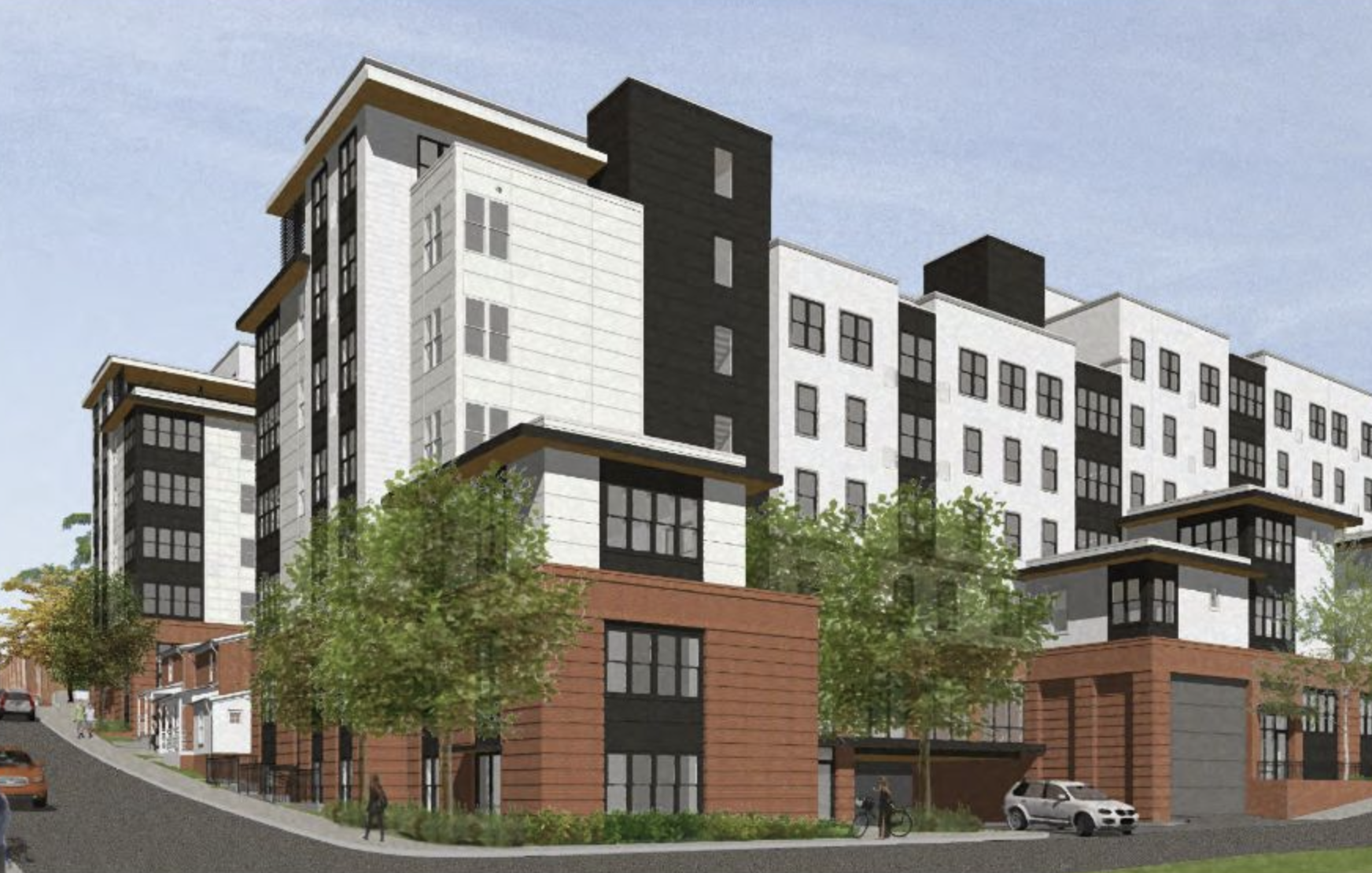
Mitchell Matthews Architects
In yet another test of the city’s new zoning code, the Charlottesville Board of Architectural Review has denied a necessary permit required for the current design of an apartment complex.
The December 16 vote against the certificate of appropriateness was 6 to 1. On December 31, an attorney for developer LCD Acquisitions filed for an appeal to City Council arguing the BAR’s decision was arbitrary and capricious and beyond its authority. That hearing has not yet been scheduled. City Council will have a work session to review zoning for student housing some time this month.
The proposed seven-story building, dubbed The Mark, had gone before the BAR for three preliminary reviews, but this was the first time one of its requests came up for a vote.
“We can find places where certainly density and growth can happen and we’re comfortable with it,” said BAR member Cheri Lewis. “But this is just a radical, radical disruption in this neighborhood.”
The project needs a certificate of appropriateness because LCD Acquisitions wants to incorporate two historically significant houses, constructed by 19-century builder James Hawkins, on Seventh Street SW that are individually protected under the city’s code.
“What you have to evaluate are those two structures and the rehabilitation that’s being proposed on them and the impact of this new development,” said Jeff Werner, the city’s historic preservation planner.
The underlying zoning of the properties, Residential Mixed Use 5, allows for a seven-story building with unlimited density if the project satisfies the city’s affordable housing requirements. Under the new zoning code adopted in December 2023, the City Council plays no role in approval unless developers seek a special exception.
John Matthews of Mitchell Matthews Architects & Planners said the building could still be constructed without touching the two 19th-century structures, but would be better with them.
“It complies with the comp plan, the zoning ordinance, the affordable housing manual, and contributes millions of dollars to the city’s essential public services,” Matthews said.
Many people took advantage of the public comment period to protest the project, including one nearby resident who said his light would be blocked by the new building.
“Charlottesville has a history of not doing right by historically Black communities,” said James Carr. “Walker Square, where we live, is probably not something that would have been welcomed in Fifeville if there had been a chance to fight it.”
City Councilor Michael Payne said that Council should amend the zoning to give protections such as those in place for portions of Preston Avenue and Cherry Avenue, where developments have to prove they will benefit the community.
“Our zoning doesn’t reflect that,” Payne said. “And that’s something I hope City Council can understand the impact of the mistake we made and correct it.”
Payne encouraged the BAR to deny the request and allow Council to take up the appeal.
“One thing that is in our purview is materiality, scale, massing of a building,” said BAR member Kate Snider Tabony. “And I do believe that this is out of character.”
BAR member Roger Birle said the project had improved over different iterations, but he said it still did not meet the city’s design guidelines. Fellow member Ronald Bailey agreed.
“I think that’s the real problem,” Bailey said. “If the city—if the citizens of the city do not want that zoning, we are the wrong people to talk to about that.”