“I’ve held hundreds of listening sessions across the Blue Ridge, and families deserve a representative who will fight to get costs down, paychecks up, and common sense back in the driver’s seat,” says Tom Perriello, Democratic primary candidate and former Fifth District congressman. Photo: Eze Amos
On April 21, Virginia voters approved state Democrats’ bid to redraw congressional maps, with roughly 51.64 percent voting “yes” in the special election. While legal challenges to the constitutional amendment persist at press time, congressional candidates are turning their attention to the primaries.
The Virginia Supreme Court heard oral arguments on the amendment on April 27. Per the Code of Virginia, two sessions of the state legislature must approve an amendment before sending it to voters. The votes on the amendment must be separated by elections for the House of Delegates. State Republicans argue that since early voting for the 2025 election was under way when the Democratically controlled House of Delegates first passed the amendment, the legislature did not meet these requirements. At press time the Court has not ruled on the matter.
For the last five years, Charlottesville’s congressional district spanned from Albemarle down to the North Carolina border. Under the new map, the greater Charlottesville area moves into the newly created Sixth District alongside other localities with major universities—Harrisonburg and Blacksburg—and their rural surroundings.
Current Sixth District Rep. Ben Cline, R, is adamantly opposed to the map and is supporting the legal effort to toss the amendment. Based on his campaign website, the Congressman lives in Botetourt County in the new Ninth District—the sole seat on the new map heavily favoring Republicans.
Although results were closer in 2024, with 50.6 percent going for former Vice President Kamala Harris, data from the Virginia Public Access Project shows that Gov. Abigail Spanberger carried the new Sixth District by 11 points in 2025.
Not every candidate C-VILLE spoke to was happy about the redistricting, but most were glad to have a better idea of which district they’re running in. Others were adamant that the amendment would not hold up under legal scrutiny.
“When I was in the General Assembly, my team and I were able to pass bills every year where every Democrat and every Republican voted yes,” says current Rep. John McGuire. “At the same time, I received the highest award for conservatism. Fast forward to my time in Congress, today, I received the highest award for conservatism in Congress.”
McGuire is the far and away favorite for the Republican nomination in both the old Fifth and new Sixth district.
“I was elected to represent Virginia’s Fifth Congressional District, and Tuesday’s election does not change that,” he says. “We expect the Virginia Supreme Court to do its constitutional duty and uphold the lower court ruling on the redistricting referendum as unconstitutional and illegal. Until then, I will continue to campaign and represent the amazing people of the current Fifth District.”
In the Democratic field, the pool of candidates from the previous Fifth District is down to three: Tom Perriello, Suzanne Krzyzanowski, and Rob Tracinski. Although Gabriella Bedsworth recently decided to end her bid for the party nomination, redistricting was not the main reason for her exit.
On April 11, Bedsworth received a note taped to her front door. Already weighing the financial cost of continuing her campaign, she decided to leave the race.
“The note had to do with my being a transgender woman,” says Bedsworth. “The emails didn’t bother me, but when someone came to my home in the middle of the night, that’s another story. Money was still my primary motivation for dropping out.”
While she’s opposed to gerrymandering in general, Bedworth says she voted “yes” on the amendment to “level the playing field after Texas did the same.”
Krzyzanowski, also opposed to gerrymandering, is staying in the race in hopes of making change at the federal level.
“Once the possibility of redistricting came up, I had to ask myself if I would continue the race in the new Sixth District, with more candidates,” says Krzyzanowski, who was inspired to run by her experience as a family health physician. “I think one of our priorities early on when we Democrats get the majority should be to pass legislation ending gerrymandering. And if Trump vetoes it, then it will be clear to everyone who is responsible.”
Tracinski, who is continuing his reform-focused anti-Trump campaign, is narrowly within the bounds of the newly formed Sixth District.
“Well, it’s nice to know finally what district I’m running in,” wrote Tracinski in a campaign update after the special election. “The voters of the Commonwealth have chosen to create new congressional districts to counterbalance Donald Trump’s spree of racial and partisan gerrymandering.”
Former Fifth District Rep. Tom Perriello campaigned in support of the amendment. Prior to redistricting, Perriello was running an uphill campaign to unseat McGuire. In the Sixth, he’s the frontrunner.
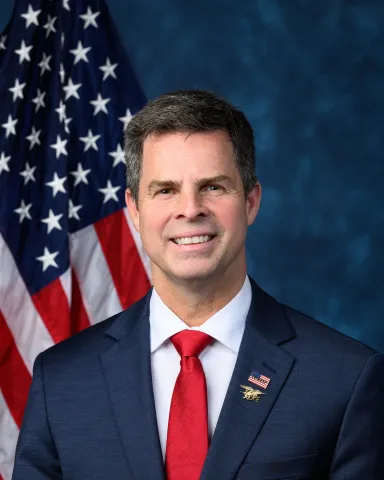
“Folks around here can agree on one thing—we are paying way too much for gas, groceries, and healthcare. It’s time to fire congressmen like Ben Cline who jacked up costs to protect the corrupt,” said Perriello in an April 21 post after the election was called. “I’ve held hundreds of listening sessions across the Blue Ridge, and families deserve a representative who will fight to get costs down, paychecks up, and common sense back in the driver’s seat.”
Beyond names already on the radar, new boundary lines introduce a handful of new candidates, like Beth Macy, a journalist and New York Times bestselling author from Roanoke. Perriello has raised more than $1.4 million for his campaign, but Macy isn’t far behind at almost $1.1 million.
Democratic and Republican candidates aren’t the only contenders affected by redistricting. While they’re often left out of the conversation, Independent candidates vying to get on the ballot are among those most affected by the new map.
“The Fifth District in particular was, I thought … a fairly drawn district,” says Chris Register, who opposed the redistricting amendment. Rather than new maps, Register saw a path forward with disillusioned former Trump voters in southern Virginia.
“As an Independent candidate, I thought I actually had a decent—you know small, but decent—shot,” he says. “I felt like there were enough people on the Republican side who were fed up with Trump, and I don’t think that Congressman McGuire was particularly appealing.”
“I understand why Democrats are voting yes, because the Republicans in Congress in D.C., they’re not doing their job, they’re not exercising oversight. … We’ve just become so partisan. The only way out of this is to open up the political system,” says Register. “Tyranny by majority is still tyranny. You can’t actively seek to disenfranchise your neighbors in a liberal democracy. That’s what we’ve done, and we’ve hardened the hearts of those folks.”
With redistricting moving forward, Register says his main focus is to ensure he gets on the ballot for November. Getting enough signatures by the deadline to qualify for the ballot has also been a concern for Cooke Harvey, who is also running as Independent in the new Sixth.
“I am newly encouraged, newly motivated,” says Harvey. “Now, because there’s a clear focus and a clear line, it makes it a little bit easier.”
Based on his most recent conversation with the Virginia Department of Elections, Harvey and other Independents who previously declared their candidacy in now-incorrect districts will need to update some paperwork. The exact processes are still being sorted, but election officials also need to determine which of the signatures Harvey’s already collected will count.
In an April 27 email, VDOE confirmed that the primary filing deadline for U.S House of Representatives candidates has been set for May 26. Independent candidates have until August 4 to file for the November general.
Party primaries for the 2026 midterms will be held August 4. Election Day is November 3.