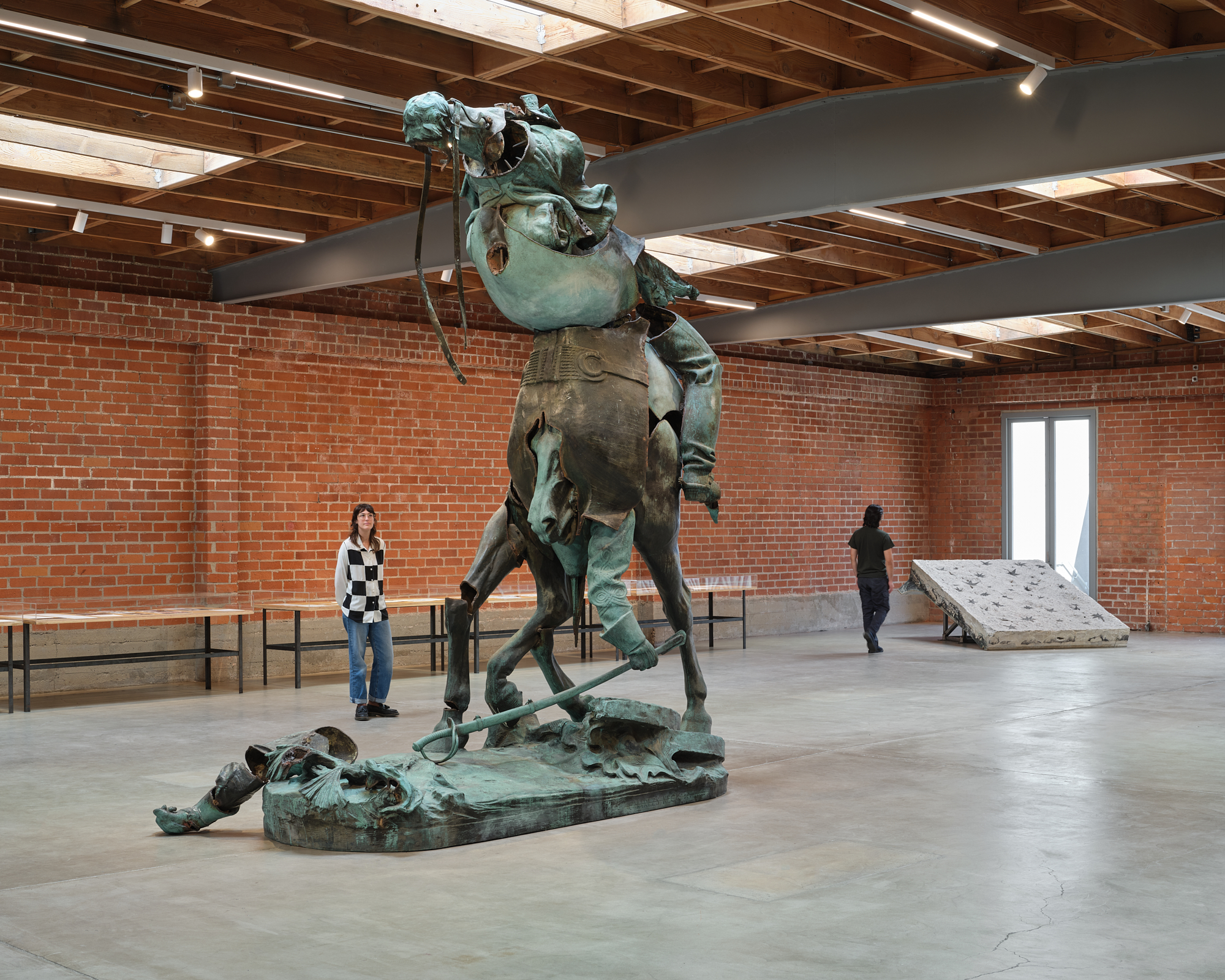
Artist Kara Walker transformed the bronze Charles Keck statue of Stonewall Jackson, which used to stand in Charlottesville’s Court Square Park, into “Unmanned Drone.” It is the centerpiece of “Monuments,” on view at the Museum of Contemporary Art in Los Angeles through May 3, 2026. Image courtesy of The Brick.
Confederate statues have roiled Charlottesville since at least 2016, when Charlottesville High School student Zyahna Bryant petitioned City Council to remove them, a request that culminated in 2017’s deadly Unite the Right rally.
Charlottesville and its Lost Cause legacy have once again taken the national stage, this time as part of a major Los Angeles exhibition called “Monuments,” a collaboration eight years in the making between the Museum of Contemporary Art and The Brick.
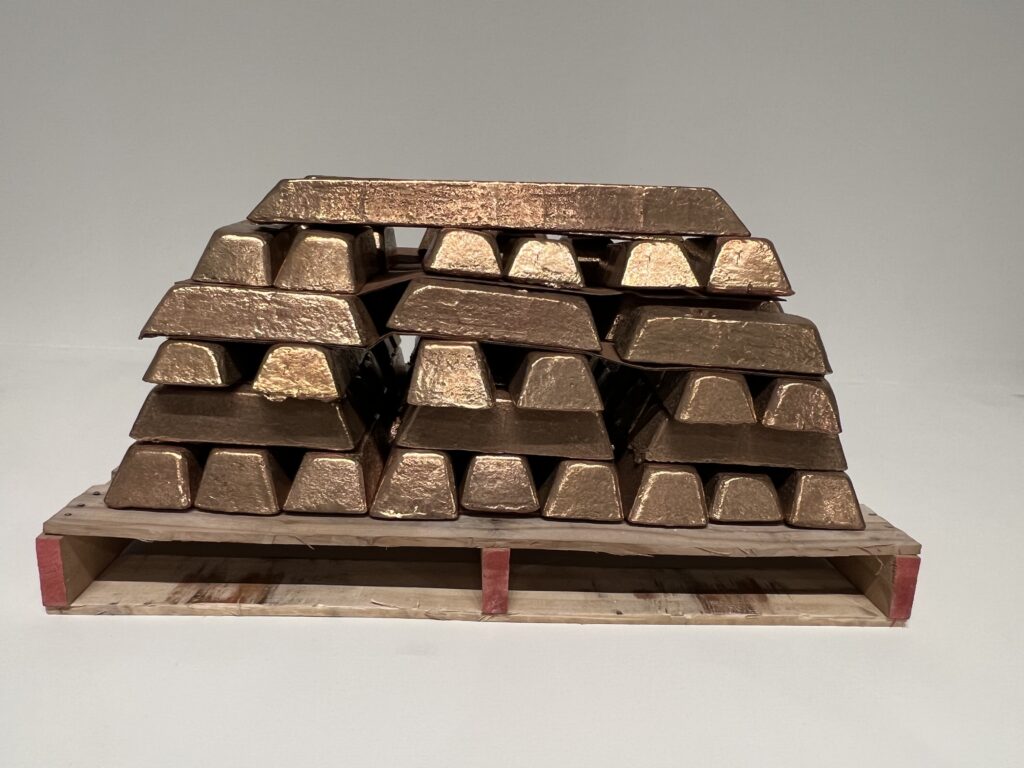
The controversial statues of generals Robert E. Lee and Stonewall Jackson have been transformed into bronze ingots and a centaur-like sculpture, respectively. Jackson’s rose granite plinth is now reenvisioned as flowers. And the museums commissioned 18 new pieces to be juxtaposed with the old.
Hamza Walker, director of The Brick, cites 2017’s Summer of Hate as his inspiration for the show. He notes that the 2015 massacre at Mother Emanuel AME Church in Charleston, South Carolina, sparked the first wave of Confederate statue removals, starting in New Orleans.
“What does contemporary art have to say about the issues?” he asks. “Monument removal was the most significant sociopolitical and cultural event of 2017. It’s a big deal. What does it mean for those statues to come down?”
Walker grew up in Baltimore, Maryland, which quietly removed its Confederate statues after a neo-Nazi drove into a crowd of Charlottesville counterprotesters in 2017, killing activist Heather Heyer and injuring dozens.
“Charlottesville is essential to the exhibit,” he says. And it was the only municipality that called for RFPs that mandated a “transformation, not further veneration,” of the Lost Cause icons, he points out.
“The statues were toxic after Unite the Right,” says Walker. “The link between Confederate statues and white supremacy was explicit.” He put in a proposal for the Jackson monument, which was deeded to The Brick, which in turn deeded it to artist and co-curator Kara Walker (no relation to Hamza).
MOCA’s Bennett Simpson, who attended UVA and is a “Monuments” co-curator, explains some of the obstacles in mounting the exhibit, starting with the fact that MOCA is a contemporary art museum. “These are not contemporary works,” Bennett says. “It’s public art owned by cities and museums.” But what has come from the show is “novel and new.”
There’s Jefferson Davis from Richmond, toppled and spray-painted, with an arm reaching up. There’s Supreme Court justice Roger Taney, who wrote the Dred Scott decision. There’s graffitied pieces of the statues that once towered over mere mortals.
The cost and the logistics involved in moving multi-ton statuary across the country were also a consideration. The Brick, which was LAXART at the time, paid $50,000 to cover expenses for the Jackson statue.
“These are highly charged objects that had just come down,” Simpson says. “We had to assure folks that we were not trying to make fun of them and this was not political.” The MOCA board had questions about why the exhibit was important and why it was so expensive, but ultimately, was very supportive, he says. “I am amazed every day that it actually happened.”
Stonewall reckoning
Artist Kara Walker, who has long delved into America’s racist history and is perhaps best known for her silhouettes of plantation life, butchered the bronze Charles Keck statue of Stonewall Jackson. In the reassembled work, “Unmanned Drone,” parts of the horse and Jackson are still identifiable, but not as the Confederate hero ready to charge into battle.
Her sculpture, she told The New York Times, “exists as a sort of haint of itself—the imagination of the Lost Cause having to recognize itself for what it is.”
“It’s horrific but still elegant,” says Hamza Walker. “It’s articulating a kind of violent set of historical circumstances about the systemic denial of rights to African Americans.”
He questions what Confederate monuments say about the “men who fought for white ethnicity and the perpetuation of child slavery,” and who were seen as heroes, at the same time African Americans were subjected to violence for “decades and decades.”
The piece “forcefully and forthrightly addresses that relationship,” he says, and could never be done “in a fashion that didn’t express that horror and pain.”
“This piece—it’s grotesque, in the best sense of the word,” says Jalane Schmidt, who co-founded Swords into Plowshares to transform the Lee statue, which was melted in 2023, into a new work of public art.
She acknowledges that Keck’s sculpture was fine art, but, “It was propaganda art. It had masked a lot of the ugliness of the Lost Cause. A lot of lies were supported by this propaganda art.
“What Kara Walker did was she literally turned it inside out and exposed the grotesqueries of slavery,” says Schmidt.
Andrea Douglas, Jefferson School African American Heritage Center executive director and Swords into Plowshares co-founder, was already familiar with Walker’s work and not surprised by “Unmanned Drone.”
“She’s always turned things inside out,” says Douglas. Walker was “already addressing the antebellum and enslaved and post-enslavement period … and the trauma and horror and debasement of bodies, particularly Black bodies. To me it makes perfect sense.”
Not everyone in Charlottesville is thrilled with Jackson’s new incarnation. “You probably wouldn’t be able to print what I really think,” says Lewis Martin, an attorney who appeared frequently at the Blue Ribbon Commission on Race, Memorials and Public Spaces meetings in 2016 when the city grappled with what to do with the monuments.
He recalls walking by the statue when he was 5 years old and his father telling him that it was one of the finest equestrian statues in the world. That sentiment was also noted on the city’s website. “What community would want to tear down what is considered the finest equestrian statue in the world?” he asks.
Martin thinks the city should have done what Albemarle County did with its “At Ready” statue, known by some as Johnny Reb, which was donated to the Shenandoah Valley Battlefields Foundation.
Stonewall Jackson should be there for those interested in fine equestrian statues, says Martin, “before it was turned into something grotesque. It’s just hideous.” This era, he believes, will be looked on in the same way as the Cultural Revolution in China.
Alexandria Searls, former director of the Lewis & Clark Exploratory Center, also favors preservation. “I don’t want authoritarians to be able to praise an artwork and then have their opponents destroy it … it gives too much power to authoritarians, and takes away from the historical record,” she says.
Total meltdown
Giving the Jackson and Lee statues to a Confederate-honoring organization in 2020 was exactly what Swords into Plowshares’ Douglas and Schmidt did not want. Schmidt calls the Lost Cause iconography “toxic waste” that shouldn’t be shipped down the road. “What Black kid in the year of our lord 2020 deserves to grow up in a town with this Lost Cause narrative looking down from a pedestal?”
They were poised to melt Lee after a series of legal hurdles: A law prohibiting removal of war memorials was repealed in 2020. An injunction prohibiting the generals’ removal was dismissed in 2021, and both Swords into Plowshares and what was then LAXART were ready with responses to the city’s Request for Proposals. The lawsuit to preserve Lee was finally settled in 2023, and the new owners–Swords into Plowshares—fired up the foundry.
“White supremacy is bad for everyone,” says Schmidt, and any decision on Lost Cause monuments—whether to give them away or keep them in storage or transform or destroy them—is a “moral choice.”
She observes wryly, “It really would have been easier to put them in storage.”
Schmidt and Douglas were in Los Angeles for the opening of “Monuments” at MOCA’s Geffen Contemporary, a former police car warehouse. “It felt like an affirmation of the strategy we adopted,” says Schmidt.
“It was great to see the statues no longer on their pedestals,” she says, “brought down to size by protest.”
Lee’s granite plinth is still spray-painted with “As White Supremacy Crumbles.” Bronze ingots that look like gold are neatly stacked on two pallets. Black slag, the impurities from the melting, is displayed nearby.
“It has cost so much time, effort and money” to get to the stage of bronze ingots, says Douglas. “Now there’s the possibility of what we can do with that.”
UVA art professor Kevin Everson was commissioned to make a film for the exhibition, and he was also at the opening. “I was really surprised everything in the show had room to breathe,” he says. When opera singer Davóne Tines sang “Let It Shine,” “it was amazing,” says Everson. “It gave the space a place to heal with all that Confederate crap.”
Everson’s film is about Richard Bradley, who climbed a flagpole three times in San Francisco in 1984 to remove a Confederate flag. “I asked him how he got up that pole,” says Everson. “Practice, practice, practice,” responded Bradley, which became the film’s title.
“It was the most African American show I’ve ever been in,” Everson notes. “Timely and fascinating.”
MOCA did not want the exhibition to be political, and it was conceived well before the current Trump administration. Nonetheless, it is taking place at a time when museums like the Smithsonian are being scrutinized for “improper ideology,” where plans are underway to reinstall a toppled Confederate statue in Washington, and with a president who complains that there’s too much emphasis on “how bad slavery was.”
Such discussions are what the curators believe should come from the show to address the legacy of slavery, as well as that of the 2015 slayings in Mother Emanuel, August 12 in Charlottesville, and the January 6, 2020, attack on the U.S. Capitol.
“There’s been a thirst, a desire for something that speaks to what happened in the past decade in meaningful ways,” says Hamza Walker. “The response has been overwhelmingly positive.”


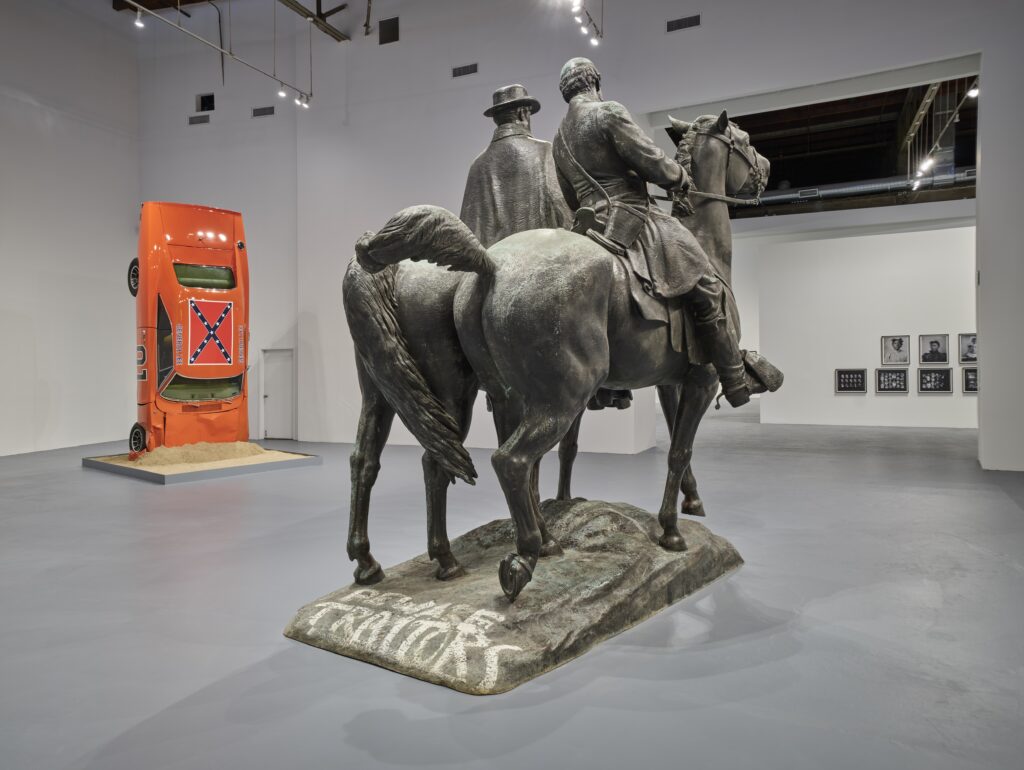
Clockwise from top left: Richmond’s Jefferson Davis statue, toppled and spray painted, with an arm reaching up, is also on display (Image courtesy of MOCA). Kara Walker’s “Tread” was created from the granite base of Charlottesville’s decommissioned Jackson monument (Image courtesy of The Brick). A graffitied fragment of the city’s Robert E. Lee statue’s base (Image courtesy of Jalane Schmidt). Baltimore’s Stonewall Jackson and Robert E. Lee statue, removed in 2017, is part of “Monuments” (Image courtesy of MOCA).
Where are they now?
Albemarle County dispatched its mass-produced Confederate soldier in 2020, and the following year Charlottesville removed four statues commissioned by Paul Goodloe McIntire. Here’s where they stand now.
“At Ready,” aka Johnny Reb
A Northern foundry that produced both Rebel and Union soldiers, depending on the requester, manufactured the statue that was installed in front of the Albemarle County courthouse in 1909. The county shipped its Lost Cause memorial to the Shenandoah Valley Battlefields Foundation. Johnny Reb now presides over the New Market Battlefield.
Robert E. Lee
The bronze remains of the Confederate general, installed in 1924 and melted into ingots in 2023, are now part of the “Monuments” exhibit at the Los Angeles Museum of Contemporary Art. When the exhibition ends, the Jefferson School African American Heritage Center’s Swords into Plowshares will proceed with its plan to create a new work of public art. It has three finalists, will mount drawings in March, and hopes to announce the winner July 10, 2026, five years after Lee came down.
Thomas “Stonewall” Jackson
Jackson was deeded to the former LAXART, now The Brick, which deeded it to artist Kara Walker. She dismantled the bronze Charles Keck statue and her new work, “Unmanned Drone,” is the centerpiece of the “Monuments” exhibit. It will be on display through May 3, 2026.
Lewis and Clark and Sacajawea
“Their First View of the Pacific,” the Keck monument that used to sit at the intersection of West Main and Ridge streets, now resides at the Lewis & Clark Exploratory Center in Darden Towe Park. The statue is not beside a dumpster, but a gardening shed, clarifies former center director Alexandria Searls. The center is open by reservation only, but according to Searls, scholars and thousands of elementary school children from around the state have visited.
George Rogers Clark
“The Conqueror of the Northwest,” the fourth McIntire donation, formerly resided at Monument Park across from the Corner, where, among the seven figures depicted on the 20-foot-long monument, Clark charges into Native Americans. It was removed in the same July 2021 sweep of the other McIntire donations, and is now in storage, according to UVA. A new design for University Avenue Park has been approved and “developed to interpret the deep history of the Commonwealth, its people, and landscape,” and will soon go out for bid.