It’s a scene out of a Stanley Kubrick film. You’re blindfolded and led into a room you’ve likely never seen before. A silent usher takes you to a seat where you’ll remain for the next hour with only your ears to guide you.
Musicians take up their instruments and begin to play. There is no stage talk, no exposition to give you a sense that you’re anywhere other than in a landscape of sound. The four vocalist-slash-instrumentalists circle around the room playing songs designed specifically for the sightless experience. None of the usual trappings of a live music event follow—no dancing, no eye contact, no physical performance connecting the band and audience.
What’s left is pure sonic alignment. What’s left is the Golden Hour Experience.
Created in 2017 by members of local Americana bands David Wax Museum and Lowland Hum, the Golden Hour Experience (formerly Concert in the Blind and, later, Golden Hour) has been a critical success. Audiences say they feel like children, relearning how to listen and feel in the presence of music. They say they feel comforted, cared for. In a 2020 World Cafe podcast, NPR reporters called the 60-minute experiment a “surround sound, immersive musical experience” that “could change the way you experience live music.”
“It’s like a theater piece in that it starts and then just goes and there’s no stopping,” David Wax says. “We almost treated it as if we were writing for a musical, because it’s a very specific thing that’s happening for the audience. It’s this private and—at the same time—communal concert.”
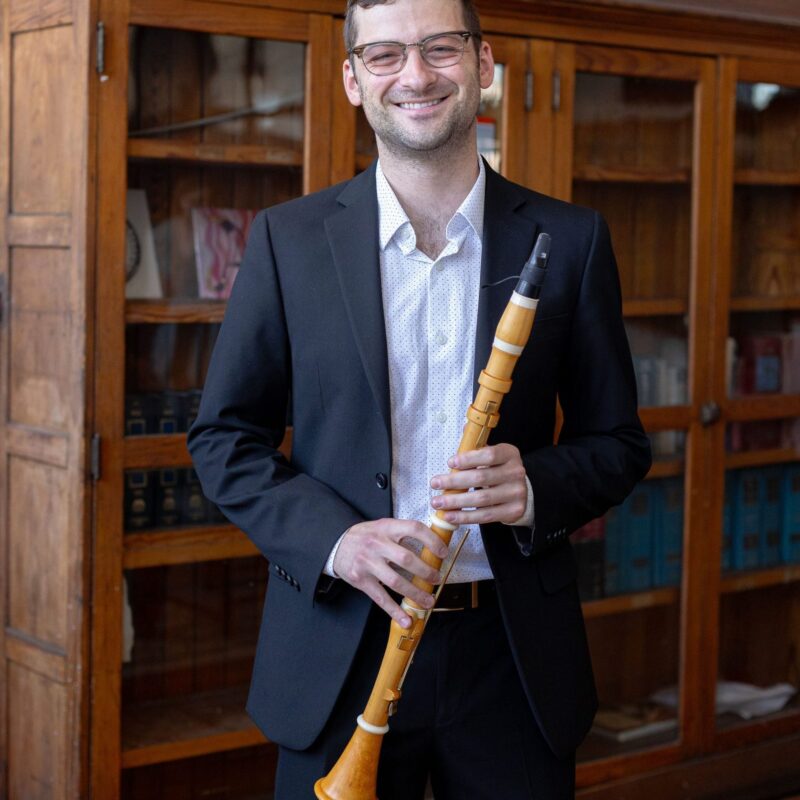
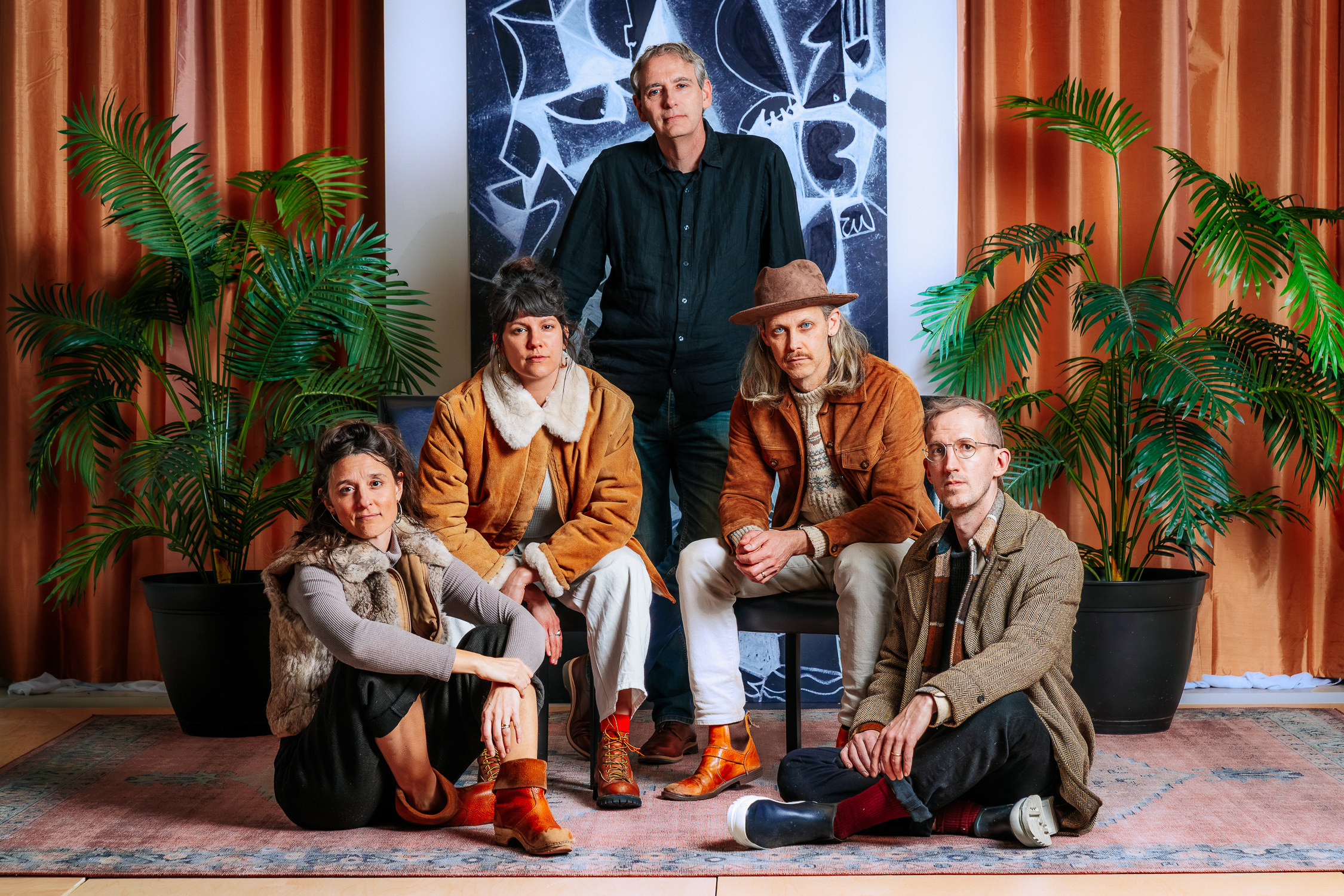
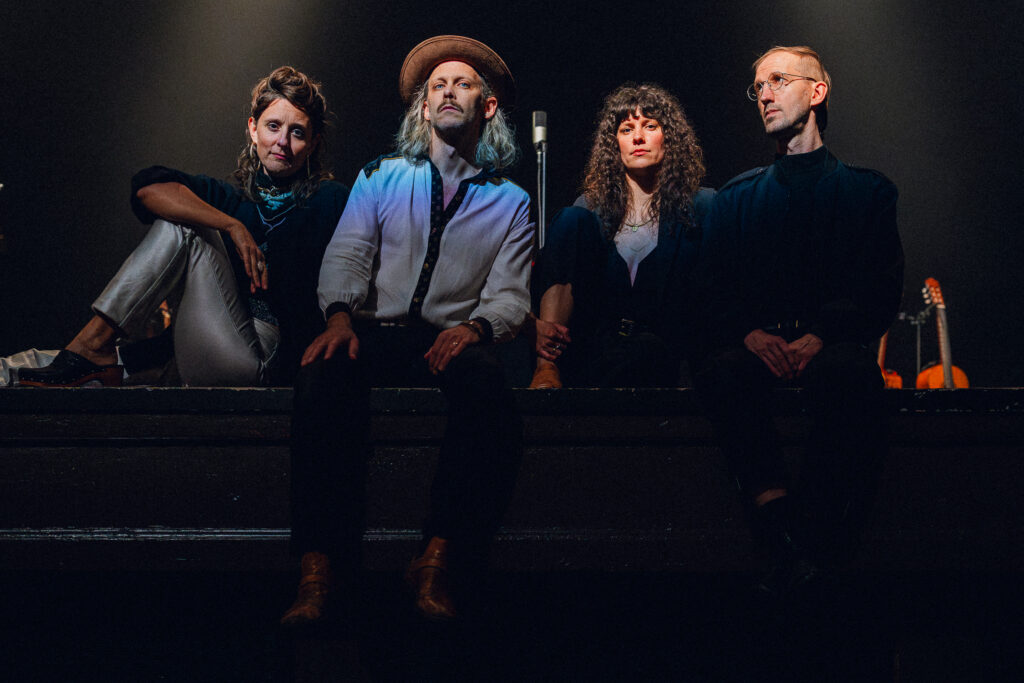
Beyond the audiences, Golden Hour Experience has had a profound effect on the musicians creating it—Suz Slezak of David Wax Museum and Daniel and Lauren Goans of Lowland Hum, in addition to the former band’s eponymous frontman. Almost unconsciously, they built a “new collective musical identity,” Wax says. The obvious next step was to form a band. Today, the four-piece is known as The Golden Hours.
After performing for the first time as a band late last year, the quartet will now try another innovative approach to making music. On February 21 at The GUILD downtown, they’ll debut a song inspired by a short story from bestselling novelist and University of Virginia professor Bruce Holsinger. The performance will be part of a live recording of the “SongWriter” podcast created by Ben Arthur, a musician, novelist, and UVA alum.
“I’ve spent my whole life playing shows, and there’s something beautiful that can happen through music when a room comes together,” Arthur says. “The term that I’ve learned for this is ‘collective effervescence.’”
Telling stories
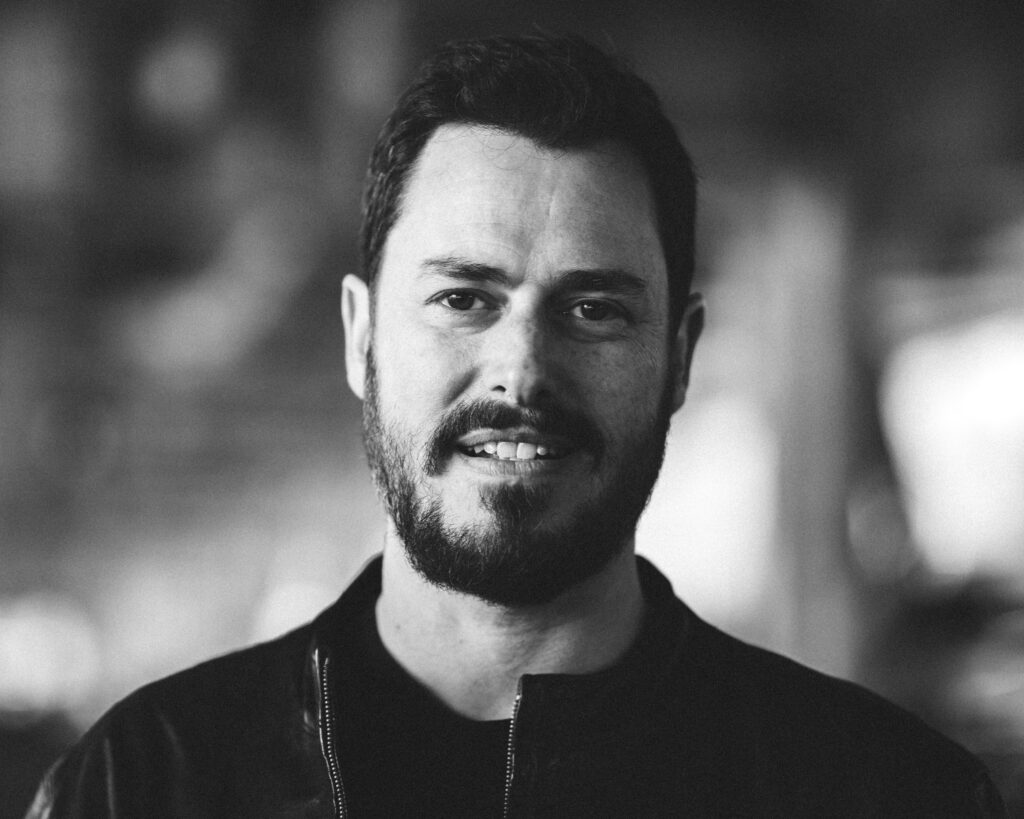
Arthur launched the popular “SongWriter” podcast in 2017 with a broad creative goal: Bring together authors and musicians to produce synergistic stories and songs. The idea has resonated with audiences and the artists themselves. Through the syndicated radio platform Acoustic Cafe, “SongWriter” now reaches more than 1.5 million weekly listeners. The podcast’s list of contributors includes some of the great creatives of our time, from National Book Award winners Joyce Carol Oates and Jonathan Franzen to Grammy winners David Gilmour, Steve Earle, and Questlove.
Now in its seventh season, the podcast asks authors to write a short fiction or nonfiction piece and songwriters to craft a tune in response. Arthur sometimes pairs the duos by first reaching out to a traditional writer; other times, he taps a songwriter. In either case, the artists choose to work with one another.
Across 83 30- to 60-minute episodes to date, “SongWriter” has featured a reading of the written word, performance of the song dealing with the same themes, and a question-and-answer session. In episode nine of season one, former New York City police captain, photographer, and filmmaker Rita Mullaney tells Arthur the story of two unhoused individuals making their way in NYC. In response, the Lumineers’ touring bassist, Byron Isaacs, performs a Lou Reed-inspired tune chronicling the tribulations of New Yorkers—over a distorted guitar riff and driving bassline.
In a two-part episode in season five, George Saunders offers a 60-minute reading of the short story “Sea Oak.” The tale—of a man working in an aviation-themed sort of Chippendales while trying to improve his family’s dystopian life—is bizarre but captivating. Asked to respond is Craig Finn, the non-autobiographical storyteller who fronts The Hold Steady.
It’s an effective pairing, and in Finn’s characteristic monotone, Saunders’ story comes to life in a way that is both true to the source material and surprisingly fresh.
In 2020, the Templeton World Charity Foundation approached Arthur about a funding opportunity. If he would produce shows “around elements of human flourishing,” such as forgiveness, empathy, caregiving, polarization, and artificial intelligence, the foundation would give the podcaster the money he needed to keep producing shows in concert with high-quality artists.
“I was like, ‘Wait a minute, you’d pay me for this?’” Arthur says. “Who among us doesn’t feel like we need to deal with polarization in this country? Who among us doesn’t think that forgiveness is something we need to apply to ourselves?”
Coming together
David Wax Museum had just finished a show in New York when the band met an illustrator. The young artist had been in the audience and drew the live performance on the spot. He showed the work to Wax and Slezak and mentioned his brother’s podcast, a project that “turns stories into songs.”
Arthur reached out to Wax about appearing on “SongWriter.” As soon as Wax and his Golden Hour bandmates saw who’d been on the podcast before them, they wanted in.
Wax, in turn, had just finished reading Holsinger’s latest novel, Culpability. “To have a local author that was having a moment—and there’s just so many fascinating themes in that book—it just felt so right to engage with whatever he’s thinking about right now,” Wax says.
At Wax’s request, Arthur contacted Holsinger, and the novelist agreed to pen a short story for the podcast. It was a step outside the scribe’s comfort zone; even in his early days as a writer, he’d never tackled short-form storytelling.
One of the topics Arthur suggested—another from the Templeton Foundation playbook—gave Holsinger an idea. In addition to themes of human flourishing, the foundation wanted to explore animal intelligence.
Holsinger penned “River Cat,” a dark comedy about a troubled feline. He sent the work to the four Golden Hours songwriters. He admitted it was a “bit off the beaten path.” It was the only context he offered.
“One of the things that powers this project is that musicians are often ridiculous fans of writers and imagine that writers have magic that they don’t have,” Arthur says. “The exact same thing is true of writers. Writers imagine that musicians have some magic, while they’re just technicians.”
When the audience sits down at The GUILD on February 21, Arthur will introduce the “SongWriter” project, Holsinger will debut “River Cat” in an unabridged reading, The Golden Hours will take the stage to offer its musical response, and a subject matter expert will join the group to discuss the intersection of animal intelligence and humanity.
At this point, everything is set—except for the song.
Seeing clearly
Michael Allenby is still tinkering with the Downtown Mall venue that is The GUILD. The space inside Vault Virginia hosted its first show last May, but only a handful of acts have played to the 100-seat room since. The scarcity is part of the allure. Allenby, who now manages both the Vault and GUILD, initially intended the intimate shows to be by invite only. He’s amended that strategy slightly over the past year.
Another point of consideration for the venue: Could it host a Golden Hour Experience after the “SongWriter” podcast recording? Wax had reached out to Allenby directly about the event early in the planning process. The Golden Hours bandmates have a years-long friendship with Allenby, and the intimacy of The GUILD felt right. Still, details needed to be finalized.
The team ultimately decided the space wasn’t optimal for a blind concert. But the audience will get a consolation prize: a short set by the burgeoning band of the same name following the “SongWriter” recording and a brief intermission.
As Golden Hour, Wax, Slezak, and Daniel and Lauren Goans approach songwriting as a true collective. “There’s no ego,” Lauren Goans says. “Things move really rapidly, and we’re able to find the shape and the form of the idea quickly.”
Goans says the humorous edge to “River Cat” has inspired her thinking about the song that might emerge, and the story is set locally, giving the songwriters another touchpoint. What else may come remains up to speculation.
“As a writer, to be able to bring in a musical component … and to have your work interpreted in the moment, I just feel like that is a really rare gift,” Wax says. “It’s a fresh ask—we’ve never done anything quite like this either.”
Arthur says the scientific element of the stories inspired by Templeton’s themes has elevated the artwork further. It’s not that our feelings and heartbreak expressed in song aren’t serious, but thinking about the science behind our interactions—both among one another and with storytelling—takes the project to the next plane.
“Your best teachers almost certainly use stories to engage you,” Arthur says. “They were instinctually doing this thing, which is like using a spoonful of sugar to help the medicine go down. And they’ve in fact been correct, scientifically, about the appropriate way to engage our minds.”
Playing it out
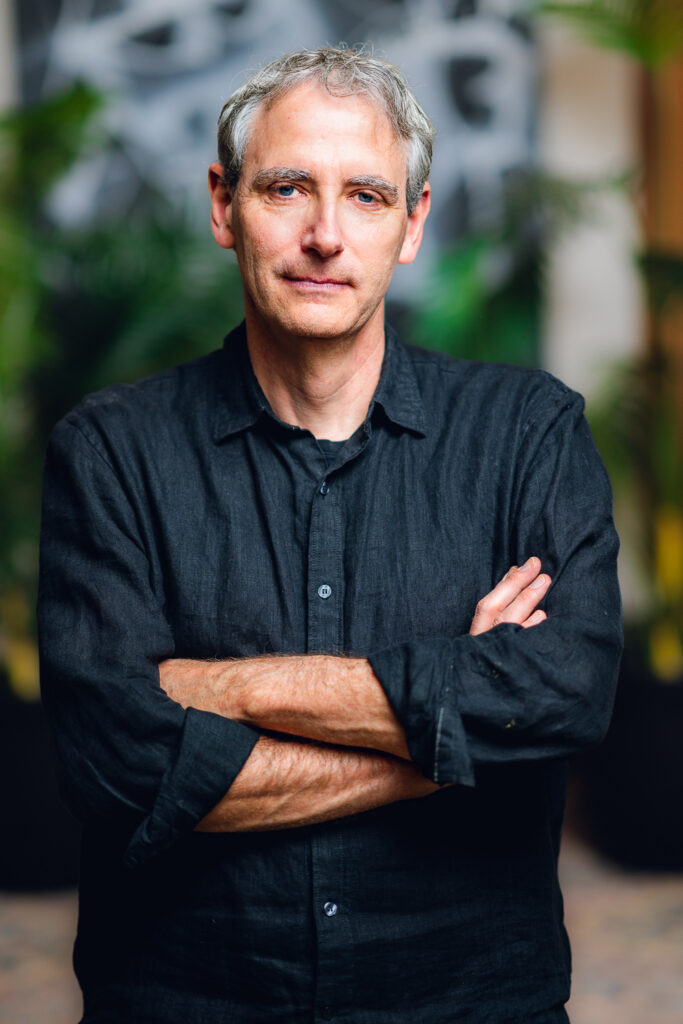
Holsinger says he’s been a fan of David Wax Museum for years. When a Golden Hour Experience came up at Fry’s Spring Beach Club last year, he and his wife enthusiastically bought tickets and prepared to don their blindfolds.
“It’s really like you don’t know where you are,” Holsinger says. “After you’re blindfolded, they lead you by the hand, and you don’t know how the room is set up. You don’t even know if the lights go dim. One musician will be in front of you, another will be behind, and you’ll hear 10 different musical instruments over the course of an hour. All you’re concentrating on are the acoustics of the room. It’s ethereal. It’s dreamlike.”
Wax is humble about the innovation. The idea of the Golden Hour Experience, he says, was a small part of it. Far more interesting have been the unintended consequences. The way he, Slezak, and Daniel and Lauren Goans have adapted to making music for an audience receiving it through a single channel. The sonic signature that launched a new musical project for the four musicians. And, now, the collective effervescence they hope to create at The GUILD with Arthur and “SongWriter.”
“When I first started the podcast, I had run into a period where I was just having trouble starting songs, and I began using other people’s work as a jumping-off point,” Arthur says. “One of the delights of this project is that I get to talk to artists all the time. And one of my experiences in talking to David Gilmour or some other great musician is realizing, ‘Oh, that guy is doing the same thing I’m doing every day.’”