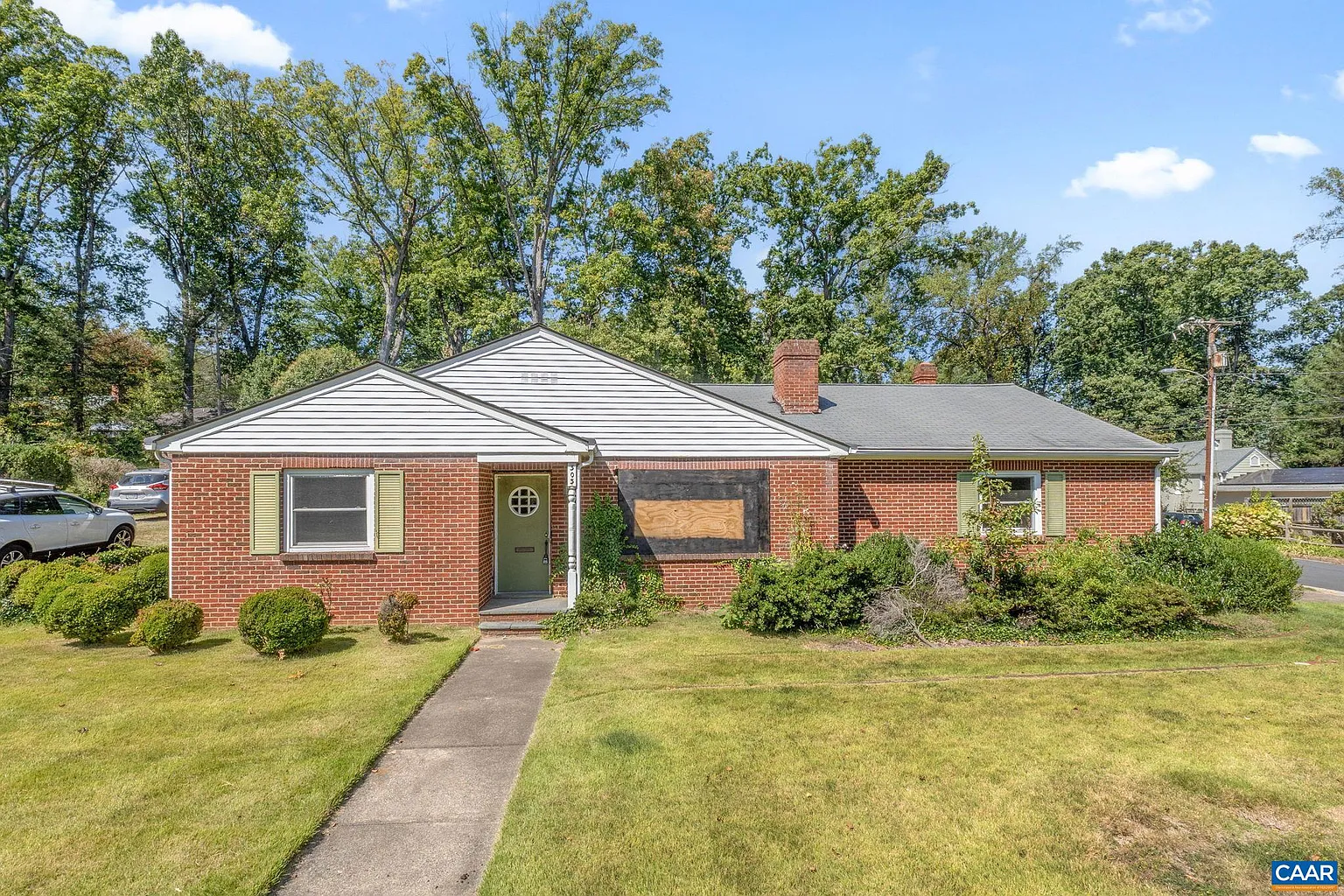
What will become of the single-family home at 303 Alderman Rd.? It exchanged hands most recently November 12, to a California-based company who has yet to file plans. Photo: Charlottesville MLS.
When Charlottesville City Council adopted a new set of building rules in December 2023, one intention was for developers to have an easier pathway to construct more homes on land that had previously been reserved for single-family residences.
One developer who tried to go through the new development code found that not to be the case, suggesting that the document tries to do too much.
“I think their intent is good and noble, but you have to understand that every sentence and every word that you put into the zoning ordinance is a potential barrier or restriction,” said Tom Ridley, vice president of sales for Evergreen Homebuilders.
The company purchased a single-family home at 303 Alderman Rd. in June 2024 for $835,000. The 0.31-acre property is zoned Residential-B and the company filed a major development plan in August 2024 to build six townhouse units.
A year later, the project had stalled after company officials were told they would have to get a special exception from City Council to meet a technical requirement.
“It is actually creating less housing and certainly more expensive housing,” said Ridley. “You have to go in front of all of these departments for a major development plan to build six townhomes, and that is the same threshold to build 150 homes.”
Such plans are required for residential projects that will have more than three domiciles, according to the city’s development manual, and staff has 40 days to issue a decision.
In September 2024, staff in the Department of Neighborhood Development Services issued a letter of denial. That is a standard part of the review process.
“Revised application materials can be submitted up to three times before a new application fee will be required for further application review,” the manual reads.
Evergreen Homebuilders tried twice more, and NDS staff issued a third denial on March 13. Ridley said the company opted to withdraw the application after learning it would have to get council’s approval.
“We did pull our major development plan because we just saw that going nowhere,” Ridley said, adding that would mean more uncertainty and cost for a relatively small number of units.
Ridley said the company had backup plans in case the zoning fell through, and one of them was to build a new house. A demolition permit was issued on July 18, and six days later the firm filed a building permit for a four-bedroom single-family house. At the time, a judge had dismissed the zoning code due to a technicality and Ridley said his company wanted to make sure they could recover value from the property. The permit has not been processed.
On November 12, the property exchanged hands again when the Keelan Property Group bought it for $840,000. That business is registered in Atherton, California, and so far it has not filed any additional plans. Ridley said he is glad his company did not go ahead with demolition to give the new owners a chance to remodel the existing structure.
The zoning code was restored in mid-August and a settlement has been reached with the plaintiffs.
Staff in the NDS have spent this year making recommendations for minor changes to the zoning code to fix grammatical errors and make some clarifications.
Ridley said he has not been following potential amendments and will not attempt to develop anything larger than a duplex in Charlottesville until there is more certainty.
“I want to wait until I see someone actually successfully plan, approve, and construct one of these projects,” Ridley said.
The Charlottesville Planning Commission will hold a public hearing on January 13 for the first round of changes to the zoning code.