Beyond the salad bar and hot foods at the 5th Street Station Wegmans, seven people play Scrabble on a rainy Friday night. Their boards are as bespoke as their tiles and tile bags, and people are confused.
“This game,” says one would-be detective, passing by, “looks a lot like Scrabble.”
“It is Scrabble,” one of the players says.
These Scrabblers—Matt, Nancy, Barry, Dana, Steve, Regina, and Jean—are as patient as they are devoted. They belong to the Cville Scrabble Club, which formed in 2010 to unite high-level players and give Charlottesville a stop in the competitive Scrabble scene.
It’s a pocket universe, home to the thousands who play the 87-year-old board game in tournaments across the world for modest winnings. This year’s world champion, Canadian Adam Logan, took home $10,000 after winning the best-of-seven final, 4-2, last month in Accra, Ghana. The event was livestreamed. For a smidgen in the early 2000s, ESPN broadcasted the national championships.
“I’ve played a lot of poker in my life, and that’s very cutthroat,” says club member Matt Kingston, who entered his first competitive Scrabble tournament last February. “You’re not trying to share information; you’re trying to keep everything to yourself. In [Scrabble], it’s, ‘Oh, hey, you’re a new player? Here’s the cheat sheet of words that you should study,’ and ‘Come play club with us. We can talk about the game and maybe help you improve.’” Poker and Scrabble players often overlap because both games involve lots of probability. Scrabble is a math game.
The Cville Scrabble Club has played in Wegmans’ commodious dining area for about a year. Its members have a gentleman’s agreement with management that says “if you eat here, you can meet here.” Tonight, there’s salad and pizza.
Charlottesville’s top player, UVA medical student Andy Hoang, was a youth national champion in grade school and played Jimmy Kimmel and Li’l Kim on network television when he was 11 years old. As of early December, Hoang’s ranked 30th by the North American Scrabble Players Association, one of three Charlottesville players in top 100. Club co-founders Clay Daniel and Barry Keith are ranked 38th and 67th, respectively.
Founded in 2009, NASPA administers competitive Scrabble around the continent. It also offers youth program grants, roughly $5,000 per year, according to Chief Operating Officer Judy Cole. NASPA has about 2,000 active members, though 5,000 get the weekly newsletter.
“Often the story is,” Cole says of how people come to the competitive game, “they played Scrabble all the time at home and that kind of stuff, and they become the people nobody in their family wants to play with because they’re better than they are. That often causes people to wander into club for the first time. People stay if they like it.
“I like the fact that you see the same people, but different people, from tournament to tournament. At the nationals in some ways, it’s like a family reunion. I mean, there are people there I see once a year, and I know I’ll play them once a year, and I look forward to it. People are interesting, and the wide variety of people is fun—people you might never have met in real life, but in Scrabble life. Even though we’re very different, we share this love of the game, and that’s good.”
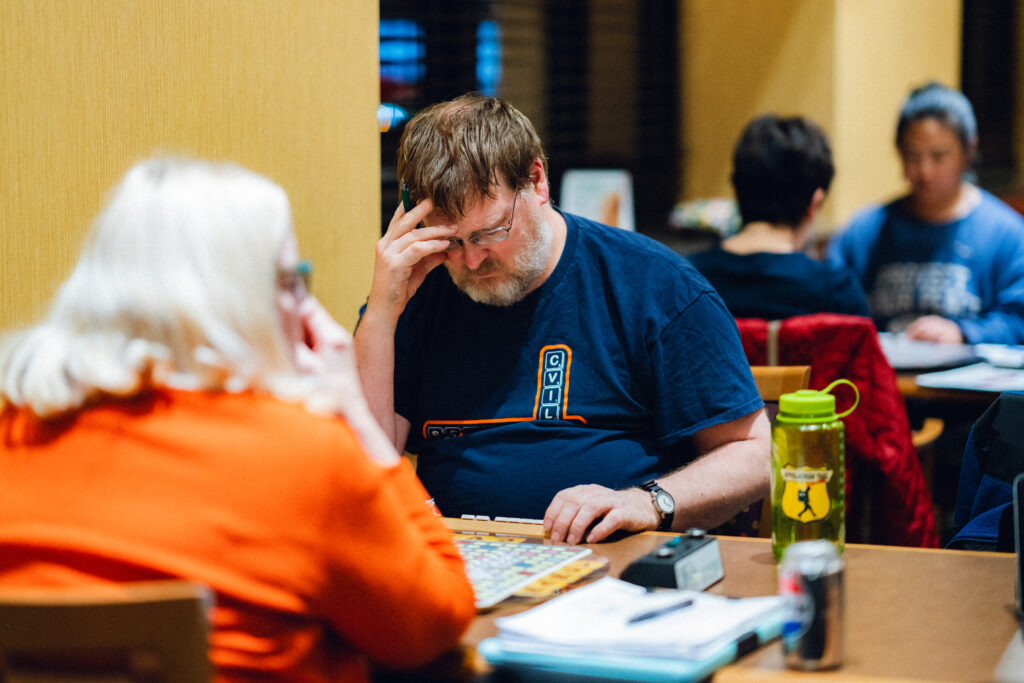
Tournaments are divided into four divisions based on skill level (Division 1 is the highest) and held in libraries, hotels, and ballrooms. The games are mostly quiet, except for players prospecting for fresh tiles. There’s food and drink, too, and time between the games for everyone to mingle. It’s not really a dating scene, but people meet. They’d have to. The nationals attract 300 to 400 competitors and a good-sized tournament will get 100. An average tournament draws 20 to 40.
Competitive Scrabble is one-on-one only and games have a 25-minute time limit, with an average of 13 turns per player. The top players average more than 400 points a game. They excel at pattern recognition, anagram like a mentat, and keep it together emotionally. They’re also good with numbers.
Engineers, musicians, and mathematicians texture the Scrabble scene, and eidetic memories are not unusual. Mack Meller, NASPA’s No. 2-ranked player, majored in astrophysics at Columbia. Language artists should beware of humility.
“You have to know all these percentages and you have to understand your leave values, which is harder math than the arithmetic that the scoring requires,” says Kingston, a teacher at Burley Middle School, where he started a Scrabble club. He also used to produce Chris Long’s podcast, “Greenlight.” “Your calculation isn’t necessarily ‘What is my highest scoring play?’ But sometimes it’s like ‘What is my highest-scoring sequence?’ or my best ‘equity play’ is what we would say—my best combination of scoring this play and what I’m leaving on my rack.”
An essential discipline of Scrabble gamesmanship involves the cunning use of fake words. The game’s more about brute memorization than a swaggering vocabulary. The greatest player of all time, New Zealander Nigel Richards, has won world championships in English, French, and Spanish, even though he doesn’t speak French or Spanish. He just memorized their Scrabble dictionaries.
Definitions are irrelevant. If you know enough words, you can screw with your opponent. This is very important.
“It’s not only allowed, it’s actually encouraged,” Meller says. “And that’s something that turns a lot of new players off, but it’s just something you have to live with and accept if you’re going to be a tournament Scrabble player. You’re going to get phonied sometimes, and it’s going to sting, but you can also do that—and you cannot, by the way, feel bad about it if you want to rise through the ranks. It’s a very important and legitimate part of the game.
“You’ll even have people who develop reputations. Like, ‘Oh, this guy plays a lot of phonies,’ and you’re going to have to play against it—[but] then you can use that in your favor if you have that reputation, because then if you play a lot of weird valid words, people might be likely to challenge those and give you free turns.” The penalty for falsely calling nonsense is one turn. “There is a lot of that, especially at the top level. Like I said: small community, everyone knows everyone. I’m known as a person who does not play a lot of phonies, [and] sometimes that can help me because that means, if I’m in a situation where I feel I really need to, I can often get away with one.”
There is prize money, but it’s not a professional circuit. TV and sponsorship deals do not abound, though Craig Ferguson hosts a Scrabble game show on the CW. (It’s a revival of the 1980s show.) But poker made it big and a Dungeons & Dragons game sold out Madison Square Garden. So maybe one day.
Meller nearly makes a living on Scrabble, but not on tournament winnings. He gives Scrabble lessons (Kingston is a pupil) and has a Scrabble YouTube channel, which has 6,200 followers. Meller plays and narrates live games, offering tips and analysis. He supplements his Scrabbling with freelance web design and writing word puzzles, notably for The Washington Post.
“Ninety-five percent of them lose money,” Meller says of tournament players. “And I might be low.” Meller won a recent tournament in New York and got $600. “I barely made a profit and I won the whole tournament,” he says.
But there is money and it is competitive, so people cheat, too. They palm tiles and sneak-peek the bag. To discourage guile, NASPA rules demand tiles be drawn from above eye level. Then there was the guy who used magnets. Possibly.
“I’m not even a hundred percent sure it’s true, honestly. It might be more of a legendary thing, but it’s pretty funny,” Meller says. “There was once a guy who, on his own set of tiles, at least—so it would only work when he was playing on his board—he put magnets on the blanks and the S’s, which are the most valuable tiles, and then he surgically implanted a magnet into his index finger. And he would thus draw all the good tiles. Like I said, that might be folklore.”
Meller regularly makes his way from his home in Lexington, Kentucky, to Charlottesville for Scrabble games. He’ll be one of 40 players expected for the Commonwealth Cup tournament December 16 to 22 at the Courtyard by Marriott on Route 29. The top players will play the 19th through the 22nd in the “main event.” (Visit cross-tables.com for more information.)
“We’re all Scrabble addicts,” Nancy Bowen says while checking NASPA stats on her iPhone. “I’ve played more games than Mack. Look at that.”
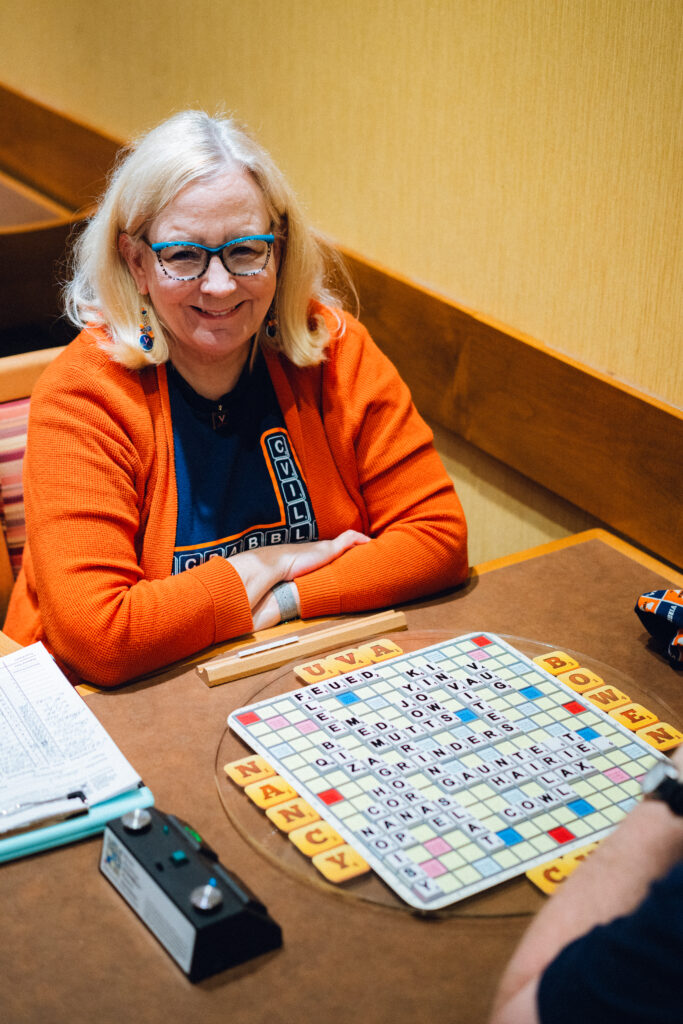
In 2023-2024, Bowen, a retired high school math teacher and a club co-founder, played more games than anyone in NASPA: 336. She received a handsome certificate, which she keeps in her Scrabble files. They all seem to have Scrabble files. Dana Tornabene’s are in a three-ring binder. It has a lot of word lists.
“Proper names are not good in Scrabble, unless they mean something else,” she says, flipping by a page that lists every fish in the Scrabble dictionary. “Toby is a drinking mug. Japan—you can japan something, like lacquer it. … I have hercules, maryjane, and what was the other one? I think benedict.”
“Don’t forget vandyke,” Kingston says.
“It’s a kind of mustache,” Tornabene says.
The Cville Scrabble Club convenes on the first and third Fridays of each month and occasionally, if the calendar allows and they’re feeling extravagant, the fifth Friday. This is a third Friday. Membership is fluid—no secret handshake necessary—and typical game-night attendance is four to six, unless they can woo a curious bystander. Tonight, they could pick from a number of unsupervised children.
The club plays from about 6 to 8pm and abides the “eat here” clause for the half hour before that. Then the Scrabblers pair off and array out.
When the club has an odd number of players, like tonight, advanced players play two games at once. Steve Gawtry, an IBM data scientist, is doing that now. Ranked 151st by NASPA, he likes the geometry of Scrabble and right now he’s split between a board set on a round granite-looking slab and another one that’s more classically rectangular but lavender and with bumblebees. Tornabene’s mother-in-law made it.
“Vowel dumps: very important,” says Tornabene, still consulting her files. She finished fifth in Division 3 at nationals this year. “If you’ve got three U’s, you need to know: What are you going to do? It turns out culture, vulture, and multure are all words that take two U’s, so that’s handy to know. … Bikini takes three I’s. Like, what are you going to do if this is on your rack? Do you want to waste your time with an exchange? Of course not.”
Barry Keith, a French and Spanish teacher at Monticello High School, is playing Bowen on her board. It has “Nancy” and “Bowen” on either side, “UVA” on one end and “CVL” at the other. And like every board, it has its own lazy Susan.
“I think playing Scrabble—and I know it sounds kind of corny—but it’s kind of a microcosm of life,” Keith says. He came to Scrabble through chess. He also plays poker. “Sometimes your situation is going to be pretty easy, and you can celebrate, and there’s kind of a charge.” Like when you hit a bingo and get 50 bonus points for playing seven tiles at once. “Then there are going to be other times where life is hard, and you just have to make the best decisions you can and muddle through. And once in a great while, you might even have to exchange letters, sometimes, like we start over in life.”